

“You, my child, shall be called the prophet of the Most High,
for you will go before the Lord to prepare his way,
to give his people knowledge of salvation
by the forgiveness of their sins.
In the tender compassion of our God,
the dawn from on high shall break upon us,
to shine on those who dwell in darkness and the shadow of death,
and to guide our feet into the way of peace.” Luke 1:76-79
Today is a day of waiting. It is a day of anticipation, and it is fitting that the Church gives to her people the Canticle of Zechariah for the Gospel of the Day. The Church gives this Canticle, prayed and prophesied by Zechariah, the father of St. John the Baptist, on the day before we celebrate the Nativity of Christ, the Dawn of Redemption Himself.
Also today, and this is often overlooked, we observe the feast day of two very important saints: Adam and Eve.1 While we do not see them on the Liturgical Calendar, Christmas Eve has traditionally been their feast day since about the 12th century. It is good that we remember these saints the day before the Nativity, as it is the sin of Adam and Eve that brought about the Incarnation and Redemption. While the Old Adam and the Old Eve brought sin and death to mankind and communicated a fallen nature to their children, the New Adam and New Eve redeem mankind through that same human nature.
As I wrote last week, the Fall and the Incarnation are the same providential and eternal decree from Almighty God. This means that Adam and Eve are an essential part of that mystery, hidden from all time. This necessary connection between the First Adam’s sin and the New Adam’s Incarnation is on display here in the Church’s observation. As the darkness and shadow of death descend on man through the sin of the Old Adam, we are left in the bitter cold of the night. As such, the Church has traditionally observed today as a day of fasting and penance.
This temporal waiting, between the bitterness of the penitential spirit and the joy of the Vigil Mass, is indicative of the time between Adam and Christ when man was awaiting the joyful fulfillment of Genesis 3:15:
“I will put enmity between you and the woman, between your seed and her seed: she shall crush your head, and you shall lie in wait for her heel.” Genesis 3:152
While the Old Adam and the Old Eve are the receivers of this prophecy, it is Mary, the New Eve, who crushes the head of the serpent through her Seed, Christ Jesus, the New Adam.
This movement from the darkness of Christmas Eve to the dawn of Christmas Day is prophesied by St. Zechariah in today’s Gospel. In God’s great compassion, He sends His Son to redeem mankind. Not because He has to. But because of His great love for His creation. To all of mankind who dwell in darkness and the shadow of death, He comes to shine His light on us and to show us the pathway unto eternal life.
The fact that the Church celebrates Adam and Eve as saints ought to bring a sense of hope to our souls. This hope is born from the necessary repentance that our original parents had to undergo in order to be saved. This is a hope that ought to shine on us that we are never too lost or too entrenched in sin to return to the friendship of God. No sin is too great to be overcome by the Incarnate Christ.
Today, let us end this Advent season in a spirit of penance. If it is possible for you, I invite you to welcome some form of fasting and/or abstinence into your day prior to the Vigil to remember that time of darkness just before dawn. To remember the grief of our first parents on account of sin, to better welcome the joy of the Dawn from on High.
For more from Dr. McGovern, visit his Substack at A Thomist, Dedicated to the Theological tradition of St. Thomas Aquinas. Exploring Thomas’ Spiritual Theology and topics in Christology and Mariology.
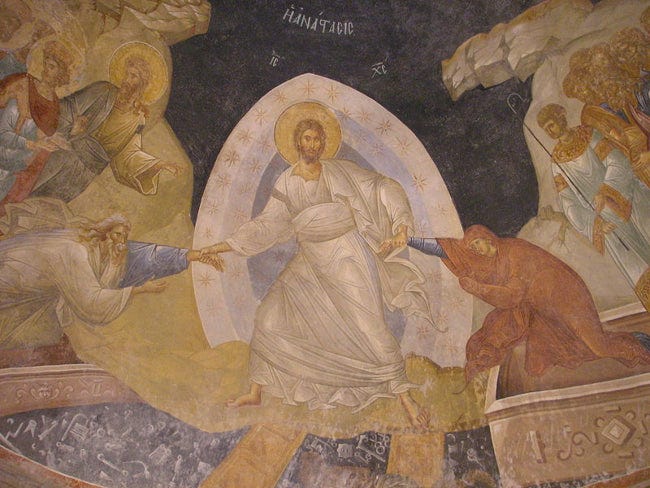
The art chosen for this article is an Icon of the Harrowing of Hell. In it, we can see the Lord delivering Adam and Eve from the Limbo of the Fathers. For more on the Harrowing of Hell, see my article here.
Translated from the Latin: “Inimicitias ponam inter te et mulierem, et semen tuum et semen illius: ipsa conteret caput tuum, et tu insidiaberis calcaneo ejus”
Beautiful description.