

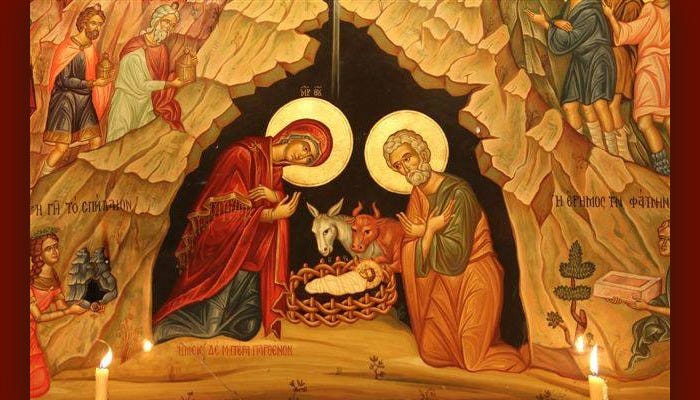
The Gospel for today comes from St. Matthew, and it is the Genealogy of Jesus Christ. I wrote on this passage last year for the Solemnity of the Nativity. You can find that here. This year, I want to reflect on the Incarnation as a providentially ordered act by God.
As we await the Nativity, it is good for us to contemplate the great mystery of the Incarnation. This mystery does not begin on a cold night around 2 BC, nor does it begin even at the message of an angel to a young Jewish Virgin. To find where the mystery of the Incarnation begins, we must trace the promise of it back through the lineage of Jesus Christ, back to Jechoniah at the time of the Babylonian Exile,1 back to the promise made to Ahaz and his son Hezekiah,2 back to King David and his son Solomon,3 back to Abraham, Isaac, and Jacob.4 Truly, though, we must trace this lineage back to a promise made in a garden to the snake concerning the fallen man and woman:
“I will put enmity between you and the woman, between your seed and her seed: she shall crush your head, and you shall lie in wait for her heel.” Genesis 3:155
However, while the prophecies concerning the Incarnation begin in the garden and at the fall of man, the eternal decree of the Incarnation of Christ comes before the foundation of the world. It comes from the one who is from Ancient Days6 who uttered this eternal decree before time began, before man was made and placed in the garden, before he reached toward the tree to take the fruit from which he had been forbidden.
It is here, decreed by the providence of God, that the second person of the Blessed Trinity would step down into time and assume a temporal origin. The creator would become the creature.
“She [Wisdom] reaches mightily from one end of the earth to the other, and she orders all things well.” Wisdom 8:1
God’s providence orders all things to their end. The incarnation was not a response to a problem that God encountered when His creation strayed from His intention. The sin of Adam and Eve did not throw a wrench into the plans of God. From the first act of creation until the consummation of the world, all things are ordered by God’s providence. St. Thomas writes:
“We must say, however, that all things are subject to divine providence, not only in general, but even to their own individual selves… For since every agent acts for an end, the ordering of effects towards that end extends as far as the causality of the first agent extends… But the causality of God, Who is the first agent, extends to all being, not only as to constituent principles of species, but also to individualizing principles; not only of things uncorruptible, but also of things corruptible. Hence, all things that exist in whatsoever manner are necessarily directed by God towards some end.”7
The Angelic Doctor beautifully speaks to all things in existence being ordered properly and divinely by God to whatever end He has seen fit to bring them to according to His wisdom. This is why the book of Wisdom speaks about all things being ordered by Wisdom.
When St. Thomas says all things, he is including even the first sin, which necessitated the incarnation itself. This means that the incarnation was ordained by God to be the remedy for sin.8 God providentially ordered (divine permittance) that man would fall so that he would be redeemed by the Incarnate Christ and be united to God forever. The sin of Adam, the Incarnation, the Redemptive Act, and the Glorification of Man are one singular providential decree of the Almighty God.
“For God allows evils to happen in order to bring a greater good therefrom… so also He predestined the work of the Incarnation to be the remedy of human sin.”9
To this end, each of these individuals who is named in Matthew’s genealogy was providentially ordered to be a part of the family line of Christ. To each of them, the coming Messiah, the Incarnate Lord, is promised, who will redeem them from their sin. Today’s first reading foretells this:
“The scepter shall never depart from Judah,
or the mace from between his legs,
While tribute is brought to him,
and he receives the people’s homage.” Genesis 49:10.
In a special way, the Virgin Mary is predestined to be the Mother of the Lord. She is preeminently predestined to this life of Glory that was won by her Son on the cross through the Mystery of the Incarnation. She is the Woman mentioned above in the passage from Genesis. Thus, her predestination as the Mother of God is placed at the apex of this genealogy:
“Of her was born Jesus, who is called the Christ.” Matthew 1:16
Each generation spoken of in this genealogy was providentially ordered to contribute to the Incarnation, both on St. Joseph’s side (Matthew’s genealogy) and on Mary’s side (Luke’s genealogy).10 From both of these familial lines, which branch off after King David, both the legal and genetic kingly authority find their perfection in Jesus Christ, the Incarnate Lord. The divine decree to the incarnation and redemption from sin, which was laid down before the foundations of the world, finds its fulfillment in the Son of Mary, who is called the Christ.
For more from Dr. McGovern, visit his Substack at A Thomist, Dedicated to the Theological tradition of St. Thomas Aquinas. Exploring Thomas’ Spiritual Theology and topics in Christology and Mariology.
Cf. Matthew 1:12.
Cf. Matthew 1:9.
Cf. Matthew 1:6.
Cf. Matthew 1:2.
Translated from the Latin: “Inimicitias ponam inter te et mulierem, et semen tuum et semen illius: ipsa conteret caput tuum, et tu insidiaberis calcaneo ejus”
Cf. Daniel 7:9 and Micah 5:2.
St. Thomas Aquinas, Summa Theologiae, Ia q. 22, a. 2.
Cf. ST IIIa q. 1, a. 3.
Cf. Ibid.
See Luke 3:23-38. Many scholars view the genealogy given in St. Luke’s Gospel as the genealogy of Mary. The difficulty for readers will be found in the phrase “…being the son (as was supposed) of Joseph, the son of Heli…” Two difficulties arise: it would seem a contradiction between Matthew and Luke as Joseph is cited as the son of both Jacob and Heli, further, Luke seems to be giving another account of the genealogy of Joseph. The difficulties are solved by looking at the commentarial tradition of the Church. Frequently we find that Joseph is the son of Jacob as Matthew cites and that Joseph was the Son-in-Law of Heli also called Joachim. Taking this understanding, we can see that Joseph would have been from the descent of Solomon while Mary was of the descent of Nathan another Son of David. By this, the bloodline of David is brought back into union. Cf. Luke 3:23-38 as well as Haydock’s Catholic Bible Commentary, Remarks on the Two Genealogies of Jesus Christ.
Beautifully aligned with today’s O Antiphon. Thank you for this inspiring reflection!
Fascinating, thank you Andrew