

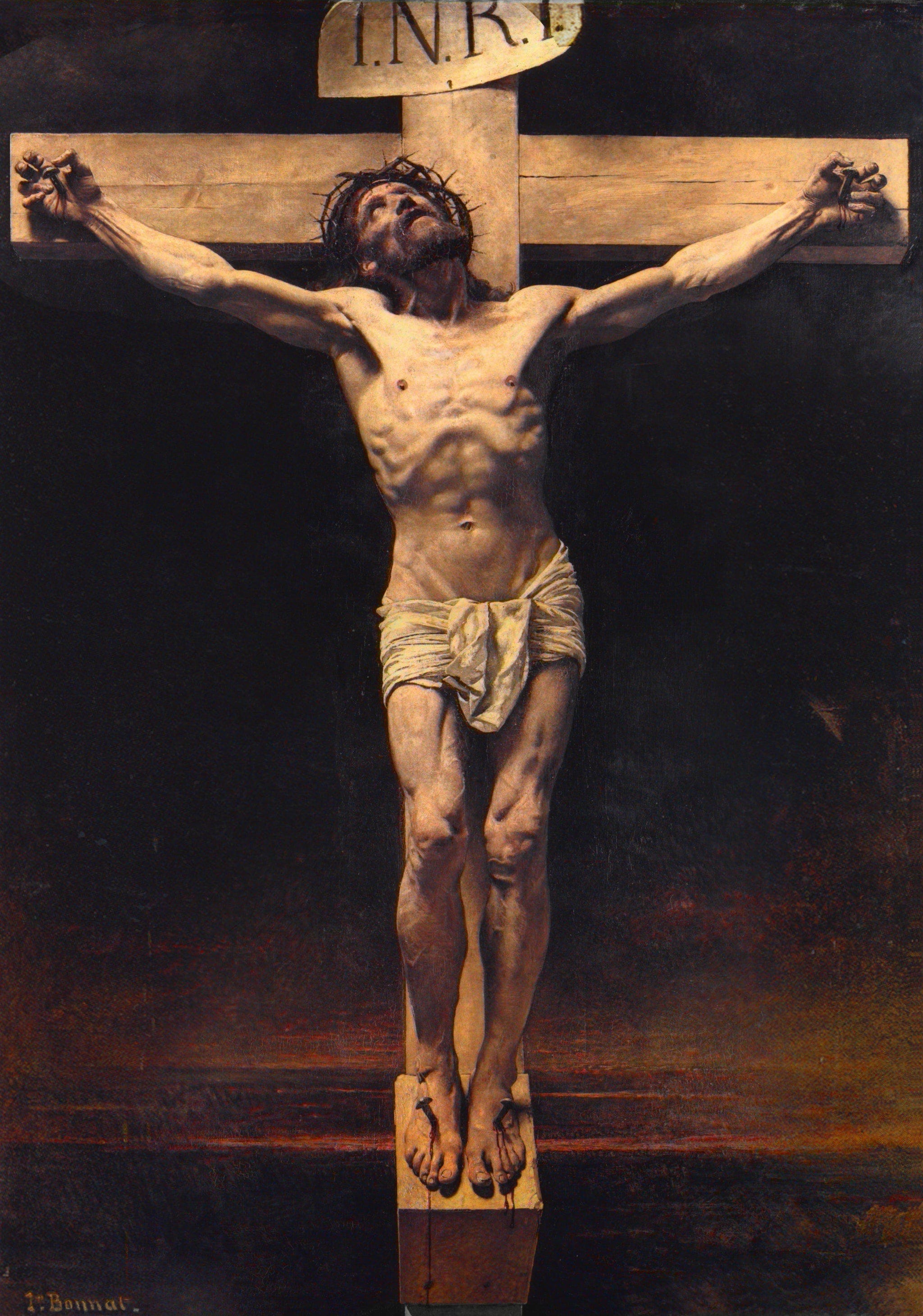
We have come to the threshold of another Lent. Ash Wednesday stands as the entrance into the desert of self-denial in preparation for Holy Week. Today, we hear the yearly reading from the Prophet Joel and the Gospel from Matthew, where Our Lord exhorts us to pray, fast, and give alms from the secret of our inner room. For a reflection on the threefold acts of Lent, see here. For a reflection on the Inner Room, see here.
This year, I want to look at Lent as a whole and offer a reflection on the topic of reparation. Truly, the life of the Catholic is one that is ordered toward conformity to Christ. Through Lent, we anticipate the coming cross. And through that anticipation, we offer sacrifice during this season so that we can identify with Christ in His sufferings. Thus, we have the exhortation in today’s Gospel to pray, fast, and give alms:
“When you give alms, do not blow a trumpet before you, as the hypocrites do in the synagogues and in the streets to win the praise of others. Amen, I say to you, they have received their reward…When you pray, do not be like the hypocrites, who love to stand and pray in the synagogues and on the street corners so that others may see them. Amen, I say to you, they have received their reward…When you fast, do not look gloomy like the hypocrites. They neglect their appearance, so that they may appear to others to be fasting. Amen, I say to you, they have received their reward.” Matthew 6:2, 5, 16.
In addition to these things, we usually give up something, and many also add a spiritual practice they don’t normally do. All of these are good and laudable. They all have one thing in common: they are meant to be a means of offering reparation for our sins and those of others. At the depths of the heart of the Catholic ought to be a spirit of offering ourselves in reparation for the many sins and blasphemies that the world commits.
The truth of the matter is this: Our Blessed Lord took flesh and went to the cross to pay back the debt that was too great for us to repay.1 But, in conjunction with this, Our Lord was also setting an example on how to go to our own cross. His passion did not make the cross absent in our lives. Too many believe this. But that is contrary to the words of Christ Himself:
“Then Jesus told his disciples, ‘If any man would come after me, let him deny himself and take up his cross and follow me.’” Matthew 16:24.
Our Lord Himself tells us that we have to take up our cross. We are not free to lay the cross down and walk away from it. Christ’s sufferings grant to our own sufferings the ability to merit. This is what allows us to do reparation on others’ behalf as well as our own. This is the beauty of St. Paul’s words:
“Now I rejoice in my sufferings for your sake, and in my flesh I complete what is lacking in Christ’s afflictions for the sake of his body, that is, the Church…” Colossians 1:24
He is not saying that Christ’s work is somehow lacking. Our Lord’s work has infinite merit. What is lacking is its radiation in us.2 This is because something is lacking in the disposition of those whom He seeks to save. But He calls and welcomes us to participate in His suffering so that the radiation can be completed, as St. Paul writes.
This is where offering our sacrifices of reparation comes in. On this subject, Fr. Garrigou-Lagrange writes:
“In the Mass, the immolation of Jesus is no longer bloody and painful as on the cross, but the painful immolation ought to continue in the mystical body of the Savior and will continue until the end of the world.”3
Our Lord no longer suffers. He is glorified in Heaven, but He invites us into an intimate communion with Him in His cross.4 Our Lord shows us that souls are saved only through suffering and dying for them. We are able to participate in His salvific mission with our own reparative suffering. Garrigou quotes Venerable Father Chevrier of Lyons on the fullness of this reparative suffering in the faithful. He writes:
“The priest should be another Christ. Thinking of the crib, he should be humble and poor; the more he is so, the more he glorifies God and is useful to his neighbor. The priest should be a man who is stripped. Recalling Calvary, he should think of immolating himself in order to give life. The priest should be a crucified man. Meditating on the tabernacle, he should remember that he ought to give himself incessantly to others; he should become like good bread for souls. The priest should be a man who is consumed.”5
While he is specifically speaking about the priest, we want to remember that all the baptized share in the common priesthood, and this means that we have a participation in this state of Jesus as victim.6 He goes on to affirm this:
“...even in saints who have not received the priesthood properly so called, it is a very close union with the eternal priest… This configuration to Christ crucified by the life of reparation is like the immediate prelude to eternal life.”7
It is here that we realize the words of St. Peter that we are to be “a spiritual house, a holy priesthood, to offer up sacrifices, acceptable to God by Jesus Christ.”8
Christ invites us to enter into His passion and to offer reparation for our sins and the sins of the whole world. This Lent, let us offer up what we can out of love for those who may not be able to sacrifice because of the hardness of their hearts or because they are ignorant of the need to. It is in that Charity that we are able to help atone for the sins that are committed and that we are conformed to Christ crucified so that we might bear in our bodies the wounds of Jesus Christ for the salvation of souls.9
For more from Dr. McGovern, visit his Substack at A Thomist, Dedicated to the Theological tradition of St. Thomas Aquinas. Exploring Thomas’ Spiritual Theology and topics in Christology and Mariology.
Cf. St. Thomas Aquinas, Summa Theologiae IIIa q. 48, a. 2.
Cf. Fr. Reginald Garrigou-Lagrange, Three Ages of the Interior Life, 498.
Ibid., 497.
See St. Thomas Aquinas, “The head and the members are as one mystical person; and therefore Christ’s satisfaction belongs to all of the faithful as being His members. Also, insofar as any two men are one in charity, the one can atone for the other as shall be shown later (Supp. q. 13, a. 2).” IIIa q. 48, a. 2.
Three Ages, 498.
Ibid., 502.
Ibid.
1 Peter 2:5.
Cf. Galatians 6:17.
Dr McGovern, your writing is so wonderful. I hope you will be writing more frequently during this Holy season of Lent so we can spend time meditating on your works.
What a blessing your writing is…thank you so very much.