

The 2025 College Football Committee did not select the Notre Dame Fighting Irish. Many college football writers have spent countless hours spilling digital ink & filling up the airwaves about the injustice of the CFP snub. The non-football fan might think, “Injustice, it’s just a game?” It’s a bit more complicated than that, with all the money being made in the sport and who owns the television rights, etc. I assure anyone who looks for ten minutes can find numerous legally questionable activities that occur before Selection Sunday and leading up to the first game of the CFP season.
And that being said, I want to focus my attention on Notre Dame’s CFP run in the 2024-2025 season, where they surprisingly made it to the National Championship Game led by quarterback Riley Leonard. Riley Leonard started his collegiate football career at Duke University, where he played for three seasons. Leonard had a tremendous sophomore season with Duke, with a stat line: 2,967 yards passing, 20 TDs, 6 Ints, 699 yards rushing, 13 rushing TDs. Leonard was a threat passing the football, but a tremendous weapon in college football; he could beat you with his legs, too.
Riley Leonard did not see the same success during his junior year, battling injuries throughout the season and playing only seven games. Leonard, seeing the writing on the wall in a quarterback competition at Duke, entered the college football transfer portal (streamlined and popularized during the COVID-19 and NIL era) and transferred to Notre Dame.
In the 2024-25 season, Riley Leonard would return to form with his best collegiate season by leading the Fighting Irish to a 14-2 record, posting: 2,861 yards passing, 21 TDS, 8 Ints, 906 yards rushing, 17 rushing TDs.
The on-field success of Riley Leonard in the 2024 season was incredible—but what was more remarkable was how, in that year, Leonard was able to become the leader of the locker room because Leonard is a man of God—a true Notre Dame man. In fact, to this day, on social media, Notre Dame fans adore Leonard's exploits on the field, his leadership, and his witness to the gospel of Jesus Christ.

How did Riley Leonard inspire the Notre Dame Football locker room and win the lasting adoration of the fans? Leonard loves Jesus and shares the gospel with the world. St. Paul writes, “For I am not ashamed of the gospel, for it is the power of God for salvation to everyone who believes, to the Jew first and also to the Greek. For in it the righteousness of God is revealed from faith for faith, as it is written, “The righteous shall live by faith.”1
Robert Karris, a biblical scholar, notes that St. Paul's passage in the Letter to the Romans conveys the theme for the entire text—the election of the faithful and the saving power of the good news of Jesus Christ.2 There is little doubt that the Holy Spirit has endowed Riley Leonard with many gifts (vv. 1 Cor. 1-11)—and he takes these gifts and his election seriously.
On the national stage in last year’s College Football Playoff, Riley Leonard continued to proclaim the Gospel and Jesus Christ:

Leonard preached Jesus Christ, as the leader of one of college football’s blueblood programs, emphasizing life's priorities: beginning with the properly ordered foundation of a person striving for divine friendship with God. While it is true that every person is born in the Image of God—Imago Dei—the Catholic faithful who are catechized in our Catholic Faith come to understand from the letters of St. Paul that it is in our baptism that we become adopted sons and daughters of God—and heirs to the kingdom:
But when the fullness of time had come, God sent forth his Son, born of woman, born under the law, to redeem those who were under the law, so that we might receive adoption as sons. And because you are sons, God has sent the Spirit of his Son into our hearts, crying, “Abba! Father!” So you are no longer a slave, but a son, and if a son, then an heir through God.3
It’s important to note that while some Catholic influencers on social media reported that Riley Leonard is Catholic, the evidence does not support this claim. The Baptist Press reported during the 2024-25 CFP campaign that Leonard “was an active participant in youth group activities at First Baptist Church while a high school student. He and his family attended a nondenominational church, but Leonard would regularly visit small groups and Wednesday night youth activities with FBC.”4 The r/Catholicism section of Reddit suggests there’s no indication that Leonard ever joined the Catholic Church.
The Baptist upbringing would then be evidence that Riley Leonard doesn’t see baptism as a sacrament but rather as an outward symbol of a believer's faith. In the Catholic tradition, baptism regenerates the soul, healing the wound of original sin, according to 1 Peter 3:20-21.
The Catechism of the Catholic Church 1213 explains, “Holy Baptism is the basis of the whole Christian life, the gateway to life in the Spirit (vitae spiritualis ianua), and the door which gives access to the other sacraments. Through Baptism we are freed from sin and reborn as sons of God; we become members of Christ, are incorporated into the Church and made sharers in her mission: “Baptism is the sacrament of regeneration through water and in the word.”5
Nonetheless, Riley Leonard continued to herald the name of Jesus Christ and the saving power of the gospel on the national stage, representing arguably the premier Catholic University in the United States. Avery Cardinal Dulles S.J., who is considered by many to be the most significant American Catholic theologian, explains in his book Models of the Church that Leonard’s theological view falls into the model of The Church as Herald:
The goal of the Church, in this style of theology, is simply to herald the message. This ecclesiology goes with a strong evangelistic missionary thrust. The Church’s responsibility is not necessarily to produce conversion (only God can do that), still less to build the Kingdom of God; but rather to evangelize all the nations in accordance with the “great commission” of Mt. 28:18–20. The preaching of the gospel is related to salvation, because it summons men to put their faith in Jesus as Savior. It announces the day of salvation that is at hand for believers. More than this, the preaching is itself an eschatological event. The word of God, on the lips of the authorized herald, is impregnated with the power of God himself, whose word it becomes. The word saves those who believe in it. Conversely, it condemns those who refuse to believe.6
Dulles explains, from a Catholic viewpoint, that there are certainly criticisms to this view of theology not being founded in an incarnation view of Jesus Christ (and with it, the sacramental economy of salvation), but the strength of this point of view that Catholics can certainly incorporate into their lives is the boldness of proclaiming and living the faith on their sleeves.
Dulles continues:
For one thing, it [the Church as Herald] has a good biblical foundation in the prophetic tradition of the Old Testament, in Paul, and elsewhere. Secondly, this ecclesiology gives a clear sense of identity and mission to the Church—especially the local church—as a congregation that heralds the good news of Jesus Christ and sets its face against all idolatry. Thirdly, it is conducive to a spirituality that focuses on God’s sovereignty and on man’s infinite distance from him. This ecclesiology leads to obedience, humility, and readiness for repentance and reform.
Pastor Ryan Smith notes in Baptist Press, “Leonard, the starting quarterback for the Notre Dame, is “just the most humble kid you’ve ever met,”7 The explanation by Avery Cardinal Dulles tracks for how Riley Leonard views his relationship with God and how he continues to live by his faith and share it with the world.
At the University of Notre Dame, Leonard drew a tremendous amount of attention on social media for more or less leading a Bible study that would become a hit among his teammates:

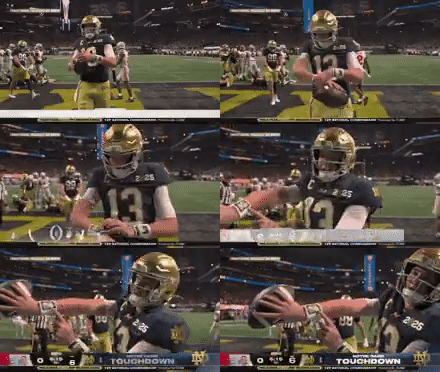
The Notre Dame Fighting Irish in the 2024-2025 season made the improbable Cinderella run in the College Football Playoffs. Naturally, the framing of their run might catch some flak from other Notre Dame fans—but the experts didn’t see it coming. Riley Leonard would lead the Notre Dame Fighting Irish to the National Championship Game, scoring the game’s first touchdown and showing the camera and all the eyes of college football fans:
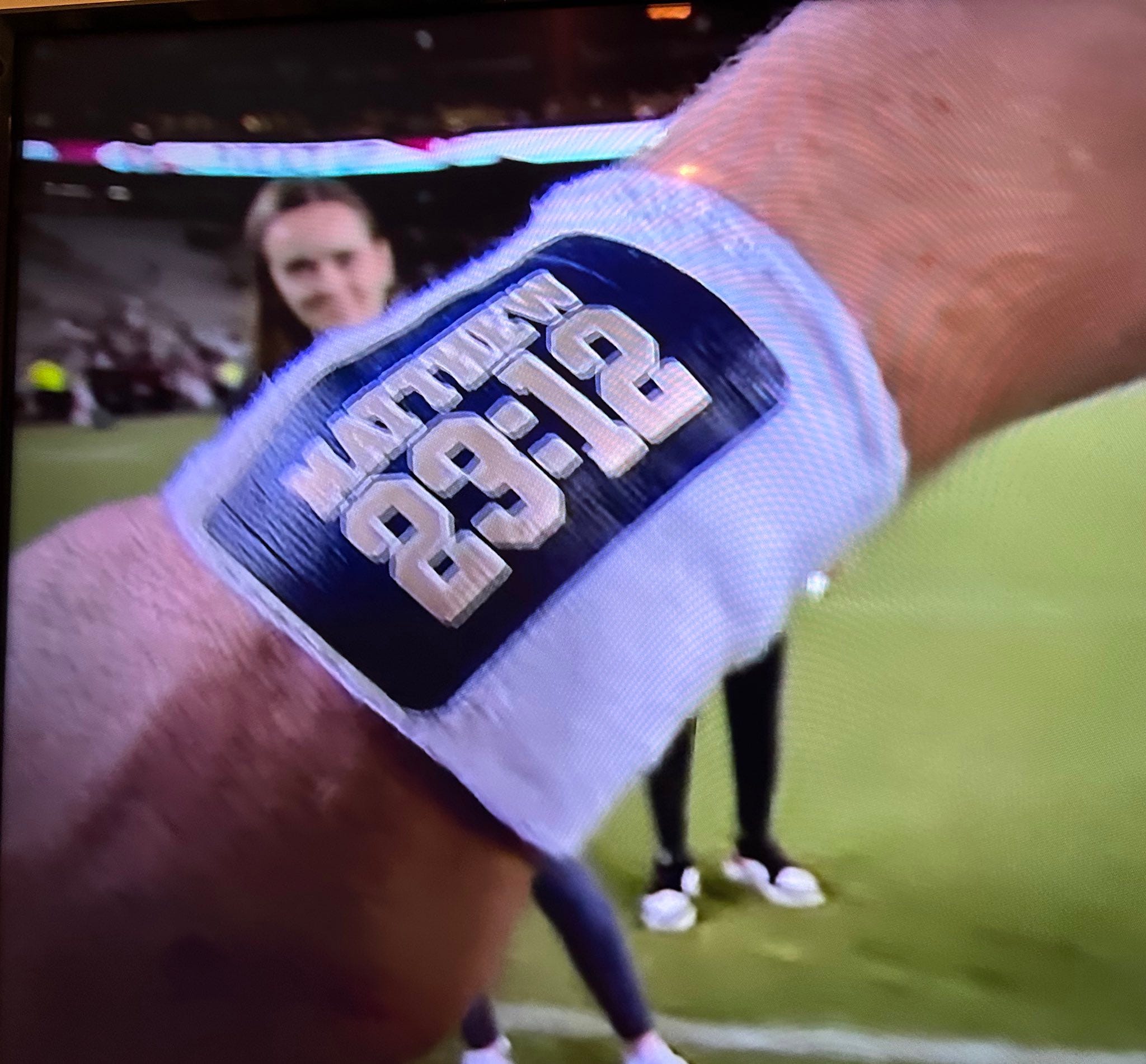
Whoever exalts himself will be humbled, and whoever humbles himself will be exalted.
-Mt 23:12.
Unfortunately, Riley Leonard would be humbled by the Ohio State Buckeyes in that game. The Buckeyes defeated Notre Dame 34-23. In the post-game press conference, Riley Leonard would continue to preach the gospel on the national stage in defeat. So, my fellow Catholics, ask yourself, what can we learn from Riley Leonard’s witness to our LORD?

The Irish Heretic is stacked within Missio Dei. If you would like to continue to receive posts, podcasts, etc., go to manage your notifications & manually opt into The Irish Heretic: college football’s heresy—but authentically Catholic.
Rom. 1:16-17 ESV-CE
Robert J. Karris, “The Letter to the Romans,” in New Testament, ed. Daniel Durken, The New Collegeville Bible Commentary (Collegeville, MN: Liturgical Press, 2009), 446.
Gal. 4:4-7 ESV-CE
Tim Ellsworth, “Pastor Recalls Riley Leonard as ‘the Most Humble Kid You’ve Ever Met,’” Baptist Press, January 20, 2025, https://www.baptistpress.com/resource-library/news/pastor-recalls-riley-leonard-as-the-most-humble-kid-youve-ever-met/.
Catholic Church, Catechism of the Catholic Church, 2nd Ed. (Washington, DC: United States Catholic Conference, 2000), 312.
Avery Cardinal Dulles. Models of the Church (Image Classics Book 13) (p. 76). Kindle Edition.
Tim Ellsworth, “Pastor Recalls Riley Leonard as ‘the Most Humble Kid You’ve Ever Met,’”