

Jesus said to the crowds:
“Come to me, all you who labor and are burdened,
and I will give you rest.
Take my yoke upon you and learn from me,
for I am meek and humble of heart;
and you will find rest for yourselves.
For my yoke is easy, and my burden light.” Matthew 11:28-30
Our Lord instructs us in the way of humility in today’s Gospel. He invites His listeners to imitate Him and to take the yoke of the cross upon their shoulders. Humility, as I have continually written, is the foundation of the spiritual life. For a longer consideration of this most important virtue, see here.
I want to touch on the spirit of humility as it is manifested in the perfect. I am often asked by students: What does it mean to be humble? How do I practice humility? To understand this, I want to return to Fr. Garrigou-Lagrange:
“The perfect know themselves no longer merely in themselves, but in God, their source and their end; they examine themselves, pondering what is written of their existence in the Book of life, and they never cease to see the infinite distance that separates them from their Creator. Hence their humility.”1
Humility is truly found in our acknowledgment of our infinite distance from the Creator. There is an infinite chasm that separates the divine from the human. Of itself, humanity cannot traverse this infinite chasm. In her visions, God said to St. Catherine of Siena, “I am He who is; you are she who is not.” This is not to diminish the dignity of a person or to make us feel isolated from God. To think this way is actually prideful because we think that God’s greatness should be nearer to our nothingness.
Humility, then, lies in the opposite understanding. When we acknowledge our nothingness before God, He is actually nearer to us. This seems like an odd dichotomy. How does recognizing our nothingness before the grandeur of God bring Him closer to us? Simply: it is only in our nothingness that we are able to receive all that God desires for us. Advent is one of the best times to consider these things. We are anticipating the three advents of the Lord. Each of them requires a foundation in humility to properly receive the graces offered:
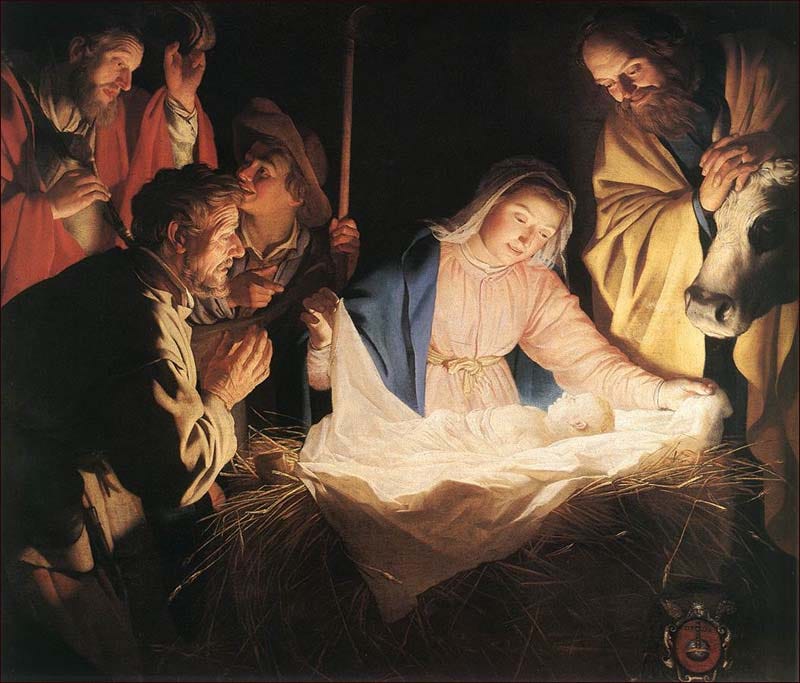
1. His first advent as a babe--- It requires humility on our behalf in the face of the extreme humility of God becoming man and appearing as an infant. Pride will prevent us from worshiping the Incarnate Lord from the throne of the manger.
2. His daily advent in the Eucharist--- Humility is the only way that we can come to the faith of Christ present under the disguise of bread and wine. Our Lord humbles Himself to come to us under these earthly accidents to be our spiritual food.
3. His second coming--- Humility is absolutely necessary to anticipate the second coming of Our Lord because it ought to drive us to repent and prepare for judgment. It is only through humility that we can acknowledge our sin and the need for God’s mercy.
It is in these three advents that we can see the infinite distance between God and us, but it is also in these three advents that we can see that for the humble, God bridges that infinite divide and comes to us out of love for us. God is near to those who have taken the yoke of Christ upon their shoulders and have been conformed to the humility that He has clothed Himself in. The yoke is humility. By taking this yoke upon ourselves, we are conformed more and more to Christ who seeks to come to us from the manger, the altar, and at the end of time.
For more from Dr. McGovern, visit his Substack at A Thomist, Dedicated to the Theological tradition of St. Thomas Aquinas. Exploring Thomas’ Spiritual Theology and topics in Christology and Mariology.
Reginald Garrigou-Lagrange, The Three Conversions of the Spiritual Life, (Charlotte, NC: TAN Books, 2015), 96.
Thank you for your thoughts on Christ’s yoke, which is His meekness and humility toward God. It brings our souls to rest. Our slavery to God is easy and light, in contrast with slavery to sin which brings us unrest (cf. 1Peter 5:5-7; Philippians 4:6-7; James 4:5-10).
Lovely reflection!