

The Tel-Dan Stele is a significant artifact discovered in 1993. A stele is a pillar, typically made of stone, used in the ancient world for commemorative purposes. Why is the Tel-Dan Stele so important? Before its discovery, there were no extra-biblical sources that indicated King David existed, nor was there any indication that David’s family established a ruling monarchy as a political entity among the Israelites. In light of the earlier lack of extrabiblical sources, late 19th- and 20th-century academics challenged the notion that David was a historical figure, despite verifiable evidence of David’s grandson, Rehoboam, fortifying Bethlehem with a wall in the 10th century BC. The discovery of the Tel-Dan Stele bearing the inscription “The House of David” overturned the consensus of biblical scholarship. There was now archaeological evidence with David’s royal house in stone, dated 150 years after David’s death, for all the world to see.
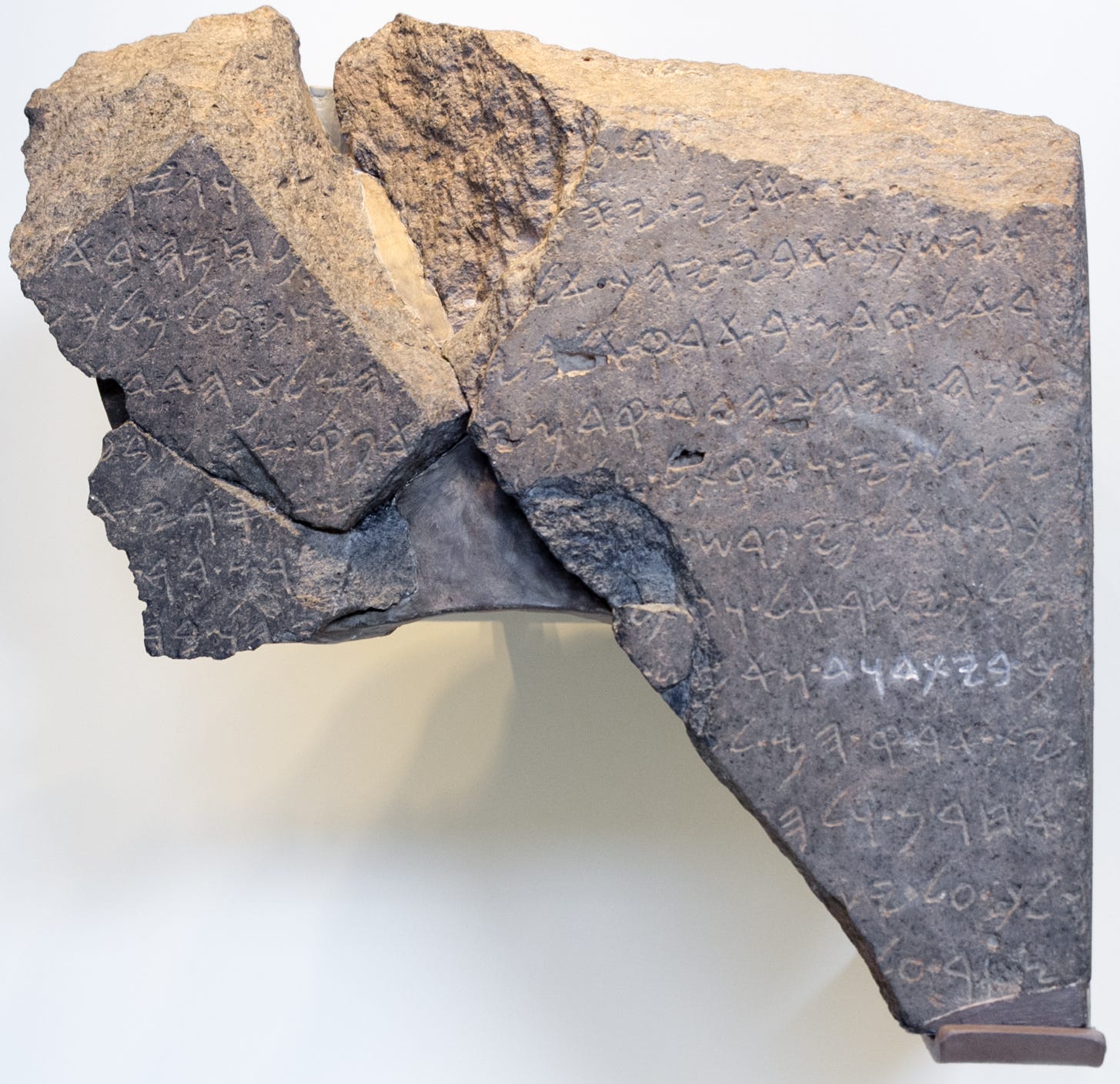
Three possible inscriptions referring to King David have now been discovered since the discovery of the Tel-Dan Stele in 1993. Egyptologist Kenneth Kitchen has made the most compelling proposal found in Egypt. Naturally, Kitchen is not without controversy in the archeological community because Kitchen is a professed Christian. The now deceased long-standing editor of the Biblical Archaeological Review, Hershel Shanks, explains, “In the 15th century B.C.E., Pharaoh Thutmose III initiated the practice of carving on the walls of the Temple of Amun in Karnak the names of territories he conquered or over which he claimed dominion. The last of the Egyptian rulers to follow this custom was the tenth-century B.C.E. pharaoh Sheshonq I, called Shishak in the Bible (1 Kings 14:25 and elsewhere). Shishak campaigned in Palestine in 925 B.C.E. In the following year, he had a vast triumph-scene, including over a hundred place-names, carved on the temple wall.”1
Egyptologists have discovered an inscription on those walls that Kitchen has interpreted as King David. What would be most significant about this proposed inscription is that it would date only 50 years after the traditional date of King David’s death.2
Many in secular academia challenged the historicity of King David. Secular archaeologists and biblical scholars present themselves as unbiased in their work, but nothing could be further from the truth. There is a motive for research, and typically, people don’t work so hard to return the scholarly consensus that King David is a mythical figure found in the Bible.
For example, Welsh archaeologist Philip R. Davies reignited the minimalist thesis that King David is a myth in his 2010 book, The Beginnings of the Kingdom of Judah. Davies argues regarding the Tel-Dan Stele, “I am not aware that the fragments have been subject to forensic examination, something that perhaps should now be routine in view of recent proven forgeries … Until reasonable doubts [of authenticity] are removed, any conclusions are provisional.”3
To the credit of The Biblical Archaeological Review, of which I am a member, the cited article presents a counterargument to Davies’ minimalist thesis regarding the existence of King David. Archaeologist Aren Maeir rejects Davies’ skepticism on the Stele, “ while at the beginning of the chapter, he concedes that the inscription is authentic, he once again raises the claim that, due to the circumstances of its discovery, it requires forensic examination of authenticity. This is quite preposterous, since the circumstances of its discovery are not at all questionable, as [the stela fragments] were discovered in a controlled, scientific excavation and swiftly and admirably reported.”4
Why should Catholics, or any Christians, care so much about this debate of whether King David is a historical figure? It’s because of who David represents.
In some respects, the Davidic covenant, like the Abrahamic covenant, is more important than the Mosaic covenant to the story of Israel & Christianity. As Avery Cardinal Dulles, SJ, explains, the former covenants fall under covenant grants—promises made by God without conditions. However, the Mosaic covenant is best understood as a treaty: if the conditions are not met, as explained in Numbers 25, the covenant is broken. Jeremiah 11 states that the Israelites violated the covenant with Ezra 7, indicating that after the temple was rebuilt, the Shekhinah did not return to the temple.
This is why the Stele is important: it provides historical evidence for David. We are told in Sacred Scripture that it is the Davidic covenant in which God will “establish his royal throne forever.” 2 Sam 7:16 The immediate recipient is King Solomon—but, of course, an everlasting throne, as shown by the fall of many royal houses in history, requires an Everlasting Man. The prophet Amos prophesies that God will “raise up, the fallen hut of David.” (Amos 9:11)
What is interesting is how this plays out in Jesus’ teaching in the temple regarding David’s son. Jesus explains, in Mark 12:37, “David himself calls him ‘lord’; so how is he his son?” [The] great crowd heard this with delight.” Notably, secular scholars regard this as an authentic quotation & interpretation of Jesus found in the gospels, given that the question is left open-ended. Furthermore, it would be evidence of Marcan priority.
The open-ended question is a rhetorical device posed to readers & listeners of the gospel passage to prompt reflection on why David calls his son “LORD”; Mark is making a divine claim. We know that Mark is making a divine claim because before the high priest, Jesus quotes Ps. 110, which causes the high priest to exclaim “blasphemy.”
It’s not blasphemy to be David’s son. It’s not blasphemy for Jesus to claim to be the messiah—it is ‘blasphemy’ in the mind of the high priest for Jesus to identify as David’s LORD, in which “Yours is princely power from the day of your birth. In holy splendor before the daystar, like dew I begot you.” Ps. 110
The promises of the Old Testament must be read through the lens of the promises given to a very real King David and his ruling house, to the historical reality of the incarnation—the condescension of God becoming man. Pope Benedict XVI, then Cardinal Ratzinger, explained in his 1988 Erasmus lectures, “The debate about modern exegesis is not at its core a debate among historians, but among philosophers.”5
I have long debated Benedict’s view on Scripture—at face value, the future pope is correct. The statement appears correct on the surface; however, the difficulty with this assertion is that it presents a false dichotomy in interpreting what is true and what actually happened as described in the written record. In attempting to determine what is true, the historian–both secular and religious–deals with the axiological value judgment of the truth just as much as any philosopher would when it comes to scriptural exegesis and the matter of what is the truth.
Philip R. Davies’ academic bias forever clouds his judgment in interpreting historical discoveries such as the Tel-Dan Stele. I wrote in a previous article here regarding this very question on Pope Benedict:
On the Biblical Bias of the 'Academic'

“What do you mean ‘in a Jewish manner’? Remember, you’re talking to actual scholars of Judaism.”
History is important. The reported empty tomb is significant to the evidence for whether the resurrection of Jesus of Nazareth occurred. The inquirer, though, will never accept any facts regarding the gospel witness of the resurrection as a possibility unless there is an acknowledgment of a metaphysical reality. To put it more clearly: Is there something beyond material reality? Does God exist? If answered in the negative, then Ratzinger, commenting on Rudolph Bultmann, explains the methodological limits regarding bias, “He is certain that it cannot be the way it is depicted in the Bible, and he looks for methods to prove the way it really had to be. To that extent there lies in modern exegesis a reduction of history into philosophy, a revision of history by means of philosophy.”6
Davies concludes, on a metaphysical level, that God does not exist. Therefore, the bias undermines the historical record supporting Bishop Robert Barron's claim that King David is the hinge figure of God’s promises, a claim that must be read in Sacred Scripture. In +Barron’s view, King David points back to King Adam, encompassed by their failures and fall into sin, but also points toward Jesus Christ, the King. 7
But—the history does matter. It may be a philosophical question on a personal level: Does God exist? Davies knows that the reality of King David, a historical figure, points to the eternal promises of the empty tomb on Easter Sunday and the good news of Christianity.
Hershel Shanks. “Has David Been Found in Egypt?” Biblical Archaeology Review 25.1 (1999): 34–35.
Ibid.
“A House Divided: Davies and Maeir on the Tel Dan Stela,” Biblical Archaeology Review 39.1 (2013): 22.
Ibid.
Matthew J. Ramage, Jesus Interpreted, 9
Pope Benedict XVI, “Biblical Interpretation in Crisis: Benedict XVI,” First Things, accessed January 16, 2023, https://www.firstthings.com/web-exclusives/2008/04/biblical-interpretation-in-crisis.
Robert Barron, “David the King,” Word on Fire Digital, accessed January 3, 2026, https://www.wofdigital.org/products/david-the-king.