

Then Jesus was led by the spirit into the desert, to be tempted by the devil.
And when he had fasted forty days and forty nights, afterwards he was hungry.
And the tempter coming said to him: If thou be the Son of God, command that these stones be made bread.
Who answered and said: It is written, Not in bread alone doth man live, but in every word that proceedeth from the mouth of God.
Then the devil took him up into the holy city, and set him upon the pinnacle of the temple,
And said to him: If thou be the Son of God, cast thyself down, for it is written: That he hath given his angels charge over thee, and in their hands shall they bear thee up, lest perhaps thou dash thy foot against a stone.
Jesus said to him: It is written again: Thou shalt not tempt the Lord thy God.
Again the devil took him up into a very high mountain, and shewed him all the kingdoms of the world, and the glory of them,
And said to him: All these will I give thee, if falling down thou wilt adore me.
Then Jesus saith to him: Begone, Satan: for it is written, The Lord thy God shalt thou adore, and him only shalt thou serve.
Then the devil left him; and behold angels came and ministered to him. (Matthew 4:1-11 DRA)
One of the most noticeable differences between Catholics (and Orthodox) and Protestants is how we design crosses. Catholics have always primarily used crosses with the corpus of Jesus visibly present on it – whether in 3D in the West or 2D in the East – while Protestants usually use only a bare cross. Different reasons could be given for this, but perhaps the most important is a theme which unites our readings for this Sunday and ultimately underlies our entire Catholic faith. This reason is: the Cross is the unique way to become like God.
In the first reading, Satan tempted Adam and Eve – who already lived according to God’s intention for them and had everything they could want, without any of the fallenness that we endure today – with two things: ease and divinity. He offered them the satisfaction of their bodily desires through the forbidden fruit, and promised them divinity if they would obey him. Satan would repeat this same temptation to Christ millennia later in the desert, offering to alleviate His hunger with bread and His loneliness with angelic ministration, and promising Him divinity if He would only worship him. But the new Adam, unlike the first, passed the test and overcame the serpent.
This is the standard way, especially among Catholics, that the temptation of Christ tends to be explained and preached on, and it is perfectly legitimate. But an important point that is often missed is that nothing in Creation is inherently evil, nor can man have any natural desire without some appropriate satisfaction for it. Satan did not offer Adam and Eve, or Christ later, anything intrinsically evil. Rather, he tempted them with what humans are designed by God to want: bodily contentment and perfect likeness to God. Everything that we do as humans is ordered to one of these two desires, today as much as in Eden, and all the wars, achievements, inventions and crimes in history derive in some way from one of these most fundamental human longings.
The problem, however, is that evil is not so much a thing as a disorder. Evil is disordered goodness, not an entity in itself. What the devil offered them was good, but he did it in a disordered way. He tempted them with bodily satisfaction – but against the orders of God. And he seduced them with divinization – but through a creature rather than the grace of God. And the first must be subordinated to the last.
This is the true message of the Cross, and it is the reason why Catholics and Orthodox preserve the Body of Christ affixed to it. As Venerable (soon Blessed!) Fulton Sheen once wrote,
The modern world, which denies personal guilt and admits only social crimes, which has no place for personal repentance but only public reforms, has divorced Christ from His Cross; the Bridegroom and Bride have been pulled apart. What God hath joined together, men have torn asunder. As a result, to the left is the Cross; to the right is Christ. Each has awaited new partners who will pick them up in a kind of second and adulterous union. Communism comes along and picks up the meaningless Cross; Western post-Christian civilization chooses the unscarred Christ.
“God became man so that man might become God.” (St. Athanasius of Alexandria)
The Son of God assumed human nature in order to divinize it, to transform it into His perfect likeness through union with God; and He chose to be crucified to show us how we may become divinized like Him, through participation in and imitation of Him. The Cross reveals the true meaning of love: not ease and comfort but self-sacrifice, the pouring out of yourself as a gift to others so that you may be filled with God. Satan’s temptation in the garden and the desert offers Christ without the Cross – divinization without sacrifice, without fasting from the fruit of the tree for Adam and Eve or the asceticism of the desert for Christ, receiving everything for yourself while giving nothing in return.
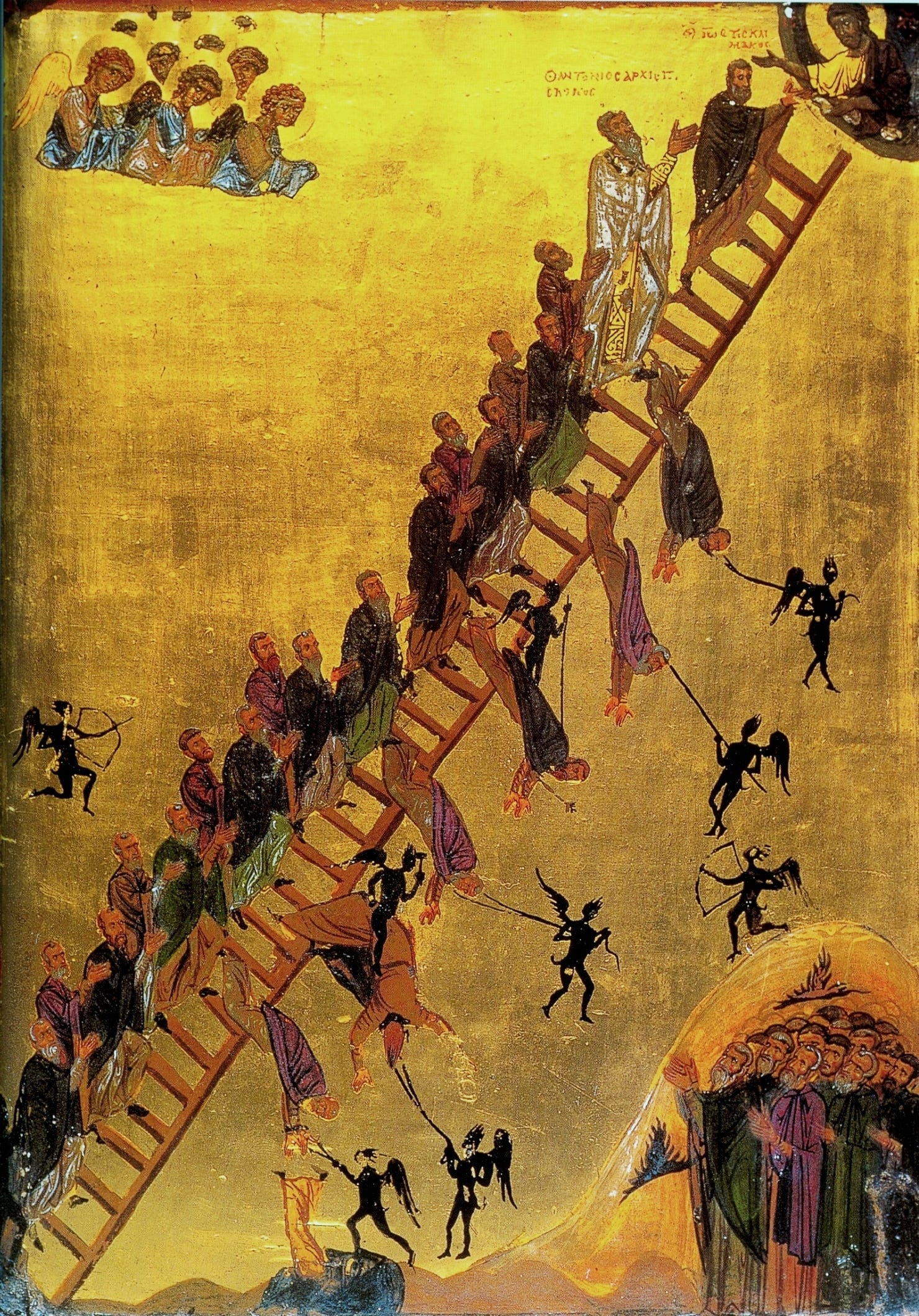
But in the end, Satan gives only the Cross without Christ, depriving us of the happiness in the good and true union with God that we all desire. This is the “long defeat” of history, as Tolkien called it, the legacy of sin in the world since Adam abdicated his throne as prince of Creation and was usurped by Satan. Now, in the modern world, even Catholics try to ignore the sacrificial aspect of love (hence why many modern crucifixes obscure His wounds), or else seek their divinization from creatures through technology, science, wealth, pleasure, power or fame. The season of Lent, as well as our Gospel for today, show us the truth: to become like gods, we must be willing to do as Christ commanded,
If any man will come after me, let him deny himself, and take up his cross daily, and follow me. (Lk 9:23)
Join the Fellowship at Saint Tolkien!
Great reflection Kaleb. God Bless!
A very unique (to my reading) interpretation, Kaleb. Thank you for sharing.