
You Are a Man, and Not a God
Tuesday of the Twentieth Week in Ordinary Time | Ezekiel 28:1-10 | Psalm 82 | Matthew 19:23-30

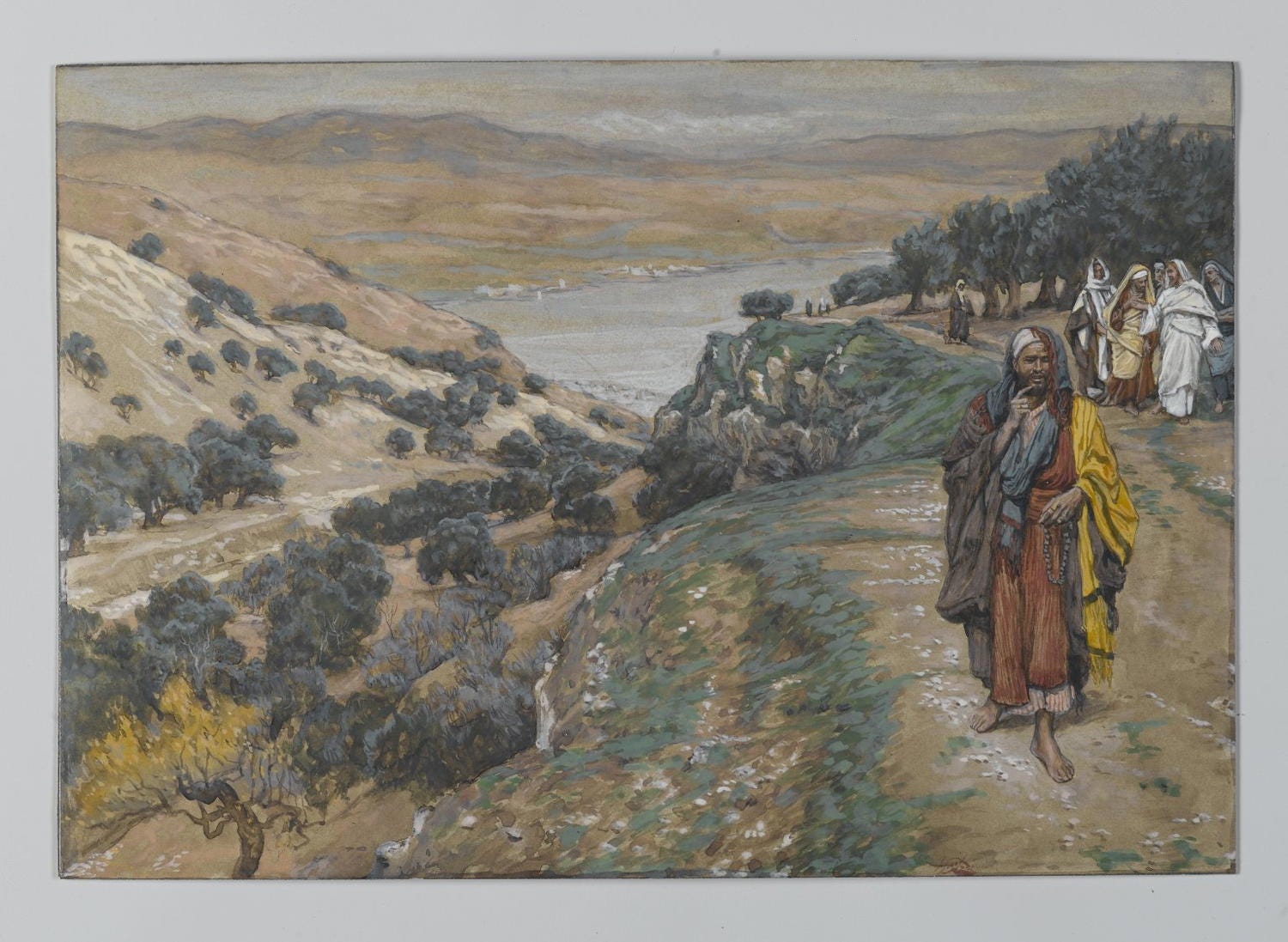
The prince of Tyre is not a fool.
He is, by the text’s own account, extraordinarily gifted. “Oh yes, you are wiser than Daniel, there is no secret that is beyond you.” He has applied his wisdom to commerce and accumulated real wealth. He has built something impressive. And from that accumulated gift and that accumulated wealth, he has drawn a conclusion that the gifts themselves seemed to authorize: “A god am I! I occupy a godly throne in the heart of the sea!”
This is what God reframes through Ezekiel: “And yet you are a man, and not a god, however you may think yourself like a god.”
It’s neither a rebuke of his wisdom nor a denial of his gifts. It is instead a clarification about what the gifts mean and what they don’t mean. The wisdom and wealth are real. The conclusion drawn from them - that he has transcended the creaturely condition, that he is his own highest authority, that he sits on a divine throne of his own making - is false. And it is the falseness of the conclusion, not the reality of the gifts, that destroys him.
We live in a cultural moment that has produced the prince of Tyre at scale.
The “spiritual but not religious” person is now a recognizable social type - someone who affirms the transcendent, who may even practice forms of meditation or contemplation, who speaks freely of their inner life and their personal connection to something larger than themselves. What they decline is submission to any authority outside that inner life. No creed, no sacrament, no institution, no tradition holds authority over what they have discovered in themselves. Their spiritual experience is the oracle. Their moral sense is the measure. They have, in the language of Ezekiel, set themselves up in the place of God.
This is not stupidity. The prince of Tyre wasn’t stupid. Many people who inhabit this spiritual posture are thoughtful, generous, perceptive. Like the prince of Tyre, they have real gifts. The problem is not the gifts but the conclusion: that the gifts are self-sufficient, that inner wisdom is the final court of appeal, that no external word has authority to correct what the self has determined.
Philosopher Charles Taylor, in his analysis of our secular age, describes this as the triumph of what he calls the “buffered self” - the modern self that has sealed itself against any claim from outside its own experience, that processes the transcendent entirely on its own terms.1 The prince of Tyre is the ancient type for the buffered self. He is wiser than Daniel. There is no secret beyond him, and he sits on a throne in the heart of the sea, accountable to no one.
Benedict XVI named the theological consequence of this posture in his homily before the 2005 conclave: “We are building a dictatorship of relativism that does not recognize anything as definitive and whose ultimate goal consists solely of one’s own ego and desires.”2 The ego as its own highest authority, its own desires as the final measure - this is the prince of Tyre translated into the spiritual vocabulary of our moment. And Benedict’s counter-statement is the answer Ezekiel is already giving: “We, however, have a different goal: the Son of God, the true man. He is the measure of true humanism.” Not the wisdom-accumulating self-sufficient prince. The Son of God who became a man - who emptied himself rather than filling himself up.
“And yet you are a man, and not a god.”
Jesus has just watched a young man walk away sad.
He was virtuous, this young man. He had kept the commandments. He had come to Jesus with a genuine question - “What must I do to have eternal life?” - and had received a genuine answer, and the answer had cost more than he could pay. He had great possessions. He went away grieving.
And Jesus says to his disciples: “It is easier for a camel to pass through the eye of a needle than for a rich person to enter the Kingdom of God.”
The disciples are astonished, and Jesus receives it seriously rather than dismissing it. If even the virtuous rich person, who has kept the commandments, cannot enter the Kingdom - then the Kingdom is beyond human reach at any level of achievement. Chrysostom, in his homily on this passage, notices exactly this: the disciples are not rich. They are poor. And they are still confounded. Because they have understood that Jesus is not merely diagnosing the danger of wealth. He is pointing out the impossibility of self-generated salvation at any income level.3
Saint Jerome sees the camel and the needle as an image of utter impossibility - the difficulty so complete that no human effort can overcome it.4
“Who then can be saved?”
Jesus looks at them. “For human beings this is impossible, but for God all things are possible.”
This is the line today’s readings have been building toward, and it is extremely liberating. The impossibility is not a condemnation, it is a clarification. Salvation is not a human achievement that accumulates to a threshold, the way the prince of Tyre accumulated wisdom and wealth. It is a gift that arrives entirely from the outside. Augustine, reflecting on this passage, insists that salvation is entirely dependent on God’s grace - that what we cannot do for ourselves, God does for us, and that this is not a consolation prize but the very structure of redemption.5
“For human beings this is impossible” is the word spoken to every attempt at every version of the self-made god. The prince of Tyre built his throne on his own wisdom and found it insufficient. The rich young man kept the commandments and found the keeping insufficient. The “spiritual but not religious” person cultivates their inner life and will find, eventually, that the inner life cannot generate its own salvation. Not because these things are worthless. Because they are not God.
“And yet you are a man, and not a god.”
This is a liberation.
You are not required to be the highest authority on your own existence. You are not responsible for generating your own salvation. The throne in the heart of the sea that the prince of Tyre built for himself is exhausting to maintain - all that wisdom, all that vigilance, all that self-sufficiency required to sit on it. To hear you are a man, and not a god is to be released from the labor of occupying a throne you were never built to sit on.
Peter, characteristically, hears the impossibility and moves toward it anyway: “We have given up everything and followed you.” Jesus receives it without rebuke. The hundredfold, the renewal of all things, the first who are last and the last who are first. Not as wages for what Peter has given up, but as the imagination of what life looks like when you stop trying to sit on the throne and simply follow the one who made you.
The household that practices the faith together - that submits to a creed, receives sacraments, prays a tradition rather than inventing one - is making a quietly countercultural claim. It is saying: we are not our own highest authority. There is a Word outside us that we receive rather than generate. There is a grace that does for us what we cannot do for ourselves.
That posture is exactly what the prince of Tyre found incomprehensible. It is what the buffered self cannot accommodate. And it is the only posture from which the Kingdom can be received - open-handed, empty of the throne, ready for the impossible gift.
For human beings this is impossible. For God all things are possible. The household that knows the difference between those two sentences has found the beginning of wisdom that the prince of Tyre, for all his gifts, never reached.
The domestic church doesn’t form itself. Domus Formation’s & Altar app gives your household a daily rhythm of Catholic prayer and formation - tracks for families, men, women, teens, and those in the second half of life. Start a free trial at WeAreDomus.com/start.
If Catholic fiction that takes the Communion of Saints seriously - as doctrine, not sentiment - is what you are looking for, I am writing two things. Lux Perpetua is a serial novel publishing weekly in two tracks, set in Alton, Illinois, at the edge of the Mississippi - a story of custody and fidelity and a flame passed forward across centuries. And Two Lamps is a weekly short story on Substack, each one braiding two saints from different centuries into a single imagined meeting. Both are for the kind of reader who believes the imagination is also a faculty of faith.
Deacon Michael Halbrook is husband to Suzanne, father of four sons, and a permanent deacon of the Diocese of Springfield in Illinois. He serves at St. Elizabeth Parish in Granite City. He is the founder of Domus Formation, a collection of Catholic prayer and formation resources for every stage of life, and he writes at DeaconMichael.net.
Charles Taylor, A Secular Age (Cambridge: Harvard University Press, 2007); on the "buffered self" as the defining characteristic of modern secularity - a self sealed against claims from outside its own experience. Taylor is a practicing Catholic philosopher.
Benedict XVI, Homily at the Missa Pro Eligendo Romano Pontifice, April 18, 2005; available at vatican.va. Delivered just before his election as Pope.
John Chrysostom, Homilies on the Gospel of Matthew, Homily 63 (on Matthew 19:23-26); available at New Advent, newadvent.org.
Jerome, Commentary on Matthew, 3:19; on the eye of the needle as an image of the impossibility of salvation through human effort or attachment to wealth.
Augustine of Hippo, Confessions, VIII.12.29; on the sovereignty of God's grace over human endeavor in the work of salvation.