
Whose Image Is This?
Tuesday of the Ninth Week in Ordinary Time | 2 Peter 3:12-15a, 17-18 | Psalm 90 | Mark 12:13-17

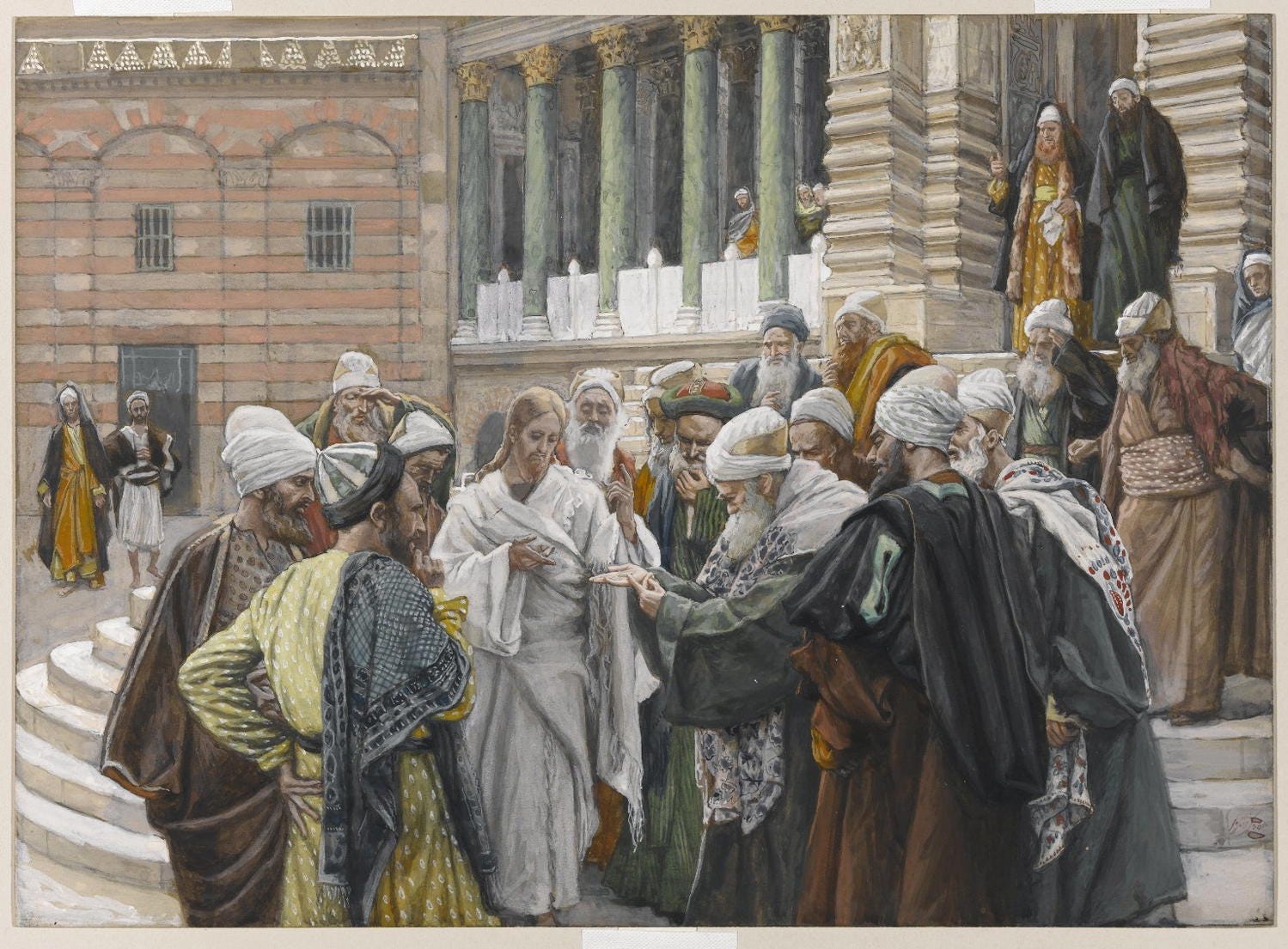
They have come together for one purpose and it is not good.
The Pharisees and Herodians were not natural allies. The Pharisees despised Roman taxation as an affront to Jewish sovereignty under God; the Herodians supported it as the practical price of political stability.
But they agreed on this: Jesus needed to be silenced. And so they come together, with their flattery carefully prepared: “You are a truthful man, you are not concerned with anyone’s opinion, you teach the way of God in accordance with the truth” - and their trap set beneath it. If he says pay the tax, he offends Jewish religious sensibility. If he says refuse it, he can be handed to Rome.
Jesus sees through it immediately: “Why are you testing me?” He does not pretend the flattery is sincere. And then he asks for a coin.
“Whose image and inscription is this?”
Caesar’s, they say. Of course it is. The denarius bore the image of Tiberius and the inscription Tiberius Caesar Divi Augusti Filius Augustus - Tiberius Caesar, son of the divine Augustus. The coin itself was a small act of imperial theology, a claim about who held ultimate authority over all things.
“Repay to Caesar what belongs to Caesar and to God what belongs to God.”
They were utterly amazed. And well they might be - because Jesus has not answered the question they asked. He has asked a different question, one they cannot unhear.
Tertullian, writing to the persecuting empire around the turn of the third century, drew out what Jesus left implicit: “The image of Caesar which is on the coin is to be given to Caesar, and the image of God which is in man is to be given to God.”1 The logic is precise. Whatever bears an image belongs to the one whose image it bears. The coin is Caesar’s because Caesar’s face is on it. The human person belongs to God because God’s image is stamped on every one of them - “So God created man in his own image, in the image of God he created him” (Gen 1:27). The eikon of Genesis is the same Greek word Mark uses when Jesus asks whose image is on the coin. The parallel is not accidental.
This means the question Jesus asks of the coin is the question he is simultaneously asking of every person in the crowd - the Pharisees, the Herodians, the bystanders, and everyone who has read the passage since: Whose image is this? The coin belongs to Caesar. The person belongs to God.
Second Peter closes with a phrase that lands differently in this light: “Grow in grace and in the knowledge of our Lord and savior Jesus Christ.” It sounds like a devotional encouragement - and it is - but it is also a description of what it means to render to God what belongs to God. The imago Dei stamped on every human person is not static. It is not a fixed mark like a face on a coin. Aquinas, following Augustine, distinguishes three levels of the image in man: by nature, possessed by all rational souls; by grace, present in those who actually and habitually know and love God; and by glory, perfected in the blessed.2 To grow in grace and knowledge is to let the image become more fully what it already is - more legible, more luminous, more clearly oriented toward the one whose face it bears.
The patience of the Lord, Peter says, is salvation. We are given time - the seventy years the Psalm counts, or eighty if we are strong - to grow into what we already are. The image is not something we acquire. It is something we allow grace to clarify in us, year by year, until it is recognizable.
“Let your work be seen by your servants and your glory by their children.”
Psalm 90 is Moses’s prayer, the oldest psalm in the collection, written by a man who spent forty years watching a people learn - slowly, badly, with enormous resistance - what it meant to belong to God rather than to Egypt. He prays that the work will become visible, that the children will see the glory the servants could only glimpse, and that the image, clarified across a generation, will be legible to the next one.
This is the domestic question the readings give us. The household is where the image of God in persons is either tended or allowed to blur. Not because families are the only site of formation, but because they are the first, and the most sustained, and the one that runs deepest.
The parent who prays beside a child is doing something more specific than teaching a religious practice. They are orienting a person stamped with the image of God toward the one whose image they bear, returning to God what belongs to God, in the most ordinary and irreplaceable way available to them.
The spouse who remains faithful through difficulty, the grandparent who keeps praying when the grandchildren cannot see why, the household that gathers at the table and blesses the food and names the God who gave it - these are all acts of rendering. Small, daily, mostly invisible. The image clarified one morning at a time.
The Pharisees and Herodians came to trap Jesus with a question about money. He gave them back a question about persons. They walked away amazed and, Mark says, left him alone. They had no answer for what he had asked.
We do. Or we are given the grace to grow into such an answer.
Whose image is this? It is God’s. And what belongs to God is to be given back to God - in grace, in knowledge, in the slow faithful work of a household that knows what it bears.
Domus Formation offers tracks of daily prayer and formation for families, men, women, teens, and those in the second half of life. The first school of faith is the home, and every member of it deserves to be formed. WeAreDomus.com
If Catholic fiction that takes the Communion of Saints seriously - as doctrine, not sentiment - is what you are looking for, I am writing two things. Lux Perpetua is a serial novel publishing weekly in two tracks, set in Alton, Illinois, at the edge of the Mississippi - a story of custody and fidelity and a flame passed forward across centuries. And Two Lamps is a weekly short story on Substack, each one braiding two saints from different centuries into a single imagined meeting. Both are for the kind of reader who believes the imagination is also a faculty of faith.
Deacon Michael Halbrook is husband to Suzanne, father of four sons, and a permanent deacon of the Diocese of Springfield in Illinois. He serves at St. Elizabeth Parish in Granite City. He is the founder of Domus Formation, a collection of Catholic prayer and formation resources for every stage of life, and he writes at DeaconMichael.net.
Tertullian, De Idololatria, Ch. 15 (c. 203-206 CE).
Thomas Aquinas, Summa Theologiae I, q. 93, a. 4 - on the three levels of the imago Dei in man: by nature, by grace, and by glory. The image by grace consists in the soul actually and habitually knowing and loving God - which is precisely what 2 Peter means by growing in grace and in the knowledge of Christ.
"The coin belongs to Caesar. The person belongs to God." I've never heard this before, thank you Michael, for clarifying.
I know this saying of Christ and always loved it. Your explanation of it is very beautiful and profound. Thank you. Everybody should have that saying ready when needed ,to answer certain people.