
What Sort of Man Is This?
Tuesday of the Thirteenth Week in Ordinary Time | Amos 3:1-8; 4:11-12 | Psalm 5 | Matthew 8:23-27

Amos is not a comfortable prophet. He does not arrive in the Northern Kingdom with a word of consolation. He arrives with a logic.
“You alone have I favored, more than all the families of the earth; therefore I will punish you for all your crimes.”
The therefore is the hinge. Election is not protection. It is accountability. The nations around Israel will be judged by general standards of human justice - cruelty, violence, the ordinary moral failures of the powerful. Israel will be judged by the standard of the one who chose her, who brought her up from Egypt, who made his name known among her. The higher the calling, the more exacting the reckoning. You cannot claim the privilege of the relationship while ignoring the obligations that flow from it.
Amos builds the logic with a series of questions that refuse to be dismissed. Does a lion roar when there is no prey? Does a snare spring without catching anything? If a trumpet sounds in a city, will the people not be frightened? If evil befalls a city, has not the Lord caused it? The point is causation - that nothing happens without a reason, that effects follow from causes, that the prophetic word is not random noise but the roar of a lion who has already found what he is hunting.
“The Lord God does nothing without revealing his plan to his servants, the prophets. The lion roars - who will not be afraid!”
And then the final accusation, spare and devastating: “You were like a brand plucked from the fire, yet you did not return to me, says the Lord. Therefore thus will I do to you, O Israel; and since I will deal thus with you, prepare to meet your God.”
This Tuesday falls four days before July 4th - the 250th anniversary of the Declaration of Independence. It would be too easy, and too small, to use these readings as a partisan cudgel, to aim Amos at one side or the other of the political arguments that will fill this week’s air. The readings do not invite that. They invite something harder.
A nation founded on ideals as high as life, liberty, and the pursuit of happiness - ideals that echo, however imperfectly and partially, the dignity of persons made in the image of God - carries with it a proportionally serious accountability to those ideals. Not because America is the New Israel in any theological sense, but because the logic of Amos is not limited to Israel. It is the logic of all serious calling: the higher the aspiration, the more exacting the examination. A nation that has been given much, that has been - in its own self-understanding - plucked from the fire of tyranny and given a new beginning, is a nation that has reason to ask, at its 250th year, whether it has returned to what it claimed to believe.
The question is not partisan. It is prophetic. And it is the right question to bring to prayer this week, in the household as much as in the public square.
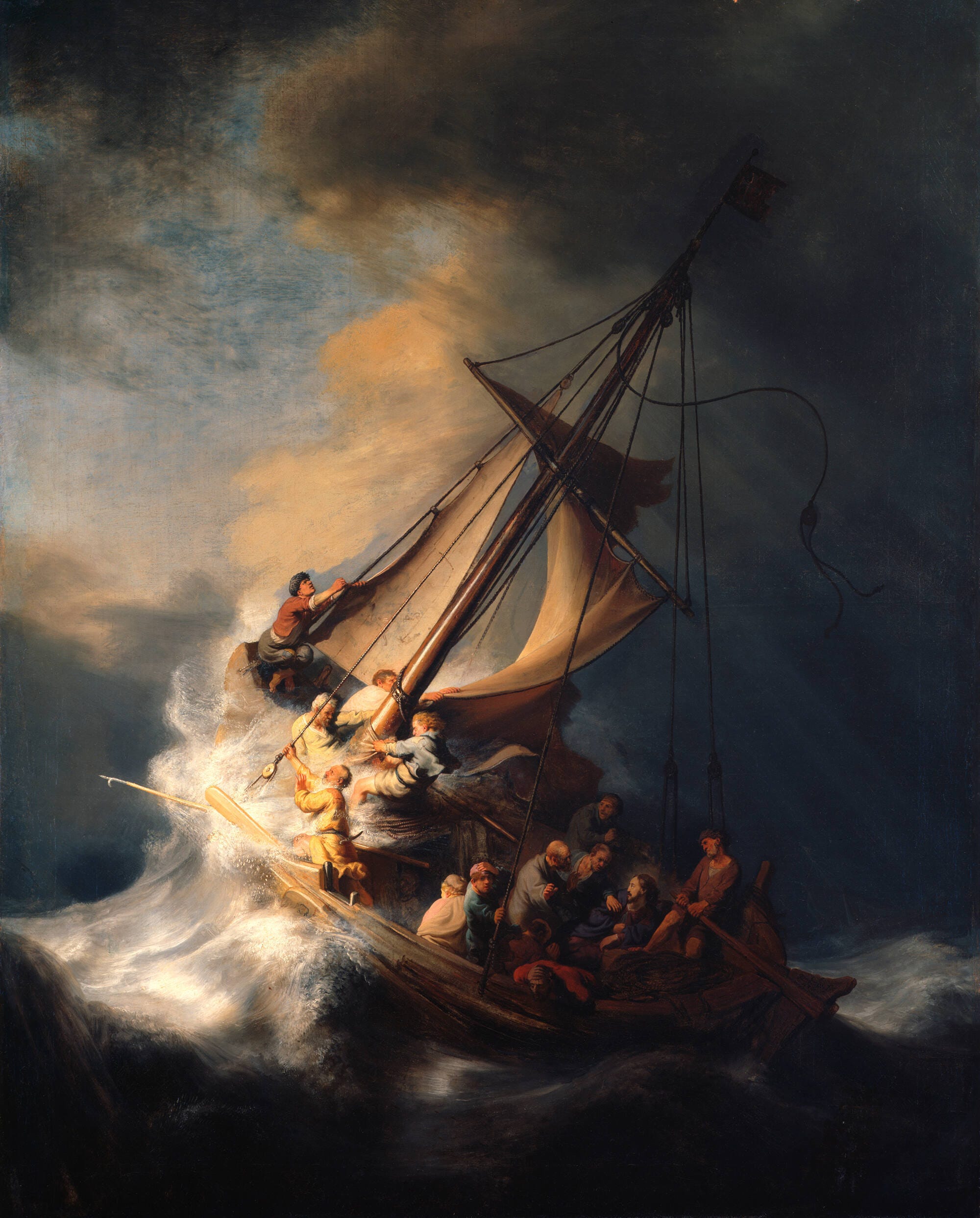
Into this prophetic frame, Matthew places a storm.
Jesus and his disciples have gotten into a boat. He falls asleep. A violent storm arises - the Greek seismos megas, a great shaking, the same word used for earthquake. The waves cover the boat. The disciples, some of whom are experienced fishermen who know this lake, are terrified. They wake him: “Lord, save us! We are perishing!”
He says: “Why are you afraid, O you of little faith?”
Then he rises and rebukes the winds and the sea. And there is a great calm.
And the men marveled, saying: “What sort of man is this, that even the winds and the sea obey him?”
Chrysostom, in his homily on this passage, notes that Jesus sleeps deliberately - not because he is unaware of the storm, but to give the disciples occasion to experience their own fear and their own need.1 “Since they had seen all benefitted, while themselves had enjoyed no benefit,” Chrysostom observes, “it was meet they should enjoy His benefits by their own perception.” The sleeping is pedagogical. The storm is the classroom. And the lesson is not about the disciples’ weakness - it is about what happens when they turn, in their weakness, to the right person.
Chrysostom also notes the wonder of the question the disciples ask afterward. While the sleep and the outward appearance showed a man, he says, the sea and the calm declared him God. The question - what sort of man is this? - holds both realities at once. It is not a failure of theological precision. It is the right posture before the one who is both, the one in whom the two natures are united without confusion or separation. The disciples do not yet have the vocabulary for the Council of Chalcedon. They have something better: the fresh astonishment of men who have just watched the wind obey a word.
Notice the order of what Jesus does.
He does not rebuke the storm first. He rebukes the disciples’ fear first. “Why are you afraid, O you of little faith?” Then he rises and calms the sea. The inner storm is addressed before the outer one. Or rather - the addressing of the inner storm is itself the precondition for receiving what comes next. The disciples cry out, they are rebuked, they watch the impossible happen, and then they ask the question that has been the right question all along.
This is the domestic shape of faith in a storm. The household that is being beaten by waves - illness, estrangement, financial collapse, the grinding anxiety of a nation at a hinge moment in its history - is not first asked to solve the problem. It is first asked to wake Jesus. To cry out. To say, even imperfectly, even with the little faith that is all we have: Lord, save us, we are perishing.
The rebuke is not a rejection. It is an invitation to look at who is in the boat. And the question that follows - what sort of man is this? - is the question that every household, every nation, every frightened person in a storm needs to be asking. Not as a challenge but as a dawning. The winds and the sea obey him. That is not a comforting abstraction. It is a specific claim about the specific person who is asleep in the stern of the specific boat you are in.
At 250 years, America is in a boat with a history of storms. The founding was itself a storm - a break with everything familiar, a bet on ideals that had never been fully tested, a venture into waters no republic had navigated at this scale. The storms since then have been real: a civil war, a depression, two world wars, the long reckoning with the gap between the founding ideals and the lived reality of those those ideals excluded.
The prophetic question Amos asks is not whether the storms have come. They have. It is whether the nation has returned - whether it has, in its extremity, done what Hezekiah did last week and what the disciples do in this passage: turned toward the one who holds the winds and the sea and said, with whatever faith is available, Lord, save us.
The household that prays for the nation this week - that spreads the whole thing out before God on the Fourth of July, that brings the 250 years and the unfinished promises and the renewed aspirations to the one who makes his sun rise on the just and the unjust - is not being naive about politics. It is being precise about theology. The storm is real. The question is who is in the boat.
And what sort of man is this, who is asked that question and answers it by speaking to the wind.
Domus Formation offers tracks of daily prayer and formation for families, men, women, teens, and those in the second half of life. The first school of faith is the home, and every member of it deserves to be formed. WeAreDomus.com
If Catholic fiction that takes the Communion of Saints seriously - as doctrine, not sentiment - is what you are looking for, I am writing two things. Lux Perpetua is a serial novel publishing weekly in two tracks, set in Alton, Illinois, at the edge of the Mississippi - a story of custody and fidelity and a flame passed forward across centuries. And Two Lamps is a weekly short story on Substack, each one braiding two saints from different centuries into a single imagined meeting. Both are for the kind of reader who believes the imagination is also a faculty of faith.
Deacon Michael Halbrook is husband to Suzanne, father of four sons, and a permanent deacon of the Diocese of Springfield in Illinois. He serves at St. Elizabeth Parish in Granite City. He is the founder of Domus Formation, a collection of Catholic prayer and formation resources for every stage of life, and he writes at DeaconMichael.net.
John Chrysostom, Homilies on the Gospel of Matthew, Homily 28 (on Matthew 8:23-27); available at New Advent, newadvent.org.
Amazing reflection of today’s readings, Deacon Michael. Thank you. 🙏