
What Are "Divisions" in the Church?
Gospel Reflection for January 25, 2026 - Matthew 4:12-23

And when Jesus had heard that John was delivered up, he retired into Galilee:
And leaving the city Nazareth, he came and dwelt in Capharnaum on the sea coast, in the borders of Zabulon and Nephthalim;
That it might be fulfilled which was said by Isaias the prophet:
Land of Zabulon and land of Nephthalim, the way of the sea beyond the Jordan, Galilee of the Gentiles:
The people that sat in darkness, hath seen great light: and to them that sat in the region of the shadow of death, light is sprung up.
From that time Jesus began to preach, and to say: Do penance, for the kingdom of heaven is at hand.
And Jesus walking by the sea of Galilee, saw two brethren, Simon who is called Peter, and Andrew his brother, casting a net into the sea (for they were fishers).
And he saith to them: Come ye after me, and I will make you to be fishers of men.
And they immediately leaving their nets, followed him.
And going on from thence, he saw other two brethren, James the son of Zebedee, and John his brother, in a ship with Zebedee their father, mending their nets: and he called them.
And they forthwith left their nets and father, and followed him.
And Jesus went about all Galilee, teaching in their synagogues, and preaching the gospel of the kingdom: and healing all manner of sickness and every infirmity, among the people. (Matthew 4:12-23 DRA)
What does it really mean for there to be “divisions” in the Church, as St. Paul talked about in the Epistle? We have heard this term used frequently in recent years, especially from the previous and current pontificates and by many of the bishops. Ironically, while Protestants are commemorated with paintings in the Vatican and the anniversaries of their important events are celebrated by the hierarchy, including ‘Reformation Day,’ the accusation of being “divisive” is most often leveled against those groups in the Church which advocate for Tradition, which love the Traditional Latin Mass and which seek to live, belief and pray as Latin Catholics have throughout history, including the SSPX, FSSP, ICKSP and others.
The fact that the one Catholic Church is made up of many distinct churches, all united in communion with the Supreme Pontiff and holding the same faith, morals and principles of discipline, shows that differences of tradition alone are insufficient to constitute true “division.” So, what was St. Paul really getting at? We can see this clearly by his rhetorical question, which can be summarized this way: do you belong to Christ or to a mere man? Whose disciple are you?
This is the theme of our Gospel reading this Sunday: authentic discipleship of Christ. St. Peter and St. Andrew, the first called to be apostles of Our Lord, exemplified this discipleship, although imperfectly – but imperfectly only due to their personal sins (fleeing from Christ’s arrest in Gethsemane, St. Peter denying Him three times, etc.), not to officially teaching anything erroneous. They, like all the apostles and their successors, the bishops of the Church, for two millennia have in their official and universal teaching (the Ordinary and Extraordinary Magisteriums) always obeyed St. Paul’s command: “Therefore, brethren, stand fast; and hold the traditions which you have learned, whether by word, or by our epistle.” (2 Thess 2:14)
They remained ever faithful to Tradition, in its written and unwritten forms, receiving it humbly, growing and pruning it organically and applying it charitably to their times; even when some, like the Arians of the early centuries, the Protestants of the early modern period or the Modernists of the last century, betrayed the Faith, they endured as a whole, as did all the faithful in communion with them which together make up the sensus fidelium and the Mystical Body of Christ.
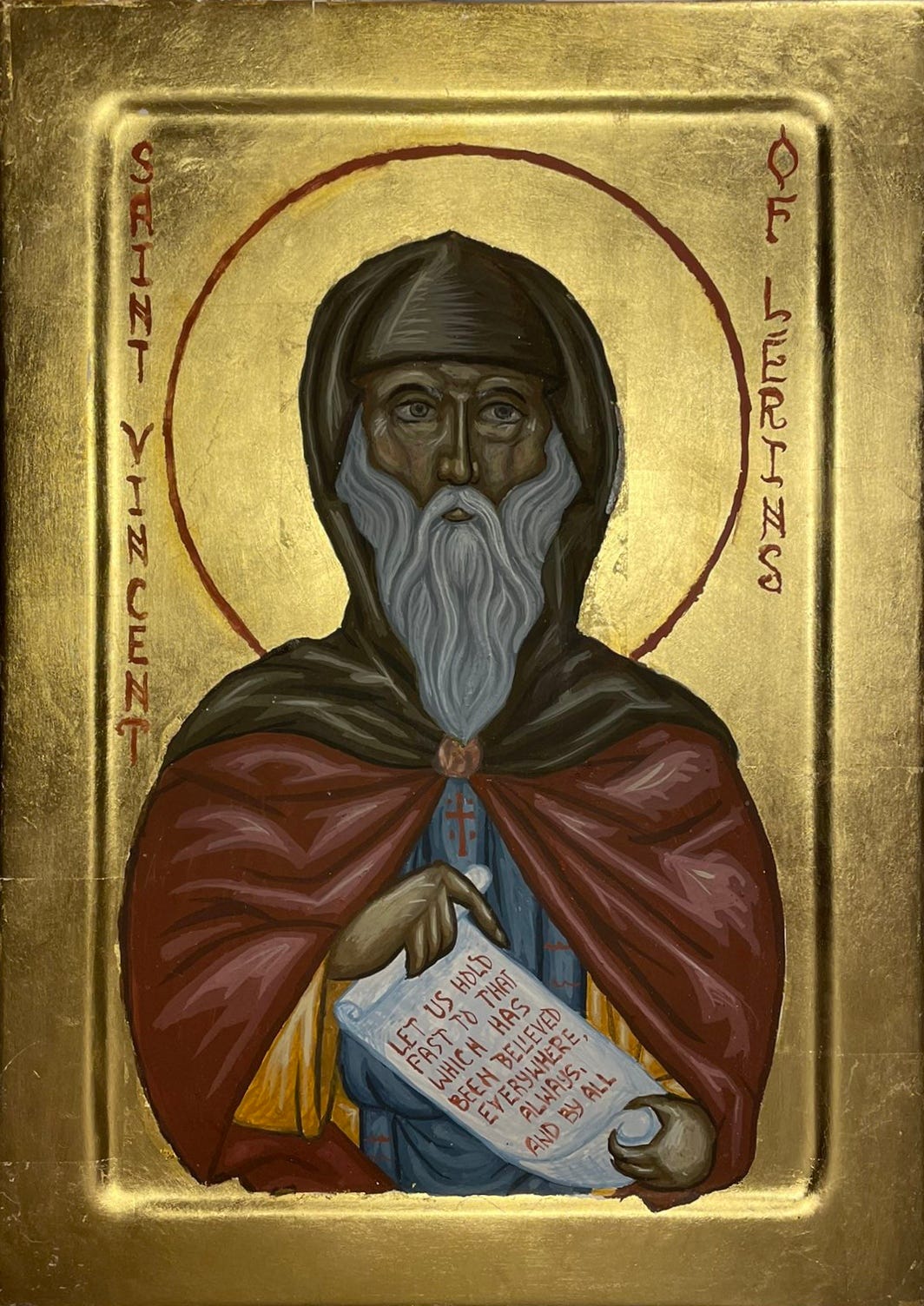
The great Church Father St. Vincent of Lérins, in his work the Commonitorium, offered several principles to help us discern authentic from false discipleship, founded ultimately in our discernment of authentic and false Tradition. Most powerful is his famous Vincentian Canon:
[I]n the Catholic Church itself, all possible care must be taken, that we hold that faith which has been believed everywhere, always, by all. For that is truly and in the strictest sense ‘Catholic,’ which, as the name itself and the reason of the thing declare, comprehends all universally. This rule we shall observe if we follow universality, antiquity, consent.
He also gave a description of what makes someone a true Catholic:
[H]e is the true and genuine Catholic who loves the truth of God, who loves the Church, who loves the Body of Christ, who esteems divine religion and the Catholic Faith above every thing, above the authority, above the regard, above the genius, above the eloquence, above the philosophy, of every man whatsoever; who sets light by all of these, and continuing steadfast and established in the faith, resolves that he will believe that, and that only, which he is sure the Catholic Church has held universally and from ancient time; but that whatsoever new and unheard-of doctrine he shall find to have been furtively introduced by some one or another, besides that of all, or contrary to that of all the saints, this, he will understand, does not pertain to religion, but is permitted as a trial.
From this, it may be seen what is real division in the Church and what is its cause: betrayal, violation and abandonment of Tradition, a refusal to accept and hand on what one has received from Christ, the apostles, the Fathers and Doctors of the Church of history; and the allegiance to demagogues, ideologies and sects in the Church which, openly or secretly, perpetrate these divisive acts and seek to spread them like a cancer in the Body of Christ. St. Vincent thus taught,
And why, I pray thee, does not God forbid to be taught what God forbids to be heard? ‘For the Lord, your God, trieth you, to know whether you love Him with all your heart and with all your soul.’ The reason is clearer than day why Divine Providence sometimes permits certain doctors of the Churches to preach new doctrines--‘That the Lord your God may try you;’ he says. And assuredly it is a great trial when one whom thou believest to be a prophet, a disciple of prophets, a doctor and defender of the truth, whom thou hast folded to thy breast with the utmost veneration and love, when such a one of a sudden secretly and furtively brings in noxious errors, which thou canst neither quickly detect, being held by the prestige of former authority, nor lightly think it right to condemn, being prevented by affection for thine old master.
Even the leaders of the Church are capable of such divisiveness, as St. Vincent makes clear:
But whatsoever a teacher holds, other than all, or contrary to all, be he holy and learned, be he a bishop, be he a Confessor, be he a martyr, let that be regarded as a private fancy of his own, and be separated from the authority of common, public, general persuasion, lest, after the sacrilegious custom of heretics and schismatics, rejecting the ancient truth of the universal Creed, we follow, at the utmost peril of our eternal salvation, the newly devised error of one man.
But why does God allows such divisions in the Church, as St. Paul said he would? (1 Cor 11:19) St. Vincent explains:
And why, I pray thee, does not God forbid to be taught what God forbids to be heard? ‘For the Lord, your God, trieth you, to know whether you love Him with all your heart and with all your soul.’ The reason is clearer than day why Divine Providence sometimes permits certain doctors of the Churches to preach new doctrines--‘That the Lord your God may try you;’ he says. And assuredly it is a great trial when one whom thou believest to be a prophet, a disciple of prophets, a doctor and defender of the truth, whom thou hast folded to thy breast with the utmost veneration and love, when such a one of a sudden secretly and furtively brings in noxious errors, which thou canst neither quickly detect, being held by the prestige of former authority, nor lightly think it right to condemn, being prevented by affection for thine old master.
He also anticipates the Protestant response of sola Scriptura and its rejection of Tradition, the Magisterium and the Fathers, writing,
Lest any one perchance should rashly think the holy and Catholic consent of these blessed fathers to be despised, the Apostle says, in the First Epistle to the Corinthians, ‘God hath placed some in the Church, first Apostles,’ of whom himself was one; ‘secondly Prophets,’ such as Agabus, of whom we read in the Acts of the Apostles; ‘then doctors,’ who are now called Homilists, Expositors, whom the same apostle sometimes calls also ‘Prophets,’ because by them the mysteries of the Prophets are opened to the people. Whosoever, therefore, shall despise these, who had their appointment of God in His Church in their several times and places, when they are unanimous in Christ, in the interpretation of some one point of Catholic doctrine, despises not man, but God.
St. Vincent’s clear, uncompromising doctrine shows us what true discipleship of Christ means, in his time and today, and it upholds the same challenge for us that it once gave for Christians in the fifth century whom he addressed: will you follow Christ, or man? Will you preserve Tradition, or innovation? Will you obey the perennial Magisterium, or subordinate it to the whims of contemporary fashions?
May all of us answer with the words first spoken by St. Peter and the apostles: “We ought to obey God, rather than men.” (Acts 5:29)
Join the Fellowship at Saint Tolkien!
Sobering. I had never heard of St. Vincent of Lérins. Thank you Kaleb, for introducing him to us.
Beautifully written and very moving . something for all of us to show to those who are complaining of divisions in the Church.