
Unless Your Faith Is Firm
Tuesday of the Fifteenth Week in Ordinary Time | Memorial of Saint Kateri Tekakwitha, Virgin | Isaiah 7:1-9 | Psalm 48 | Matthew 11:20-24

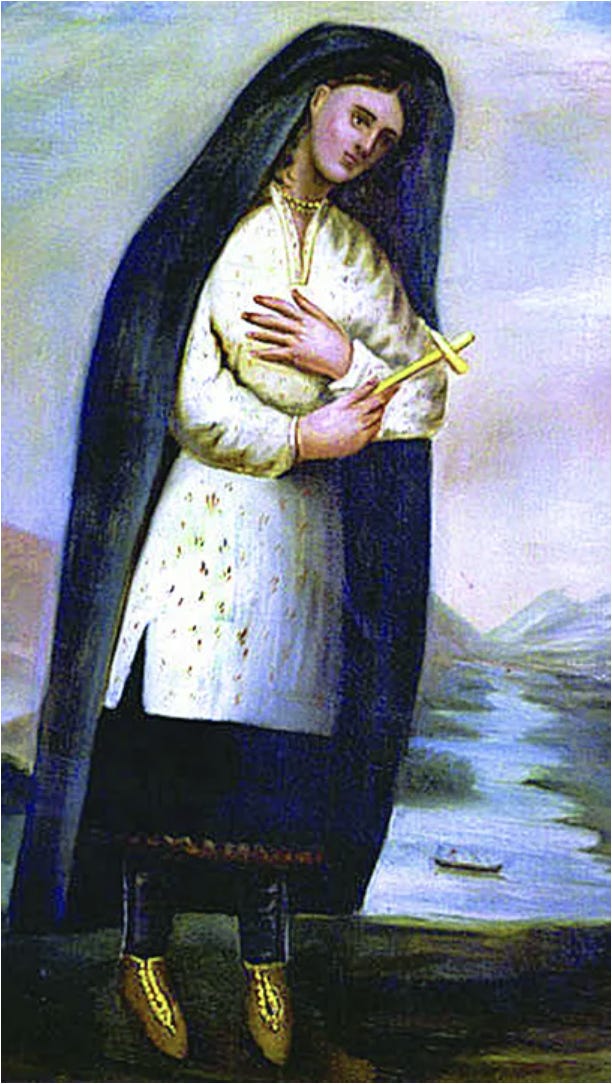
Note: Today is the Optional Memorial of Saint Kateri Tekakwitha. I have chosen to reflect on the weekday readings, though Kateri herself appears where the readings invite her.
Two kings are marching against Jerusalem.
Rezin of Aram and Pekah of Israel - the Syro-Ephraimite coalition - have set their sights on the city, and the news has reached Ahaz before they arrive. The text records what happens to the king and the city in a single image: “the heart of the king and the heart of the people trembled, as the trees of the forest tremble in the wind.”
It is a precise and honest description of a particular kind of fear. Not the sharp fear of sudden danger but the trembling fear of anticipated catastrophe, the whole body vibrating with what has not yet arrived but is certainly coming. The trees of the forest in the wind - every branch shaking, no stillness anywhere.
Into this trembling, God sends Elijah with a child.
The child’s name is Shear-jashub - “a remnant shall return” - and the name is itself a prophecy carried into the presence of the terrified king. Isaiah is to meet Ahaz at the conduit of the upper pool, on the highway to the fuller’s field, and say to him: “Take care you remain tranquil and do not fear.”
The enemies, God says, are “two stumps of smoldering brands.”
A smoldering brand looks threatening - there is smoke, there is heat, there is the suggestion of fire and burning. But a stump is already burned. The burning is over. What looks like a threat in motion is, in God’s sight, already spent. Rezin and Pekah are marching with real armies toward a real city - and God names them stumps.
“Unless your faith is firm, you shall not be firm.”
The Hebrew plays on two forms of the same root - ta’aminu... te’amenu. If you do not stand firm in faith, you will not stand at all. The word is not primarily an exhortation to try harder. It is a description of how reality works: the person whose stability rests on political calculation, on military assessment, on the trembling consensus of the city’s heart - that person is standing on something that cannot bear the weight. The only firm ground is the one the faith stands on. And the faith is in the God who already sees the smoldering brands as stumps.
Ahaz does not take the word. He will go on to make alliance with Assyria, to desecrate the Temple, to close its doors. He mistakes the smoldering brand for fire and the stump for a living tree, and he spends his reign in the fear that the word was given to release him from.
Jesus, in Matthew, is upbraiding cities.
He has gone through Chorazin and Bethsaida, teaching and healing and proclaiming. Mighty works have been done in these towns - works that Isaiah promised the Messiah would do, works that leave no room for ambiguity about what is happening and who is doing it. And the cities have not repented.
Jerome, in his commentary on this passage, names the precise weight of the indictment: “Tyre and Sidon had trodden under foot the law of nature only, but these towns after they had transgressed the natural and the written Law, also made light of those wonders which had been wrought among them.”1 The Gentile cities were without the Law and without the prophets. Chorazin and Bethsaida had both - and then they had the works of Christ done in their streets. The accountability is proportional to the gift.
Chrysostom adds a detail that cuts deeper: he notes that Jesus names Bethsaida specifically as the town from which the Apostles had come - Philip, Peter and Andrew, James and John.2 The disciples came from Bethsaida. The same soil that produced men who would turn the world over produced a city that would not repent. The grace does not guarantee the response. The same work that hardens one heart opens another.
This is the logic of Isaiah applied to the Gospel age. Ahaz trembled before smoldering brands and would not stand firm in faith. Chorazin and Bethsaida witnessed what Tyre and Sidon would have received with sackcloth and ashes - and remained unmoved. In both cases the gift was given. In both cases the trembling was chosen over the tranquility.
Today the Church celebrates Kateri Tekakwitha, the Lily of the Mohawks, canonized in 2012 - the first Native American saint.
She was born in 1656 in present-day New York. A smallpox epidemic killed her parents and a brother when she was four; she survived but with scarred skin and damaged eyesight. She was baptized in 1676 at the age of twenty, after years of quiet inquiry, in the face of family opposition and village ridicule. She fled her Mohawk village under cover of night to live among Christian Iroquois at a mission near Montreal, took a vow of virginity, and died at twenty-four in 1680.
At the moment of her death, witnesses reported that her scarred face became radiant and smooth.
What Kateri had, Chorazin did not. She received the faith on far less external evidence than the cities Jesus upbraided - no mighty works done in the streets of her village, no prophet sent to her by name, no long inheritance of the Law and the prophets. She received it in a body marked by suffering, in a community that mocked her, in a household that was the hardest possible place to remain firm. And she stood firm in it.
Unless your faith is firm, you shall not be firm. Kateri’s faith was firm. Her ground did not tremble, though everything around her did.
The domestic church is often the Bethsaida of our own lives.
It is the place where we have seen the most - where the faith has been present longest, where prayer has been practiced, where the sacraments have been received again and again. And it is therefore the place most at risk of the failure Jesus names in the Gospel: not ignorance, not paganism, not the trodden-down law of nature, but the familiarity that mistakes witness for repentance. The household that has heard the word for decades without being changed by it is in more danger than the household that has never heard it at all.
The word given to Ahaz is the word given to every trembling household: take care you remain tranquil and do not fear. Not because the threats are not real. Not because the marching armies are imaginary. But because the God who sends the word already sees the smoldering brands as stumps. The child with the prophetic name walks into the presence of a terrified king, and the name itself is the reassurance: a remnant shall return. Even from this. Even from Ahaz’s failure. Even from the city that would not repent.
The faith that stands firm is not the faith that never trembles. It is the faith that, trembling, turns toward the one who has already named the enemies stumps - and stands.
Domus Formation offers tracks of daily prayer and formation for families, men, women, teens, and those in the second half of life. The first school of faith is the home, and every member of it deserves to be formed. WeAreDomus.com
If Catholic fiction that takes the Communion of Saints seriously - as doctrine, not sentiment - is what you are looking for, I am writing two things. Lux Perpetua is a serial novel publishing weekly in two tracks, set in Alton, Illinois, at the edge of the Mississippi - a story of custody and fidelity and a flame passed forward across centuries. And Two Lamps is a weekly short story on Substack, each one braiding two saints from different centuries into a single imagined meeting. Both are for the kind of reader who believes the imagination is also a faculty of faith.
Deacon Michael Halbrook is husband to Suzanne, father of four sons, and a permanent deacon of the Diocese of Springfield in Illinois. He serves at St. Elizabeth Parish in Granite City. He is the founder of Domus Formation, a collection of Catholic prayer and formation resources for every stage of life, and he writes at DeaconMichael.net.
Jerome, Commentary on Matthew 11:20-24; cited in Thomas Aquinas, Catena Aurea on Matthew 11.
Chrysostom, cited in Thomas Aquinas, Catena Aurea on Matthew 11: "That you should not say that they were by nature evil, He names Bethsaida, a town from which the Apostles had come, namely, Philip, and two pair of the chief of the Apostles, Peter and Andrew, James and John."