
Then the Righteous Will Shine
Tuesday of the Seventeenth Week in Ordinary Time | Jeremiah 14:17-22 | Psalm 79 | Matthew 13:36-43

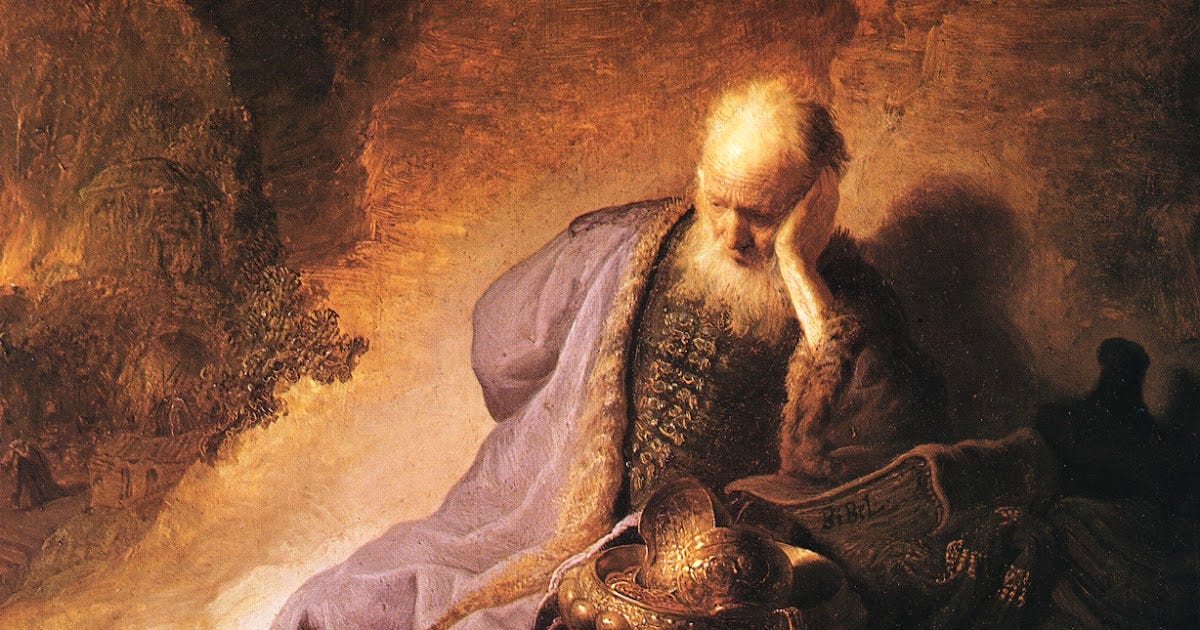
Jeremiah is weeping without rest.
What he sees is bad - and it’s everywhere: slain in the field, starving in the city, prophet and priest foraging in a land they no longer recognize. The wound of the daughter of his people is incurable. He has no consolation to offer because he has none himself. He looks at what is there and weeps.
And then he prays.
He doesn’t pray an argument for his own innocence or a protest against injustice. He begins with confession: “We recognize, O LORD, our wickedness, the guilt of our fathers; that we have sinned against you.” He does not petition from a viewpoint of deserved rescue. He is not claiming to have been wronged. He is acknowledging, in the middle of catastrophe, that the catastrophe has roots.
But then his appeal shifts. “For your name’s sake spurn us not, disgrace not the throne of your glory; remember your covenant with us, and break it not.”
God, You made promises. Please keep them. The petition is rooted not in merit but in the God’s own nature and character, in the covenant that precedes and survives every human failure. And then a question that expresses understanding: “Among the nations’ idols is there any that gives rain? Or can the mere heavens send showers? Is it not you alone, O LORD, our God, to whom we look?”
No one else gives rain. No one else sends the showers. In the middle of famine and sword and weeping without rest, Jeremiah has found the one thing that cannot be taken from him: the question that has only one answer.
In the Gospel, the disciples have a question of their own.
Jesus has dismissed the crowds and gone into the house, and they follow him privately. They have heard the parable of the weeds in the field - the man who sowed good seed, the enemy who came in the night and sowed weeds among the wheat, the servants who wanted to pull the weeds immediately and were told to wait. They did not understand it. “Explain to us the parable of the weeds in the field.”
Jesus explains. The sower is the Son of Man, the field is the world, the good seed the children of the Kingdom, the weeds the children of the evil one, the enemy the devil, the harvest the end of the age, the harvesters the angels. Nothing is left mysterious. The servants who wanted to pull the weeds immediately were asking for something that would have damaged the wheat. The separation belongs to the end of the age, to angels, to the Son of Man - not to us, not now.
And this image ends and resolves the parable: “Then the righteous will shine like the sun in the Kingdom of their Father.”
The echo of Daniel 12:3 is deliberate - “those who lead the many to justice shall be like the stars forever” - and it tells you where the parable is really going. This is not primarily a story about weeds being burned. It is primarily a story about wheat shining. The burning is real and the warning is genuine, but the final image Jesus leaves his disciples with is luminous, not punitive. Then. Not yet. Then.
Augustine, reading this parable, saw in it a counsel of patience that shapes how the Church understands herself in time. He used the phrase corpus permixtum - the mixed body - for the condition of the Church in time: wheat and weeds growing together, the good and the not-yet-good, the faithful and the failing, inseparable until the harvest that only God can bring. And he drew from it an important outcome of this mixed life: “Many are at first tares but then become good grain,” he wrote, adding that “if these, when they are wicked, are not endured with patience, they would not attain their praiseworthy transformation.”1
Patience is not indifference. It is the condition that makes conversion possible. The servant who pulls the weeds immediately has decided, before the harvest, who is wheat and who is weed - and has foregone the possibility that the weed might, given time and the slow work of grace, become grain. The patience of the householder is the patience of a God who waits without giving up.
Every household is a corpus permixtum.
Not only because households contain people at different stages of faith and different relationships to God - though they do. But because the same person is both wheat and weed, at different hours of the day, in different seasons of a life.
The doubt that enters when providence seems to have gone silent - when the prayer isn’t answered, when the loss doesn’t resolve, when the famine in the field is real - is the weed growing alongside the wheat. It is not a sign that the faith has failed. It may be the ground in which the faith is being formed into something it could not become in easier soil.
Jeremiah does not resolve his doubt before he prays. He names it in his prayer - “have you cast us off completely? why have you struck us a blow that cannot be healed?” - and then prays from inside it, turning to the only one who gives rain. The “we recognize our wickedness” and the “remember your covenant” are in the same breath. The confession and the appeal are simultaneous. The weed and the wheat are in the same prayer, offered by the same prophet, to the same God.
The household that prays from the heart of this mixed reality - from inside doubt and fidelity and the felt absence of a God it still believes in - is praying exactly as Jeremiah prays. Not from a resolved position but from a turned one. Turned toward the one who alone sends rain. Waiting for the then.
The righteous will shine like the sun.
Not yet. But the then is coming. The wheat that endures the mixed field, that keeps turning toward the God who gives rain even when the field is full of what the enemy has sown, is already beginning to learn what it means to shine.
“Whoever has ears ought to hear.”
The domestic church doesn’t form itself. Domus Formation’s & Altar app gives your household a daily rhythm of Catholic prayer and formation - tracks for families, men, women, teens, and those in the second half of life. Start a free trial at WeAreDomus.com/start.
If Catholic fiction that takes the Communion of Saints seriously - as doctrine, not sentiment - is what you are looking for, I am writing two things. Lux Perpetua is a serial novel publishing weekly in two tracks, set in Alton, Illinois, at the edge of the Mississippi - a story of custody and fidelity and a flame passed forward across centuries. And Two Lamps is a weekly short story on Substack, each one braiding two saints from different centuries into a single imagined meeting. Both are for the kind of reader who believes the imagination is also a faculty of faith.
Deacon Michael Halbrook is husband to Suzanne, father of four sons, and a permanent deacon of the Diocese of Springfield in Illinois. He serves at St. Elizabeth Parish in Granite City. He is the founder of Domus Formation, a collection of Catholic prayer and formation resources for every stage of life, and he writes at DeaconMichael.net.
Augustine of Hippo, Quaestiones in Evangelium secundum Matthaeum, 12.4 (PL 35, 1371).