

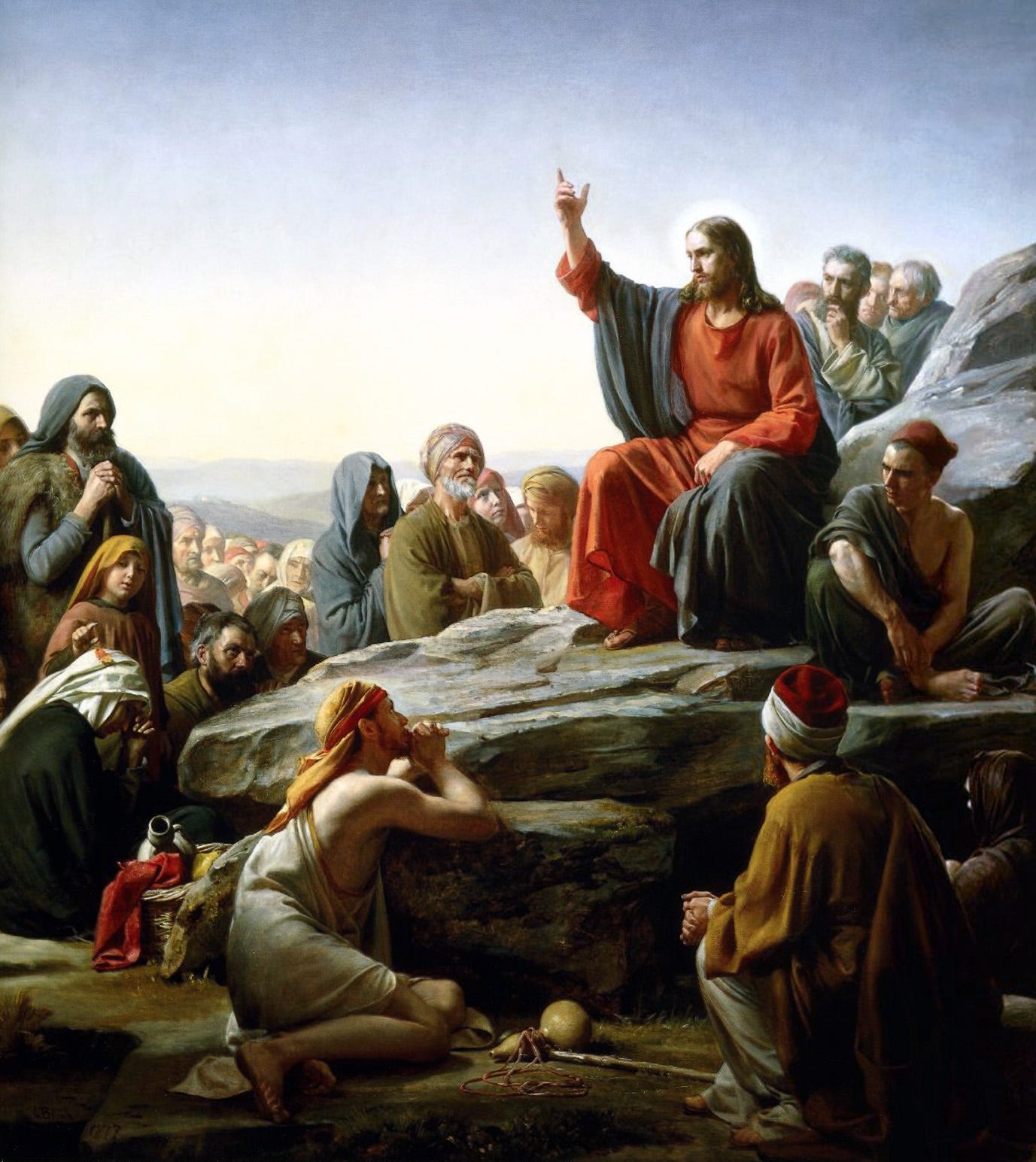
Do not think that I am come to destroy the law, or the prophets. I am not come to destroy, but to fulfill.
For amen I say unto you, till heaven and earth pass, one jot, or one tittle shall not pass of the law, till all be fulfilled.
He therefore that shall break one of these least commandments, and shall so teach men, shall be called the least in the kingdom of heaven. But he that shall do and teach, he shall be called great in the kingdom of heaven.
For I tell you, that unless your justice abound more than that of the scribes and Pharisees, you shall not enter into the kingdom of heaven.
You have heard that it was said to them of old: Thou shalt not kill. And whosoever shall kill shall be in danger of the judgment.
But I say to you, that whosoever is angry with his brother, shall be in danger of the judgment. And whosoever shall say to his brother, Raca, shall be in danger of the council. And whosoever shall say, Thou Fool, shall be in danger of hell fire.
If therefore thou offer thy gift at the altar, and there thou remember that thy brother hath any thing against thee;
Leave there thy offering before the altar, and go first to be reconciled to thy brother: and then coming thou shalt offer thy gift.
Be at agreement with thy adversary betimes, whilst thou art in the way with him: lest perhaps the adversary deliver thee to the judge, and the judge deliver thee to the officer, and thou be cast into prison.
Amen I say to thee, thou shalt not go out from thence till thou repay the last farthing.
You have heard that it was said to them of old: Thou shalt not commit adultery.
But I say to you, that whosoever shall look on a woman to lust after her, hath already committed adultery with her in his heart.
And if thy right eye scandalize thee, pluck it out and cast it from thee. For it is expedient for thee that one of thy members should perish, rather than that thy whole body be cast into hell.
And if thy right hand scandalize thee, cut it off, and cast it from thee: for it is expedient for thee that one of thy members should perish, rather than that thy whole body be cast into hell.
And it hath been said, Whosoever shall put away his wife, let him give her a bill of divorce.
But I say to you, that whosoever shall put away his wife, excepting for the cause of fornication, maketh her to commit adultery: and he that shall marry her that is put away, committeth adultery.
Again you have heard that it was said to them of old, Thou shalt not forswear thyself: but thou shalt perform thy oaths to the Lord.
But I say to you not to swear at all, neither by heaven, for it is the throne of God:
Nor by the earth, for it is his footstool: nor by Jerusalem, for it is the city of the great king:
Neither shalt thou swear by thy head, because thou canst not make one hair white or black.
But let your speech be yea, yea: no, no: and that which is over and above these, is of evil. (Matthew 5:17-37 DRA)
The Catholic Church is not a ‘denomination.’ For the first 1054 years of Christianity, there was no other Church but the Catholic Church. Christians did not join ‘Christianity’; they weren’t handed a Bible and told to figure it out for themselves. No, they received the Faith from the successors of the apostles and joined the Catholic Church through her Sacraments. All true bishops in the world were in communion with the pope, the successor of St. Peter and bishop of Rome. All shared the same apostolic faith and tradition, and all could trace their liturgical and theological heritage back to the four apostolic sees of Rome, Antioch, Alexandria and Jerusalem (later also Constantinople). This is why Vatican II taught that the “Church constituted and organized in the world as a society, subsists in the Catholic Church”. (Lumen gentium)
Even after the Eastern schism in 1054, many eastern churches remained in communion with the pope, many more reentered in later centuries, and even the schism itself did not disrupt apostolic succession, since the Orthodox to this day preserve valid bishops, priests and sacraments. Nevertheless, their defection from Rome for almost a millennium has led to certain errors in the Orthodox churches. One of the most glaring, which was and still is a strong motivator for many Eastern churches to restore communion with Rome and which remains one of the few distinctions between Eastern Catholics and Orthodox, is the Orthodox permission of divorce and remarriage.
This error is a clear violation of Christ’s teaching, in today’s Gospel and elsewhere, in which he restored marriage to its original Edenic meaning: one man, one woman, consensual, lifelong, indissoluble except by death, open to new life in procreation. This has always been the true Christian understanding of matrimony – anything else is a corruption and a concession to human weakness, akin to Moses’s permission of divorce.
This criterion is one of the most powerful, objective ways to discern which ‘denomination’ is the one true Church of Christ. Only the Catholic Church – meaning all the churches in communion with Rome – upholds Christ’s unequivocal teaching on sexual morality and the sacramental meaning of marriage. Even with all the ambiguity and disciplinary confusions (e.g. Communion for the divorced and remarried, blessings for same-sex ‘couples,’ etc.) that have cropped up since Vatican II, the Church has remained absolutely consistent and uncompromising: fornication is a sin, cohabitation is a sin, adultery is a sin, masturbation is a sin, pornography is a sin, homosexual sex is a sin, lust is a sin, divorce and remarriage is a sin, polygamy is a sin, etc. The Gospel permits no exceptions, dispensations or modernizations.
This is not easy for many people to accept (myself included during my conversion). For this reason, Protestants, varying by denomination and individual authority, range from near-Catholic values down to the most liberal toleration of every sexual depravity, all justified by their private interpretation of Scripture. (By comparison, the Orthodox permission of divorce and remarriage is relatively mild; they still uphold all other traditional teachings on sexual morality.) This is why, for example, the Catholic Church was the first and has remained the most consistent leader in the pro-life movement: any individual dissension from the Catholic condemnation of abortion is refutable by objective, infallible doctrine, not merely my opinion or preference or how I happen to read a particular biblical prooftext.
Sadly, today, in the Church there are many who try to push the Church, on all levels of authority, to alter her teachings, to deny Tradition and concede to the demonic forces of the world. And many in the hierarchy have learned that, without claiming any charism of infallibility, they can permit almost any evil through non-infallible teaching, discipline or simple administrative indifference, as with the above-mentioned examples and the almost daily scandals in the German synodal church. And while those who most love Catholic tradition are persecuted, others who seek to destroy it and replace it with a false religion of secular paganism in Catholic vestments are celebrated and promoted. But as Our Lord tells us, such members of His Body should be cut away – excommunicated - so that the rest of the Body is not infected by their corruption.
As our first reading today from Jesus ben Sira made clear, God gives to all of us a choice, the gift of free will to choose between good and evil (this is one reason why it was rejected as ‘apocryphal’ by the Protestants). God’s Law is never destroyed. The commandments of the Old Testament, to the smallest detail, are still valid today, but they have now been fulfilled in Christ and His Church. Circumcision has become Baptism; the Sabbath has become the Lord’s Day; the sacrifices of the Temple and other festal offerings, as well as the rites of the synagogue, have become the Divine Liturgy; and the moral laws, founded on the Ten Commandments, remain as valid as ever, except that now, as in our Gospel reading, Christ raises the bar even higher, so that mere external observance is not enough.
We must be purified in heart and mind, not only in act, if we are to fulfill Christ’s command later in this Sermon on the Mount: “Be you therefore perfect, as also your heavenly Father is perfect.” (Mt 5:48) And, for those who dissent, Sirach is quite clear: “No one does he command to act unjustly, to none does he give license to sin.”
As a concluding note, for those who wonder about Our Lord’s apparent exception to the indissolubility of marriage for “fornication” (Gk. porneias), St. Thomas Aquinas says this:
The Lord permitted a man to put away his wife on account of fornication as a punishment for the one who broke fidelity, and in favor of the one who preserved it, so that he would not be bound to render the marriage debt to her who had not kept fidelity.
And for this reason, seven cases are excepted in which it is NOT lawful for a husband to put away his fornicating wife, cases in which either the wife is free from guilt, or both are equally culpable.
1) The first is if the husband himself has likewise fornicated.
2) The second, if he himself has prostituted his wife.
3) The third, if the wife, probably believing her husband to be dead on account of his long absence, has married another.
4) The fourth is if she has been secretly known by someone who entered the bed under the appearance of her husband.
5) The fifth, if she has been overcome by force [raped].
6) The sixth, if he has reconciled her to himself after the adultery was committed, knowing her carnally.
7) The seventh, if a marriage was contracted in infidelity while both were unbelievers, the husband gave his wife a writ of divorce, and the wife married another; for then, if both are converted [to the faith], the husband is bound to receive her back
(Commentary on Sentences bk. 4, d. 35, q. 1, a. 1).
Join the Fellowship at Saint Tolkien!
Absolutely! And it reminded me of a quote from St. Augustine: “The law is given that grace may be sought; grace is given that the law may be fulfilled.”
Thank you Kaleb.