

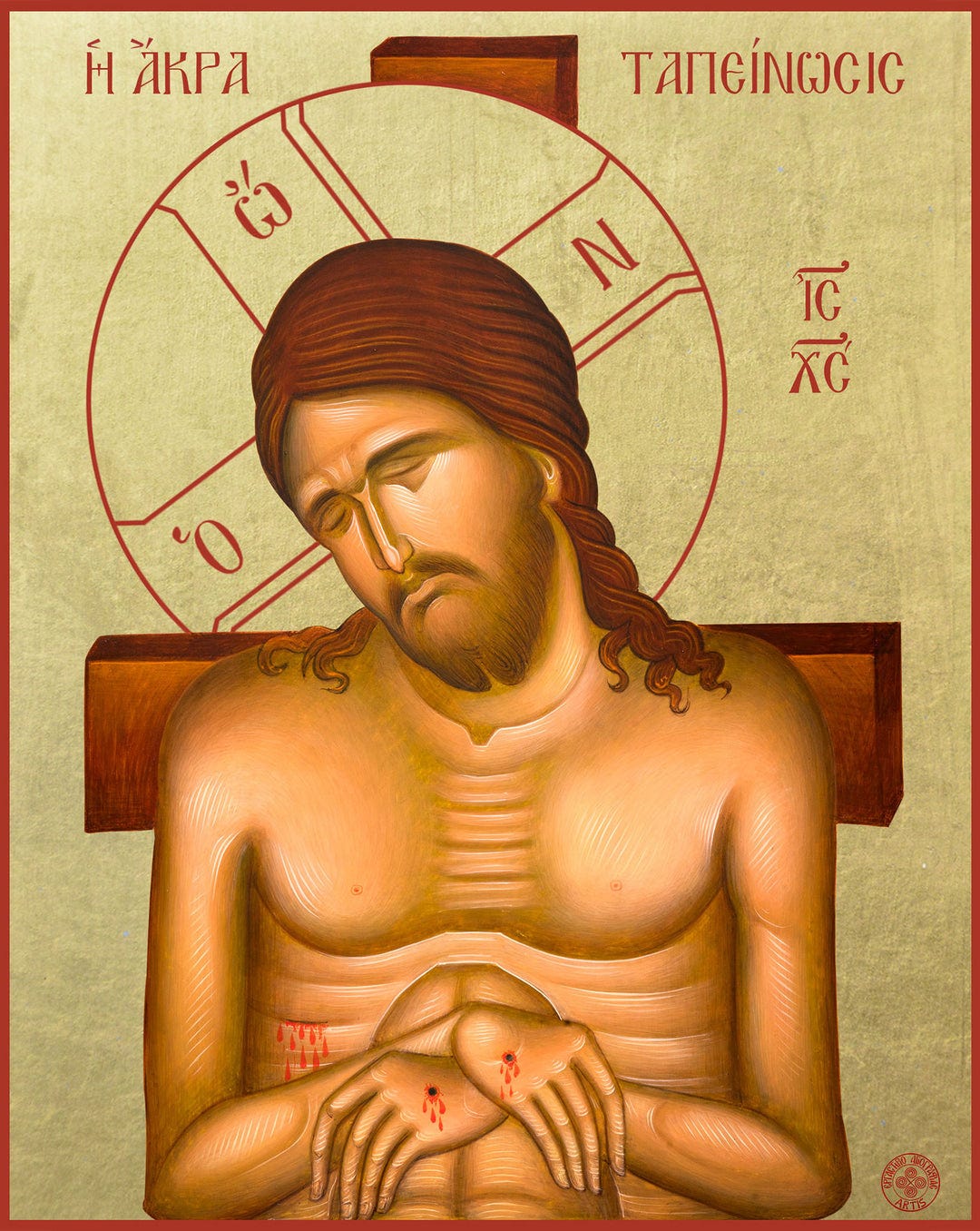
“Jesus entered the synagogue. There was a man there who had a withered hand. They watched Jesus closely to see if he would cure him on the sabbath so that they might accuse him.” Mark 3:1-2
In today’s Gospel, we find Our Lord healing a man with a withered hand on the Sabbath. The Pharisees, seeking to find something to accuse Our Lord of, watch closely, not to see the wonder and give glory to God for the miracle that is happening, or rejoicing that a brother is healed of an infirmity, but to set up Our Lord to be executed.
Here, we can see the spiritual rot that the sin of Pride causes. The core of what drives the Pharisees is that they do not want to lose their power over the people. This is grounded in Pride, the inordinate love of our own excellence. Pride leads us to form too high an opinion of ourselves and manifests in the destruction of those around us. It also tends to remove our submission to God and place ourselves as first. It turns us away from the contemplation of divine things.
Fr. Garrigou-Lagrange writes:
“Pride… hinders us from seeing the truth, especially that relative to the majesty of God and the excellence of those who surpass us. It prevents us from wishing to be instructed by them, or it prompts us not to accept direction without argument. Pride thus perverts our life as one would bend a spring; it hinders us from asking light from God, who consequently hides His truth from the proud.”1
How much do the Pharisees embody this quote from Garrigou? Their pride has kept them from seeing the majesty of God Incarnate in front of them, working miracles for the good of others. They refuse to be taught by Him that the Sabbath was made for man. Thus, the truth of the Messiah was hidden from them.
St. Thomas lists three main defects that are born from Pride: Presumption, Ambition, and Vainglory.2 While there are numerous other effects, these remain the three primary ones. These are manifest in the Pharisees in today’s Gospel, and it shows why these things remain hidden from them, the so-called learned.3
Presumption is an inordinate hope of doing something above our power. The presumptuous are full of egoism and aspire to great heights that they have not been predisposed to. In particular with the Pharisees here:
“The presumptuous man believes himself capable of studying and solving the most difficult questions; he settles the most abstruse problems with rash haste.”4
How quickly did they believe they had solved the problem of Jesus of Nazareth? They were so presumptuous that the Messiah had not yet come that they closed themselves off to the many signs of His coming because they had a preconceived notion of who He was supposed to be.
Presumption then leads into ambition. Through presumption, the man considers his powers so great that he then considers himself greater than others and thus desires to dominate and impose his ideas on them.5 The Pharisees find themselves in this position as well. They sought a higher office than they were due according to merit. They sought a higher learning than they were capable of since they had no humility. Thus, the sin of ambition is born when “he seeks honors for himself and not for the glory of God or for others.”6 Our Lord sought to heal the withered man’s hand. The Pharisees could not abide this good thing happening to him since they were not the ones doing it or receiving the glory.
Ambition then gives way to vainglory, the “wish to be esteemed for oneself, without referring this honor to God, the source of all good, and often a wish to be esteemed for vain things.”7 Vainglory causes numerous defects to spring from the soul infected by it. In particular, the part of the Pharisees, I want to point out three:
Stubbornness
Contention in defending one’s opinion
Disobedience
All three are on display in the souls of the Pharisees.
The pride of the Pharisees remains a lesson for us all. We cannot lean on our own understanding. We must return to God daily with a heart of humility. There is a reason why the moralists cite Pride as the most grave of all sins. It is the sin most in opposition to Our Lord, who Himself is meek and humble of heart. We must uproot all traces of pride from our souls if we desire to be united to Him.
For more from Dr. McGovern, visit his Substack at A Thomist, Dedicated to the Theological tradition of St. Thomas Aquinas. Exploring Thomas’ Spiritual Theology and topics in Christology and Mariology.
Reginald Garrigou-Lagrange, Three Ages of the Interior Life, Vol. I, 381.
Cf. Summa Theologiae II-II, q. 130-132, respectively.
Cf. Matthew 11:25.
Three Ages, 384.
Cf. Ibid.
Ibid.
Ibid. 385.
Indeed!!!!!! Well said!!
"Lord have mercy on me a sinner."