
The Seven Prophecies of the Passion
A Commentary on the Gospel According to St. John, Chapter 19:17-42

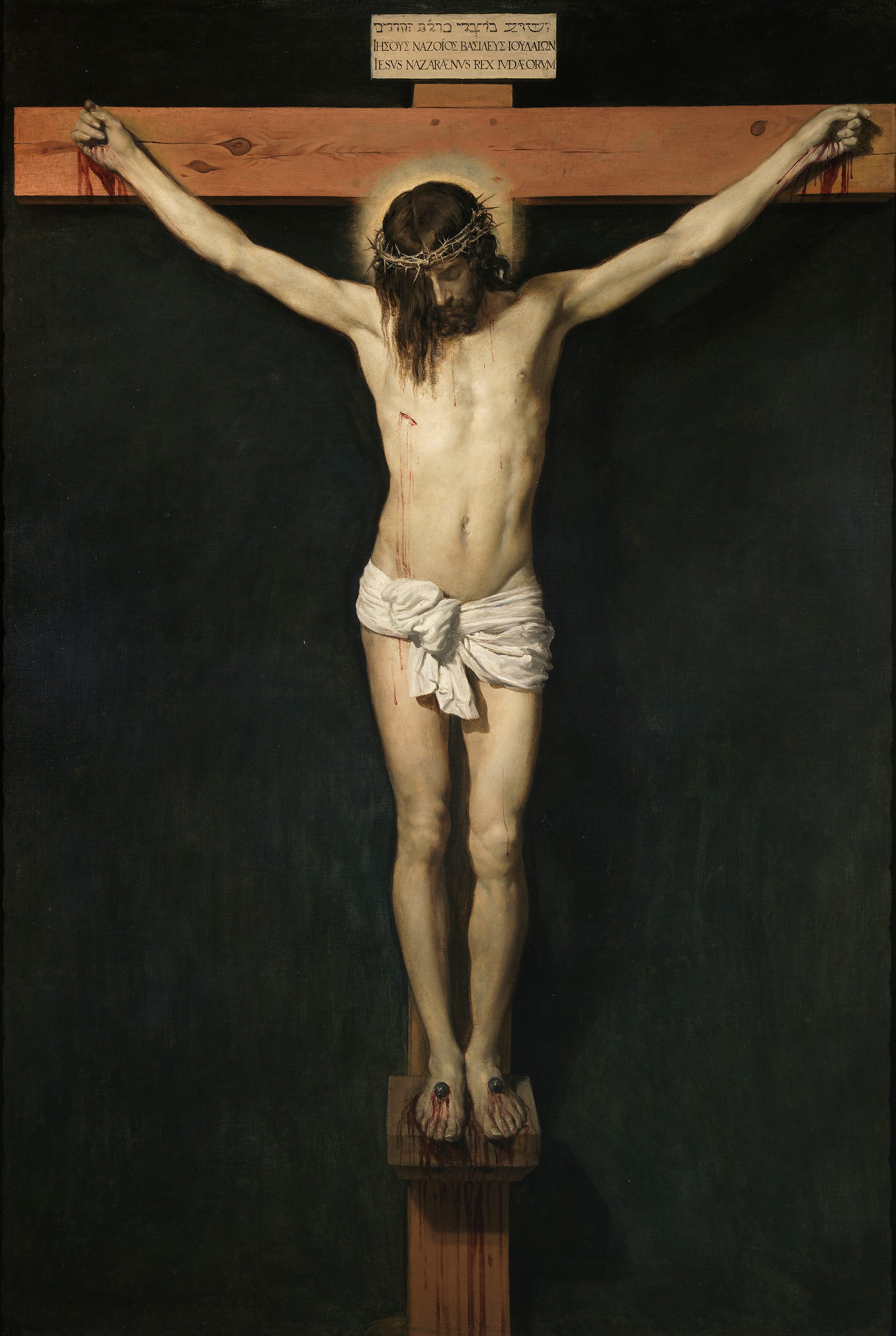
The New Testament is filled with Old Testament fulfillments. Truly, as Hugh of St. Victor says, “All of Scripture is one book, and that book is Christ.”1 This is seen beautifully all through the Gospels and most especially in the Passion Narratives. For this work, I want to specifically look at seven Old Testament prophecies that are fulfilled in the Crucifixion narrative of St. John. These occur, one after the other, in verses 17 through 42 of the nineteenth chapter.2 They are as follows:
He is crucified between two criminals
He is called the King of the Jews
They divided His clothes
Mary is called Woman at the foot of the Cross
Jesus is given vinegar to drink
No bones are broken, and His side is pierced
Buried in a rich man’s grave
Each one of them is a fulfillment of something that was foretold in the Old Testament, and so for each, I will connect it with its Old Testament counterpart and do some exegetical work to flesh out the connections. An important distinction should be noted, which St. Thomas teaches in his Commentary on the Gospel According to St. John:
“...things were written in the Old Testament because they would be fulfilled by Christ. If we say that Christ acted because the Scriptures foretold it, it would follow that the New Testament existed for the sake of the Old Testament and for its fulfillment, although the opposite is true.”3
The Angelic Doctor speaks well here that the Old Testament exists for the sake of the New Testament, both as prefigurement and preparation. Our Lord does not do these things because they were commanded by the prophets; the prophets foretold these things so that the Jews would know when the Messiah was in the midst. This needs to be remembered as we journey through this Sacred Text.
Hopefully, this bears fruit this Holy Week in the spiritual life of the reader.
Seven Prophecies in John
He is crucified between two criminals— Isaiah 53:12
“So they took Jesus, and he went out, bearing his own cross, to the place called the place of a skull, which is called in Hebrew Golgotha. There they crucified him, and with him two others, one on either side, and Jesus between them.” John 19:17-18
“Therefore I will divide him a portion with the great, and he shall divide the spoil with the strong; because he poured out his soul to death, and was numbered with the transgressors; yet he bore the sin of many, and made intercession for the transgressors.” Isaiah 53:12.
Our Lord is led out to die, and to make sure that He appeared as guilty as possible, He is executed with two criminals. All four canonical Gospels agree that Christ was crucified between two others. The nature of these others is debated; for example, St. Matthew calls them robbers.4 More than likely, they were not simple thieves, as crucifixion was not normally given as a punishment for theft. There had to be a greater crime committed. Perhaps they were murderers or revolutionaries, as they were imprisoned at the same time as Barabbas. Either way, Our Lord is associated with the Transgressor as the Prophet Isaiah foretells. This death with the transgressor ought to be seen in a couple of ways: the first, I wrote above, is to associate Him with the sinner. But this goes ever deeper than mere guilt by association; it is to show how deeply Our Lord descends into the Human condition and takes upon Himself the sins of the Transgressor. Here, Isaiah is prophesying that the Suffering Servant will take the sins of the transgressor upon Himself, bear their sins, and make them to be righteous.
St. Thomas comments on this:
…the salvation of those made subject to him: for he does not subject them to himself like a tyrant to abuse them, but to save them: and he has borne, taken away, the sins of many, efficaciously, although sufficiently of all, and has prayed for the transgressors: Father, forgive them, for they know not what they do (Luke 23:34).5
This association with the transgressors had a practical end for his executioners, but it has a deeply efficacious and salvific end for those whom He is dying for. Look no further than St. Dismas, the Good Thief, to whom Our Lord said, “Truly, I say to you, today you will be with me in Paradise.”6
He is called the King of the Jews—Zechariah 9:9
“Pilate also wrote a title and put it on the cross; it read, ‘Jesus of Nazareth, the King of the Jews.’’ Many of the Jews read this title, for the place where Jesus was crucified was near the city; and it was written in Hebrew, in Latin, and in Greek. The chief priests of the Jews then said to Pilate, ‘Do not write, ‘The King of the Jews,’ but, ‘This man said, I am King of the Jews.’ ” Pilate answered, ‘What I have written I have written.’” John 19:19-22
“Rejoice greatly, O daughter of Zion! Shout aloud, O daughter of Jerusalem! Behold, your king comes to you; triumphant and victorious is he, humble and riding on a donkey, on a colt, the foal of a donkey.” Zechariah 9:9
As Our Lord is crucified, the Romans place a sign on the cross that says, Jesus of Nazareth, the King of the Jews. This inscription is written in Hebrew, Latin, and Greek. This was to cover the major languages at the time. Hebrew, while it was not spoken as the language of the time by the Jews, was essentially a liturgical language for them; Latin was the language of the Romans; and Greek was the common trade language at the time. This ensured a type of universality in the proclamation. Thus, this shows the universality of Christ’s Kingship.
This inscription was at once both an ironic fulfillment of prophecy and meant to be an offense towards the Jews by Pilate. Surely, Pilate feels like he was backed into a corner by the Jewish leaders. He is not going to let a slight like that go unanswered, and so he mocks the malice with which the Jews turn on their king.7
In all of this, however, there is a theological beauty to the title given. St. Thomas teaches:
Second, he mentions the content of the title, Jesus of Nazareth, the King of the Jews, words which are very fitting for this mystery of the cross. The word Jesus, which means Savior, corresponds to the power of the cross by which we have all been saved: you will call His name Jesus, for He will save His people from their sins (Matt. 1:21). The word Nazareth, which means abounding in flowers, corresponds to the innocence of the one suffering: I am a rose of Sharon, a lily of the valleys (Song 2:1); a flower will rise up out of his root (Isa 11:1). The words King of the Jews accord with the power, the dominion, which Christ earned by his suffering: therefore God greatly exalted Him (Phil 2:9); he will reign as king and be wise (Jer 23:5); He will sit upon the throne of David and over his kingdom (Isa 9:7).8
St. Thomas beautifully elucidates the Scriptural significance of this title given to Christ. Unbeknownst to Pilate, the Procurator is actually participating in the prophetic charism.9 In his mind, he is mocking the Jews, but in the providential plan of God, he is announcing to the world who this man is and how He fulfills the Prophet Zechariah.
In the Prophet Zechariah, we hear of the prophecy that the King of Israel will come into the Holy City, riding on a donkey. Clearly, this was done by Our Lord on Palm Sunday.10 But this verse from Zechariah is fulfilled in a complete way because it is through the cross that Christ is ultimately triumphant and victorious, as St. Thomas teaches above. Christ, as King of the Universe, asserts His dominion by assuming the throne of the cross. He is thus hailed as King and is greatly exalted by God.11 While Our Lord is certainly triumphant on His entrance to the city, the true exaltation and dominion is grasped from the wood of the cross.
They divided His clothes— Psalm 22:18
“When the soldiers had crucified Jesus, they took his garments and made four parts, one for each soldier; also his tunic. But the tunic was without seam, woven from top to bottom; so they said to one another, ‘Let us not tear it, but cast lots for it to see whose it shall be.’ This was to fulfill the Scripture, ‘They parted my garments among them, and for my clothing they cast lots.’” John 19:23-24
“...they divide my garments among them, and for my clothing they cast lots.” Psalm 22:18.
Part of Roman crucifixion was stripping the condemned naked to maximize the embarrassment and to torment them further.12 All four Gospels record that they took Our Lord’s clothes and divided them up, and that there was a tunic which was woven top to bottom with no seam to tear it along. This singular piece is gambled for. The indivisible tunic represents a couple of things: first, according to St. Thomas, it represents the unity of the Church, the Mystical Body of Christ.13 Second, the seamless tunic is a reference to the linen vestment worn by the priests spoken of in Leviticus.14
John himself references that this stripping of Christ and the gambling for His clothes was to fulfill the prophecy. This prophecy lies in Psalm 22. This Psalm is intimately tied to the Passion. Many lines within it prophecy the death of Our Lord:
“My God, My God, why have you forsaken me?”
“But I am a worm, and no man; scorned by men, and despised by the people. All who see me mock at me… He committed his cause to the Lord, let Him deliver him…”
“...they have pierced my hands and my feet…”
“...they divide my garments among them, and for my clothing they cast lots…”
The last of these lines is specifically recounted here by the Evangelist to show how Christ is the fulfillment of this Psalm. And yet, even through all of this suffering, the Psalm ends in victory for the sufferer.15
Mary is called Woman at the foot of the Cross—Genesis 3:15
“So the soldiers did this. But standing by the cross of Jesus were his mother, and his mother’s sister, Mary the wife of Clopas, and Mary Magdalene. When Jesus saw his mother and the disciple whom he loved standing near, he said to his mother, ‘Woman, behold, your son! Then he said to the disciple, ‘Behold, your mother!’ And from that hour, the disciple took her to his own home.” John 19:25-27
“I will put enmity between you and the woman, and between your seed and her seed; he [she] shall bruise your head, and you shall bruise his heel.” Genesis 3:15
We next find Christ turning His attention to His suffering Mother. She who cooperates in a unique and supreme way in the redemption of mankind is standing firm at the foot of the cross. From the cross, for the second time recorded by John, He refers to her by the title: Woman. The first happens at the Wedding at Cana, where Mary consents to the beginning of the hour.16 Do whatever He tells you.”17 Mary begins the hour. The hour is accomplished at the foot of the cross, and it is fitting that the woman who was present at the beginning ought to be present in the consummation.
This fulfills the Protoevangelium of Genesis. The woman is foretold to crush the head of the serpent, the perpetual enemy of the Woman and her Seed. Here, at the foot of the cross, she stands on the place of the skull18 and crushes the snake through her Son. As Adam and Eve were united in the fall of mankind through the fruit of a tree, we find the New Adam and the New Eve united in the redemption of mankind, likewise, through the fruit of the tree of the cross.
Jesus is given vinegar to drink— Psalm 69:21
“After this, Jesus, knowing that all was now finished, said (to fulfil the Scripture), ‘I thirst.’ A bowl full of vinegar stood there; so they put a sponge full of the vinegar on hyssop and held it to his mouth. When Jesus had received the vinegar, he said, ‘It is finished’ and he bowed his head and gave up his spirit.” John 19:28-30
“They gave me gall for food, and for my thirst they gave me vinegar to drink.” Psalm 69:21
In the last moments of Our Lord’s earthly life, He is fulfilling the Scriptures to the last iota. All is accomplished, all is consummated. In these last moments, Our Lord cries out I thirst. St. Thomas teaches that this exclamation was for two ends: “By saying, I thirst, he showed that His death was real, and not just imaginary. It also indicated His intense desire for the salvation of the human race.”19 First, Our Lord shows that His death is a true death. Contrary to the Docetist heresy of the first century, St. Thomas shows that Our Lord, who was truly man, suffered and died for the salvation of mankind. This, then, leads to the second reason: He desires the salvation of man.
Our Lord thirsts for souls!
He was thirsting for each of our souls, dear reader.
To satisfy that thirst, the Romans gave Him vinegar to drink as it was foretold in Psalm 69. The vinegar is soaked up in a sponge and placed on a hyssop branch. St. Thomas tells us that this represents the humility of Christ since the hyssop bush is used for purification, “and our hearts are purified especially by humility.”20 Likewise, the vinegar points to the malice and severity of the chief priests.21
It is here, now that all is accomplished, He bowed His head and gave up His spirit.
No bones are broken, and His side is pierced— Exodus 12:36 and Psalm 34:20; Zechariah 12:10
“Since it was the day of Preparation, in order to prevent the bodies from remaining on the cross on the sabbath (for that sabbath was a high day), the Jews asked Pilate that their legs might be broken, and that they might be taken away. So the soldiers came and broke the legs of the first, and of the other who had been crucified with him; but when they came to Jesus and saw that he was already dead, they did not break his legs. But one of the soldiers pierced his side with a spear, and at once there came out blood and water. He who saw it has borne witness—his testimony is true, and he knows that he tells the truth—that you also may believe. For these things took place that the Scripture might be fulfilled, ‘Not a bone of him shall be broken.’ And again, another Scripture says, ‘They shall look on him whom they have pierced.’” John 19:31-37
“In one house shall it be eaten; you shall not carry forth any of the flesh outside the house; and you shall not break a bone of it.” Exodus 12:46
“He keeps all his bones; not one of them is broken.” Psalm 34:20
“And I will pour out on the house of David and the inhabitants of Jerusalem a spirit of compassion and supplication, so that, when they look on him whom they have pierced, they shall mourn for him, as one mourns for an only child, and weep bitterly over him, as one weeps over a firstborn.” Zechariah 12:10
At the death of Our Lord, there are two prophecies fulfilled, and they correspond to one action that is done and one that is not done. The Gospels tell us that the soldiers broke the legs of the men crucified with Christ. This was to expiate the death of the condemned. When the legs are broken, the condemned can no longer push themselves up to gasp for air, and as a result, will asphyxiate quicker. But when they came to Christ, He was already dead. Since Our Lord was already dead, they did not break His legs.
There are two prophecies found here. The first is found in the Exodus Narrative of the Passover Lamb. God commands that the lamb, which is slaughtered and consumed as the victim in the Passover, not have any bones broken. This Passover lamb is a foreshadowing of Christ, our Passover Lamb.22 He is our Lamb who takes away the sins of the world. Since He is the perfection and completion of the Passover Lamb, not a bone of His should be broken. This is later affirmed in Psalm 34. Both Exodus and Psalm 34 highlight that despite the immense suffering Our Lord underwent, even to the point of complete exsanguination, His bones remained in place and whole. He is the Lamb.
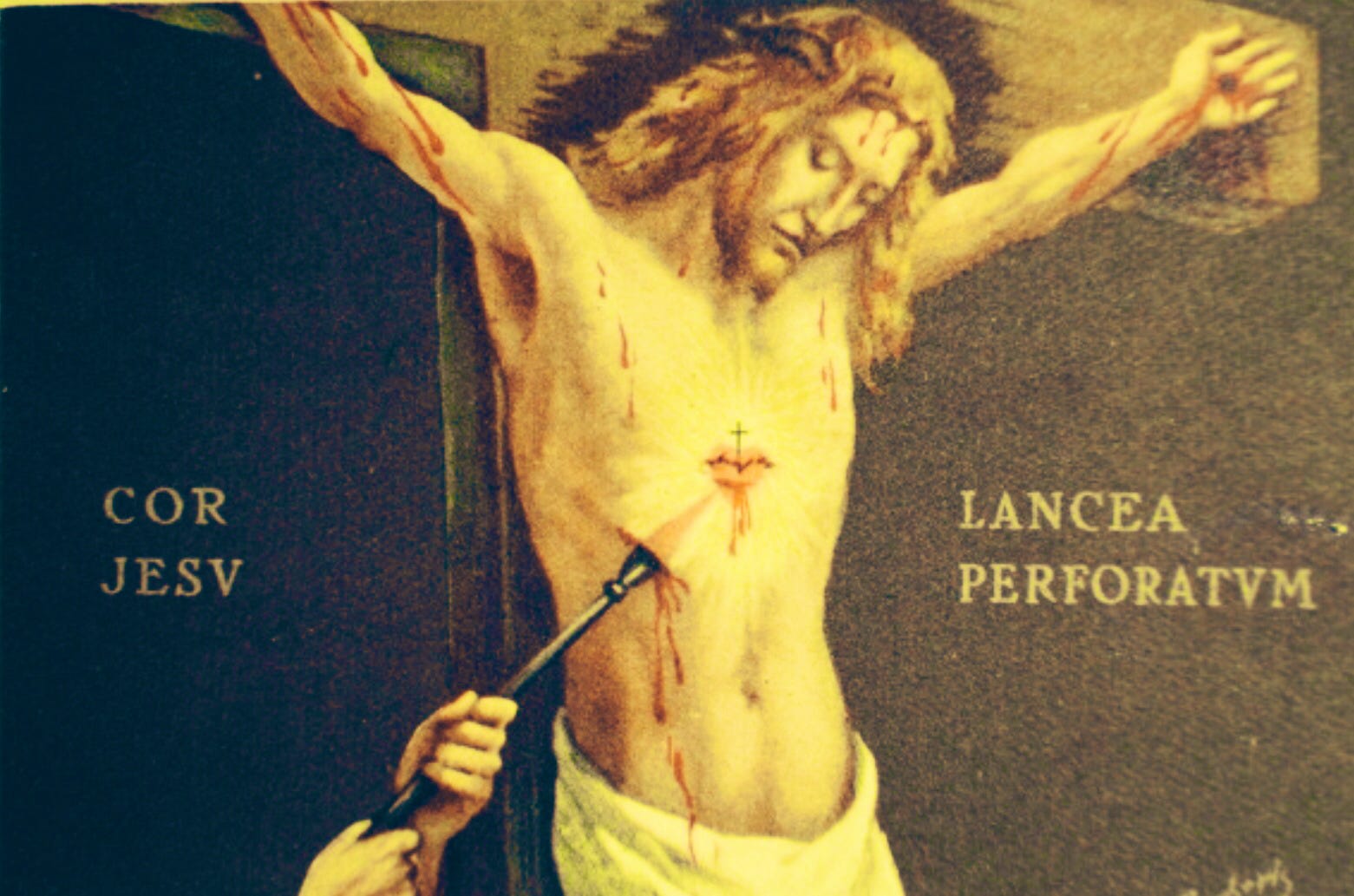
Instead of breaking His legs, the Roman soldiers pierced His side so that the Prophet Zechariah would be fulfilled, they look on Him whom they have pierced. The lance is thrust into the Sacred Heart of Our Lord, and the Evangelist says that blood and water poured forth. St. Thomas comments on this:
“This happened to show that by the passion of Christ we acquire a complete cleansing from the sins and stains. We are cleansed from our sins by His blood, which is the price of our redemption…And we are cleansed from our stains by the water, which is the bath of our rebirth…And so it is these two things which are especially associated with two sacraments: water with the sacrament of baptism, and blood with the Eucharist…”23
With the piercing, Our Lord poured out the final drops of blood so that He has given everything for love of mankind. Even in the piercing, He is still fulfilling all of the prophecies as well as pointing to the necessity of Baptism and the Holy Eucharist. It is here, at the foot of the cross, that the devout soul can be washed clean in the baptism of regeneration and consume the Lamb in the Most Holy Eucharist.
Buried in a rich man’s grave— Isaiah 53:9
“After this, Joseph of Arimathea, who was a disciple of Jesus, but secretly, for fear of the Jews, asked Pilate that he might take away the body of Jesus, and Pilate gave him leave. So he came and took away his body. Nicodemus also, who had at first come to him by night, came bringing a mixture of myrrh and aloes, about a hundred pounds’ weight. They took the body of Jesus, and bound it in linen cloths with the spices, as is the burial custom of the Jews. Now in the place where he was crucified, there was a garden, and in the garden a new tomb where no one had ever been laid. So, because of the Jewish day of Preparation, as the tomb was close at hand, they laid Jesus there.” John 19:38-42
“And they made his grave with the wicked and with a rich man in his death, although he had done no violence, and there was no deceit in his mouth.” Isaiah 53:9
Finally, we come to the burial of Our Lord. St. Joseph of Arimathea does Our Lord a great kindness. Normally, the Romans would either leave the bodies of the crucified on the crosses as a public deterrence or bury them in a mass grave. The Jews certainly did not want the bodies on the crosses over the holy days, but they were not interested in giving Our Lord a proper burial as the Law commands, “And if a man has committed a crime punishable by death and he is put to death, and you hang him on a tree, his body shall not remain all night upon the tree, but you shall bury him the same day, for a hanged man is accursed by God…”24 Not only was He a blasphemer in their eyes, but He was also accursed since He was crucified. This sheds light on why Joseph’s action of begging for the body of the Lord is such an act of reverence.
The Prophet Isaiah foretells two aspects of Our Lord’s death, the first we already covered, in the prophecy of Christ being crucified with the wicked; the second, here, we find that the Prophet foretold that He would be buried in a rich man’s grave. John’s Gospel, quoted above, tells us that the tomb in which Our Lord was laid was a new tomb. St. Matthew records that Joseph took the body of the Lord “and laid it in his own new tomb.”25 Not only did Joseph do a great reverence to Our Lord in this work of mercy, but he also gave Him the tomb that was set aside for himself. This is a great act of love that this wealthy man, a member of the Sanhedrin, would lay the crucified Lord in his own tomb.
Conclusion
In His goodness and providence, God ordained all of the events of Holy Week, and the entire life of Christ, to unfold exactly how they did. Every step He took through the Passion was ordered and permitted by God for the redemption of mankind, as it was foretold in the Scriptures. Every time we open the Scriptures and see prophecy after prophecy fulfilled in their perfection by Jesus Christ, we come to understand two most important truths:
Jesus of Nazareth is the Christ who was foretold in the Old Testament.
Jesus of Nazareth is the Christ, the Divine Son of the Living God.
Both of these truths are necessary for the Catholic to fully embrace.
I want to return to what was quoted from the Angelic Doctor at the beginning:
“...things were written in the Old Testament because they would be fulfilled by Christ. If we say that Christ acted because the Scriptures foretold it, it would follow that the New Testament existed for the sake of the Old Testament and for its fulfillment, although the opposite is true.”26
The continuity and perfection of Scripture point to the providential plan of God. Our Lord fulfilled the Scriptures not because He was checking a box, but because they spoke of Him who was to come, since He is the author Himself.
For more from Dr. McGovern, visit his Substack at A Thomist, Dedicated to the Theological tradition of St. Thomas Aquinas. Exploring Thomas’ Spiritual Theology and topics in Christology and Mariology.
Hugh of St. Victor, De arca Noe morali, 2.8
All scripture passages, unless otherwise noted, are taken from the Revised Standard Version, Second Catholic Edition.
St. Thomas Aquinas, Commentary on the Gospel According to St. John, C. 19, L.5, 2447.
Cf. Matthew 27:38.
St. Thomas Aquinas, Commentary on the Book of the Prophet Isaiah, Ch. 53, 975.
Luke 23:43.
Cf. Commentary on St. John, C. 19, L. 4, 2419.
Ibid. 2420.
What I mean by this is that, much like Caiaphas (cf. John 11:50), there are times when God gives the charism of prophecy to some in order to participate in a prophetic moment, even if they do not know it themselves. This is tied to the reality that the Charisms of the Spirit are extraordinary mystical phenomena and are what the spiritual theologians call gratia gratis data. They are given as the Spirit wills and not in accord with someone’s sanctity. For more on this, see Reginald Garrigou-Lagrange, Three Ages of the Interior Life, Vol. II, pt. V.
Cf. John 12:12-19.
Cf. Philippians 2:9.
St. Thomas comments that this was done to those whom “they despised.” Commentary on John, 2426.
Ibid., 2429.
Cf. Leviticus 16:4.
Cf. Psalm 22:22-31.
Cf. John 2:1-12.
John 2:5.
Cf. Luke 23:33.
Commentary on John, C. 19, L. 5, 2447.
Ibid. 2450.
Ibid. 2448.
Cf. John 1:29.
Commentary on John, 2458.
Deuteronomy 21:23.
Matthew 27:60.
Commentary on John, C. 19, L.5, 2447.
"Listen and listen, but never understand! Look and look, but never perceive! Make this people's heart coarse, make their ears dull, shut their eyes tight, or they will use their eyes to see, use their ears to hear, use their heart to understand, and change their ways and be healed.”
(Isaiah 6:9-10)
“This people's heart has grown coarse, their ears dulled, they have shut their eyes tight to avoid using their eyes to see, their ears to hear, their heart to understand, changing their ways and being healed by me.”
(Matthew 13:15)
I pray you, Jonathan and all associated with Misseo Dei have a blessed Holy Saturday and a joyful Easter.
Peace, in Christ
Anthony
Fabulous reflection Andrew, thank you