

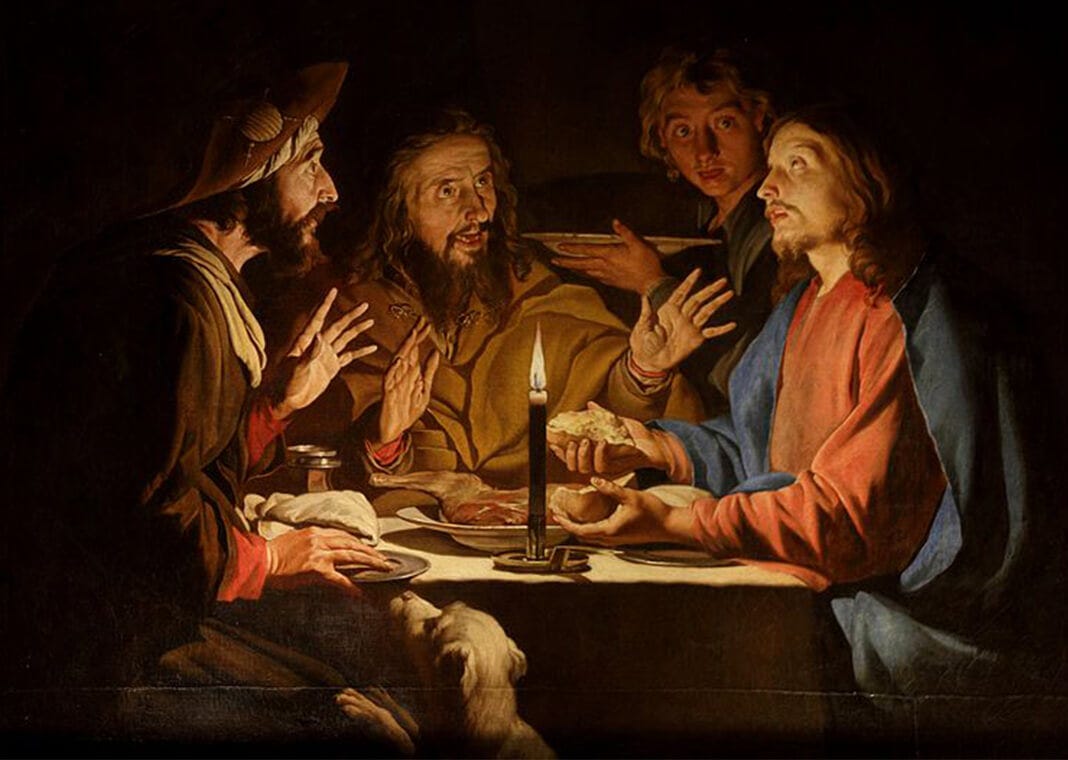
“And He said to them, ‘O foolish men, and slow of heart to believe all that the prophets have spoken! Was it not necessary that the Christ should suffer these things and enter into His glory?’ And beginning with Moses and the all the prophets, He interpreted to them in all the Scriptures the things concerning Himself.’” Luke 24:25-27.
That very day, that is, Easter Sunday, we find two disciples of Jesus leaving Jerusalem and walking to Emmaus. The only one named is Cleopas, who tradition has told us is the brother of St. Joseph. St. Luke tells us that their eyes were kept from recognizing Him, and while they walked, the Lord opened up the scriptures to them. He goes back to Moses and all of the prophets, going through salvation history and interpreting all the things concerning Himself.
This connection between the prophecies of the Old Testament and the events of Holy Week, specifically, but on a larger scale, the entire life of Christ, is imperative in showing that what has just occurred was necessary. On that connection, St. Thomas writes in his Commentary on John’s Gospel:
“...things were written in the Old Testament because they would be fulfilled by Christ. If we say that Christ acted because the Scriptures foretold it, it would follow that the New Testament existed for the sake of the Old Testament and for its fulfillment, although the opposite is true.”1
All that Our Lord did, especially during His passion, was foretold by the Old Testament, not because Christ was acting to fit into some preconceived mold, but because these events were already providentially ordered by God and so were foretold by Moses and the prophets to prepare the way of the Lord. This is an important distinction. Cleopas and the other disciple learn this distinction on the way to Emmaus. Christ came to suffer and conquer sin, not set up an earthly throne on the rubble of the Roman Empire. Christ rules from the throne of the cross, and the empty tomb is His victory.
Even after Our Lord reveals to them the providence of Salvation History, they are still in the dark. It takes one more revelation for them to see.
“When He was at table with them, He took the bread and blessed and broke it, and gave it to them. And their eyes were opened and they recognized Him…” Luke 24:30-31.
It is in this progression of take…blessed…broke…gave in which the revelation of just Who this is in front of them is made clear. It is in the Eucharistic ritual that St. Luke says that their eyes were opened.
This phrase should not be lost on us. We ought to remember that it occurs in the very beginning when Adam and Eve take the forbidden fruit from the tree: “Then the eyes of both were opened, and they knew that they were naked; and they sewed fig leaves together and made themselves aprons.”2 Here, we have two sides of the human condition:
In the first place, Adam and Eve took the fruit of the tree of Knowledge of Good and Evil, and their eyes were opened to sin and shame.
Here in the second place, these two disciples are given the fruit of the tree of redemption, that is, the Eucharist from the tree of the Cross, and their eyes are open to the Lord.
It is a type of recapitulation. Christ brings back the intended order. We no longer eat of the forbidden tree in an attempt to see God on our terms. We are now given the fruit of the Salvific Tree so that we can be united to Christ and see God by Him who is contained in the Blessed Eucharist.
This Easter, let our eyes be opened to the new life won for us in the cross and the resurrection of Christ. Let us frequently go to the tree of the cross for the fruit which endures unto eternal life.3
For more from Dr. McGovern, visit his Substack at A Thomist, Dedicated to the Theological tradition of St. Thomas Aquinas. Exploring Thomas’ Spiritual Theology and topics in Christology and Mariology.
St. Thomas Aquinas, Commentary on the Gospel According to St. John, C. 19, L.5, 2447.
Genesis 3:7. I am indebted to Dr. Scott Hahn for this connection.
Cf. John 6:27.
Amen. Hallelujah!
incredibly beautiful.