

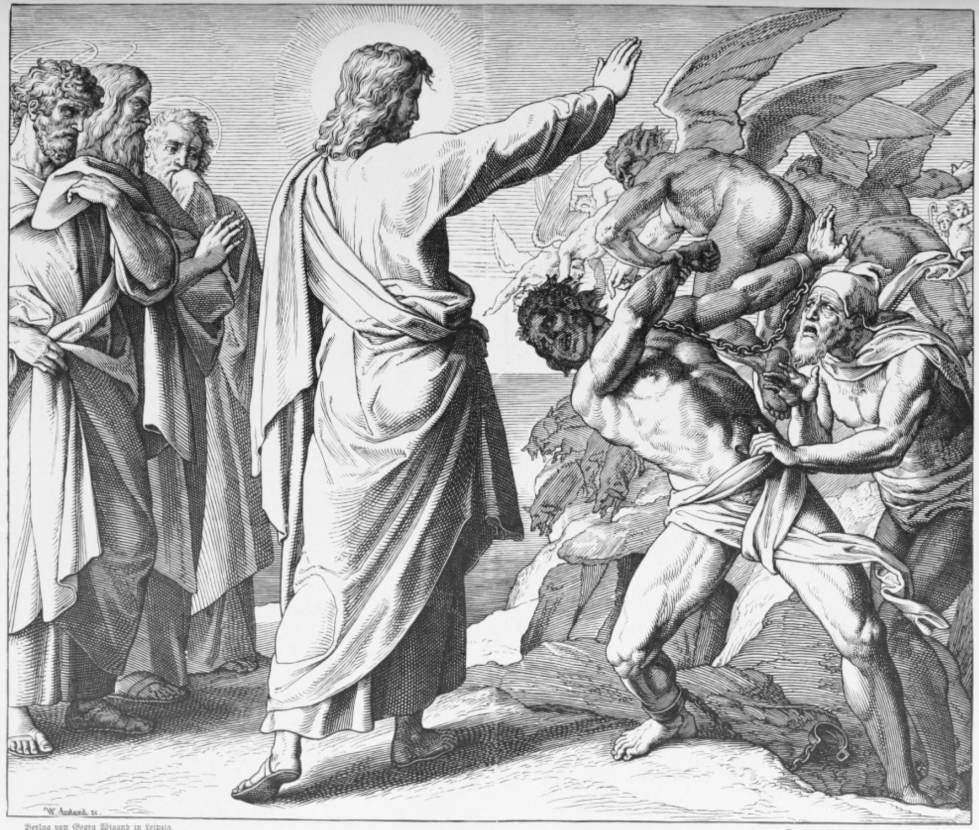
Today’s Gospel records different miracles that are performed by Our Lord in Capernaum, in particular, on and around the sabbath day. I previously wrote on Christ being an example of prayer in this passage here. Today, I want to concentrate on a small but important part of this Gospel:
“He cured many who were sick with various diseases, and he drove out many demons, not permitting them to speak because they knew him.” Mark 1:34
Our Lord exercises His authority to cast out demons from those who are possessed. And, just like in the Gospel from yesterday, He does not permit the demons to speak and to reveal who He is.
This is a curious command by Our Lord. One would think that He would want the demons to affirm that He is the Holy One of God.1 Some might think that would be a very convincing way to prove His Divine Identity. But this is not the way that Our Lord seeks to reveal Himself.
Instead, He chooses to reveal His identity slowly over time through the signs that He works, and the message that He brings. This is a main theme in the Gospel of Mark.2 Jesus is motivated to keep His identity a secret for a time. There are a couple of reasons why this could be. I find the most convincing to be these two:
He did not want to contribute to a sensationalist and erroneous idea of who He is.
In first-century Judea, it was a common belief among the people that the awaited Messiah would be a military leader, one who would come and liberate the people from political oppression. At the time of Christ, this would take the form of freeing them from the rule of the Roman Empire. This would have led to a too-human understanding of Our Lord. The Catechism speaks to this:
“Many Jews and even certain Gentiles who shared their hope recognized in Jesus the fundamental attributes of the messianic ‘Son of David,’ promised by God to Israel. Jesus accepted his rightful title of Messiah, though with some reserve, because it was understood by some of his contemporaries in too human a sense, as essentially political.”3
Jesus did not come to be a political revolutionary. He came as the redeemer of the human race. The Messianic Secret lends itself to make sure that Our Lord is not confused with the multitude of other claimants to the Messianic title. They were not divine. They could not perform the miracles that Our Lord does. He is the true Messiah.
He did not intend to stir the wrath of His enemies until the appointed time.
I think this is an even more important reason for not allowing the demons to reveal His true identity. Our Lord was sent for an appointed amount of time, and it was in the providential plan of God that at the end of that time, He would go to His death. But, until that time, He was to minister to the people and plant the seeds of the Faith. Thus, the revelation of His Divine Identity is seen only in miracles and spoken of only with the Apostles or select individuals who are told not to reveal these things.
It is not until the events of Holy Week, with a few exceptions,4 that Our Lord outright reveals Himself as the Divine Messiah for all to hear, especially the chief priests and scribes. It is then that we see their hatred for Him, and they finally resolve to put Him to death.
Our Lord is intentional about who He is. There is a sublime order and wisdom to the gradual revelation of who He is. That order and wisdom reaches its climax during Holy Week, where we see multiple instances of Our Lord allowing His divine identity to be revealed by the people, and then, by Himself. Until that time, however, the secret is only revealed through the signs and wonders that He performs.
For more from Dr. McGovern, visit his Substack at A Thomist, Dedicated to the Theological tradition of St. Thomas Aquinas. Exploring Thomas’ Spiritual Theology and topics in Christology and Mariology.
Cf. Mark 1:24.
See Mark 1:25, 34; 3:12; 5:43; 7:36; 8:30; and 9:9.
CCC 439.
For example, the exchange between Jesus and the Pharisees in John 8 is one of the exceptions. Our Lord’s use of the Holy Name: I AM in the presence of the Pharisees leads them to want to stone Him. These occasions with the Pharisees are few and far between, however. They are certainly the exception and not the norm. Cf. John 8:39-59.
One thing I’ll note about the Messianic secret is that it’s an absolute mark of Christ’s legitimacy within temple Judaism.
Both Saul & David were anointed in secret by Samuel.