

For God so loved the world that he gave his only-begotten Son, that whoever believes in him should not perish but have eternal life. For God sent the Son into the world, not to condemn the world, but that the world might be saved through him. He who believes in him is not condemned; he who does not believe is condemned already, because he has not believed in the name of the only-begotten Son of God. And this is the judgment, that the light has come into the world, and men loved darkness rather than light, because their deeds were evil. For every one who does evil hates the light, and does not come to the light, lest his deeds should be exposed. But he who does what is true comes to the light, that it may be clearly seen that his deeds have been wrought in God. John 3:16–21.
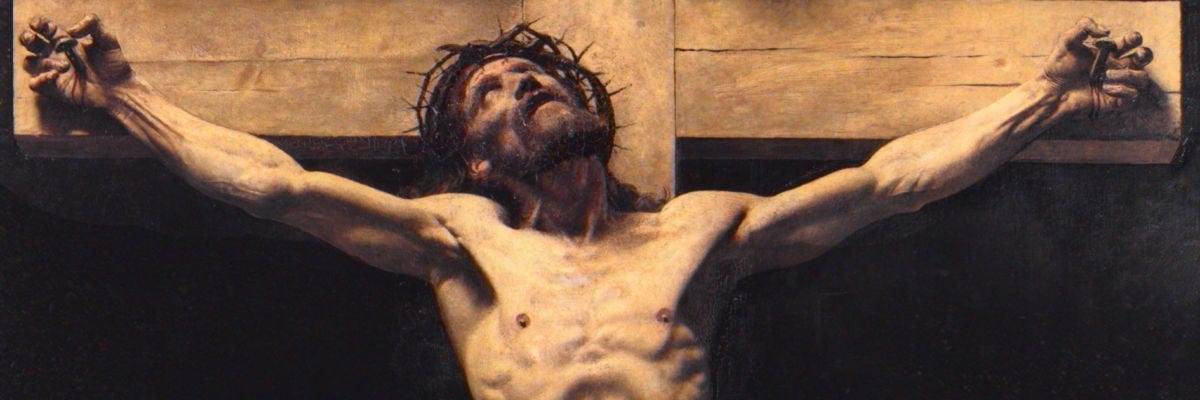
Today’s Gospel is probably the most recognizable in all of Scripture. For today, I want to concentrate on the sacrifice which Christ has made, this giving of His only-begotten Son. This giving of the Son is the most perfect demonstration of how God so loved the world.
St. Thomas writes very beautifully on the love with which Christ lays down His life:
He properly atones for an offense who offers something which the offended one loves equally, or even more than he detested the offense. But by suffering out of love and obedience, Christ gave more to God than was required to compensate for the offense of the whole human race. First of all, because of the exceeding charity from which He suffered…1
St. Thomas teaches that the atonement is a result of the offended (God) being offered something that He loves more (Christ) than He hated the offense (Man’s sin). The reason for this is two-fold: God loves Christ more than anything else in existence, and the sacrifice of Christ was offered in perfect charity and obedience, so it has a surpassing merit. Thus, St. Thomas teaches that Our Lord gives more to God than was required to atone. If we frame this in the style of a debt, which St. Thomas frequently does, Christ paid more than what was owed in the debt.
This is the great love of God. Not just in the offering by the Father but in the laying down of the Son’s life.
St. Thomas brings out this immense love in his commentary on this passage:
So he shows us here, from four standpoints, that this love of God is the greatest. First, from the person of the one loving, because it is God who loves, and immeasurably. So he says, for God so loved; he has loved the people; all the holy ones are in his hand (Deut 33:3). Second, from the condition of the one who is loved, because it is man, a bodily creature of the world, i.e., existing in sin: God shows his love for us, because while we were still his enemies, we were reconciled to God by the death of his Son (Rom 5:8). Thus he says, the world. Third, from the greatness of his gifts, for love is shown by a gift; as Gregory says: the proof of love is given by action. But God has given us the greatest of gifts, his only begotten Son, and so he says, that he gave his only begotten Son. God did not spare his own Son, but delivered him up for all of us (Rom 8:32)...Fourth, from the greatness of its fruit, because through him we have eternal life. Hence, he says, so that whoever believes in him should not perish but have eternal life, which he obtained for us through the death of the cross.2
Here, he gives us a simple formulation in four points:
God loves man immeasurably
He loves us even though we have infinitely offended Him with sin
He loves so much that He gives us the greatest gift He can, the life of the Son.
The result of that gift is eternal life.
We always want to remember: God did not have to do this. He was under no requirement to shower us with this great mercy. But He chose to do this out of His immeasurable love for man.
God so loved the world.
For more from Dr. McGovern, visit his Substack at A Thomist, Dedicated to the Theological tradition of St. Thomas Aquinas. Exploring Thomas’ Spiritual Theology and topics in Christology and Mariology.
Summa Theologiae IIIa q. 48, a. 2.
St. Thomas Aquinas, Commentary on the Gospel According to St. John, C. 3, L. 3, 477.
Beautiful! Deeply touched my heart!!!