
The Lambs of the Lamb of God
Gospel Reflection for January 18, 2026 - John 1:29-34

The next day, John saw Jesus coming to him, and he saith: Behold the Lamb of God, behold him who taketh away the sin of the world.
This is he, of whom I said: After me there cometh a man, who is preferred before me: because he was before me.
And I knew him not, but that he may be made manifest in Israel, therefore am I come baptizing with water.
And John gave testimony, saying: I saw the Spirit coming down, as a dove from heaven, and he remained upon him.
And I knew him not; but he who sent me to baptize with water, said to me: He upon whom thou shalt see the Spirit descending, and remaining upon him, he it is that baptizeth with the Holy Ghost.
And I saw, and I gave testimony, that this is the Son of God. (John 1:29-34 DRA)
The Gospel reading for today highlights an image which the great theologian of the early Church, Origen, explains in this way:
As there was a connexion between the other sacrifices of the law, and the daily sacrifice of the lamb, in the same way the sacrifice of this Lamb has its reflexion in the pouring out of the blood of the Martyrs, by whose patience, confession, and zeal for goodness, the machinations of the ungodly are frustrated. (Catena Aurea)
St. John the Baptist can be considered the first Christian martyr (perhaps second after the Holy Innocents), being murdered by Herod the Tetrarch for criticizing his relationship with Herodias, his brother’s wife, and her daughter, who thus requested that he be beheaded. (Mt 14:1-11) Verse 32 in today’s passage tells us that St. John gave “testimony” or “witness,” which in Greek is ἐμαρτύρησεν – martyrdom. The original sense of martyrdom is to give witness to Christ and to suffer persecution for Him, to pour out one’s blood willingly for love of Christ. This St. John would do soon after Christ’s Baptism, which we celebrated last Sunday.
As Origen points out, Christ is called the Lamb of God precisely because, uniquely among the animals sacrificed in the Temple, the lamb was offered daily. It was also the animal chosen for the offering on the Day of Atonement, when the sins of the people would be written down and tied to it and it would be sent into the desert as a scapegoat, and on Passover, when it would be crucified and drained of its blood before being consumed. Likewise, Christ took our sins upon Himself, carrying our guilt which, being Himself spotless, He did not deserve, in order to make up for our iniquity by His act of infinite charity on the Cross. He thus became the true Lamb of God, that which was symbolized and prefigured by the lambs of the Temple but now able to atone for sin.
St. John, in his martyrdom, became the first to participate in Christ’s sacrifice of divine love, to become a lamb in service to the Lamb, and by his great holiness, “the machinations of the ungodly are frustrated.” This is the wonderful mystery we observe in the heroic virtue of the martyrs throughout history, those who, against all worldly reasoning and pragmatism, freely offered themselves for love of Christ and their neighbor. By doing so, contrary to earthly appearances of defeat, they merited the crown of eternal life among the saints, just as Christ appeared defeated on the Cross only to rise again to newness of life three days later.
One need only recall the beautiful hagiographies of the martyrs to see that the words of Tertullian are true: “the blood of the martyrs is the seed of the Church.” This is why from the earliest centuries the Church has housed relics of the saints, especially martyrs, in altars, following the words of Scripture: “And when he had opened the fifth seal, I saw under the altar the souls of them that were slain for the word of God, and for the testimony which they held.” (Apoc 6:9)
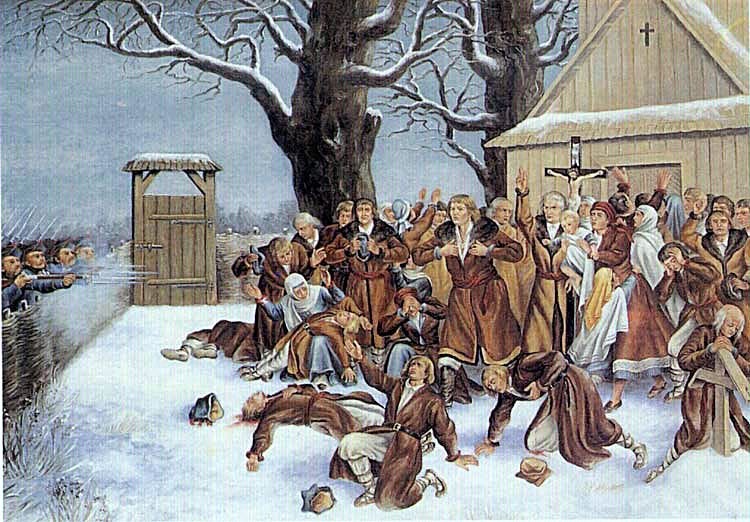
From St. Stephen the Protomartyr to the apostles, all of whom suffered martyrdom (including St. John, whom God miraculously preserved from his martyrdom in boiling oil), to such famous martyrs as St. Cyprian, St. Thomas Becket and St. Margaret Clitherow, to lesser-known martyrs like the Martyrs of Pratulin who were Ukrainian Greek Catholics killed by soldiers of the Russian Imperial Army during the forced conversion of the Chelm eparchy in the late nineteenth century, all the way to our own time, with such heroes as St. Maximilian Kolbe, St. Maria Goretti and the Ulma family. All of these great saints are now lambs in the sheepfold of Christ, the Lamb of God, their fleece made white as snow in His blood.
Today, though it is rarely publicized in the West, Christians continue to be martyred, most especially by Muslims throughout the world in their endless jihad against the true Faith, as well as by communist regimes like China and North Korea. More quietly, but no less egregiously, the West also makes new martyrs, whether by physical death, such as a Polish man known only as R.S., who suffered brain damage after cardiac arrest and for whose life his devoutly Catholic mother and sisters pleaded, with Poland and the Catholic Church offering to transfer him to their hospitals, but whom England, with the support of his wife, removed from life support and allowed to die in 2021 – or as a confessor, including those who are abused, threatened, attacked and imprisoned while working to end the genocide of abortion. These are the witnesses of our times, the heirs of St. John the Baptist who spoke up against the sins that offended Christ in his own time and who like him share in the sufferings of the Lamb of God.
Today and every day, may we pray fervently for those undergoing such persecution for Christ in the world, often at a level of brutality we can only imagine (especially those subject to the evils of Islam in Africa and the Middle East), not only for their rescue but even more for their perseverance and that we may be inspired by their example to live out our own witness to Christ in our daily lives, enduring whatever persecutions come our way in thankfulness to God for the opportunity to share in the Passion of the Lamb. By doing so, we will not only make penance for our sins and gain merit through our lives of charity, but we will also inspire others to repent and come to Christ by our example.
St. John the Baptist and all the holy martyrs, ora pro nobis!
Join the Fellowship at Saint Tolkien!