

And after they were departed, behold an angel of the Lord appeared in sleep to Joseph, saying: Arise, and take the child and his mother, and fly into Egypt: and be there until I shall tell thee. For it will come to pass that Herod will seek the child to destroy him.
Who arose, and took the child and his mother by night, and retired into Egypt: and he was there until the death of Herod:
That it might be fulfilled which the Lord spoke by the prophet, saying: Out of Egypt have I called my son.
But when Herod was dead, behold an angel of the Lord appeared in sleep to Joseph in Egypt,
Saying: Arise, and take the child and his mother, and go into the land of Israel. For they are dead that sought the life of the child.
Who arose, and took the child and his mother, and came into the land of Israel.
But hearing that Archelaus reigned in Judea in the room of Herod his father, he was afraid to go thither: and being warned in sleep retired into the quarters of Galilee.
And coming he dwelt in a city called Nazareth: that it might be fulfilled which was said by prophets: That he shall be called a Nazarene. (Matthew 2:13-15, 19-23 DRA)
The Feast of the Holy Family which we celebrate on this first Sunday of Christmas is a beautiful way to emphasize the wonder and joy of this holy season, whose central mystery is the providential plan of God to be born as a human child to human parents in an otherwise ordinary human family. He could have chosen an infinity of other options to fulfill His plan, but instead, He intended from all eternity to bring salvation to mankind through the family. For this reason, the Church has always recognized the family as the bedrock of society, the source of every vocation and the clearest sign on Earth of Christ’s union with His Church.
Depending on the arbitration of your priest or deacon, you may or may not have heard the full reading from St. Paul’s epistle, the shortened version of which excludes those dreaded words in which he details the natural hierarchical order of the family, counseling women to submit to their husbands, husbands to love and serve their wives and children to obey their parents. This wisdom, which was in many ways simply common sense for most of human history, is wholly antithetical to our modern feminist culture, to our new psychology of childrearing founded on the method of Dr. Spock (not the Vulcan) which replaces discipline with permissiveness and anarchy, and to our distorted understanding of authentic masculinity which today is often viewed either as ‘toxic’ or as a synonym for childishness and juvenility.
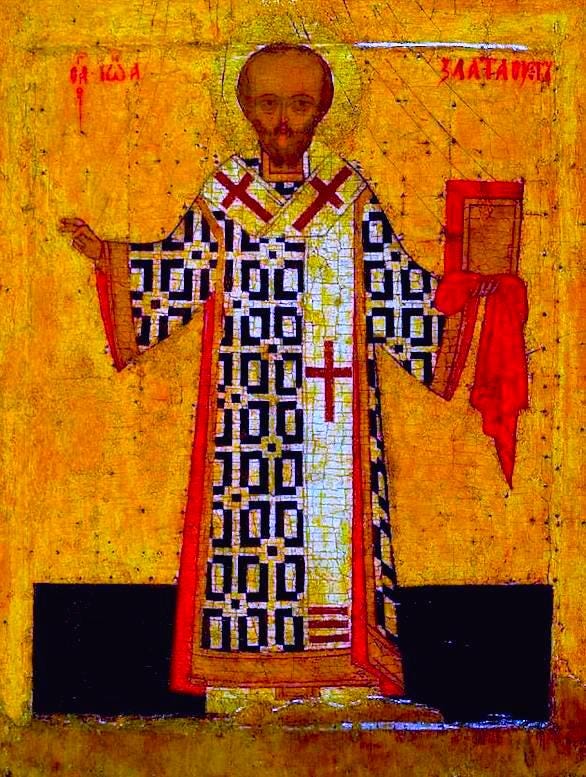
In his many homilies on this subject, which was already controversial even in his time, St. John Chrysostom clarified much of the confusion that St. Paul’s words often cause. Chrysostom grounds all of his instruction in this one statement: “The love of husband and wife is the force that welds society together.” His goal is not to denigrate marriage, sex, family life or children but to show how they should be lived as a Christian. He thus continues,
Men will take up arms and even sacrifice their lives for the sake of this love. St Paul would not speak so earnestly about this subject without serious reason; why else would he say, “Wives, be subject to your husbands, as to the Lord”? Because when harmony prevails, the children are raised well, the household is kept in order, and neighbors, friends and relatives praise the result. Great benefits, both for families and states, are thus produced. When it is otherwise, however, everything is thrown into confusion and turned upside-down.
But what exactly does this submission, subjection or subordination of the wife to the husband involve? Is it the caricature of a 1950s slave, of a housewife chained to the kitchen which we have been force-fed by feminists for decades? Not for Chrysostom, who envisions it quite differently:
Let us assume, then, that the husband is to occupy the place of the head, and the wife that of the body, and listen to what “headship” means: “For the husband is the head of the wife as Christ is the head of the Church, His Body, and is Himself its Savior. As the Church is subject to Christ, so let wives also be subject in everything to their husbands.” Notice that after saying “the husband is the head of the wife as Christ is the head of the Church,” he immediately says that the Church is His Body, and He is Himself its Savior. It is the head that upholds the wellbeing of the body... You have seen the amount of obedience necessary; now hear about the amount of love necessary. Do you want your wife to be obedient to you, as the Church is to Christ? Then be responsible for the same providential care of her, as Christ is for the Church. And even if it becomes necessary for you to give your life for her, yes, and even to endure and undergo suffering of any kind, do not refuse. Even though you undergo all this, you will never have done anything equal to what Christ has done. You are sacrificing yourself for someone to whom you are already joined, but He offered Himself up for one who turned her back on Him and hated Him.
One can see, even from this brief excerpt, how Chrysostom’s vision of family hierarchy differs from that of the world and feminism. The order of marriage is one of mutual submission: the husband under the mission of his wife, to serve her through self-sacrifice, providence and defense in love; and the wife under the mission of her husband, to support him, care for their children and offer herself in love for them. This is very far from the image of domination and dehumanization upheld for us today by the feminist malignment of Christian families. Chrysostom thus writes,
A servant can be taught submission through fear; but even he, if provoked too much, will soon seek his escape. But one’s partner for life, the mother of one’s children, the source of one’s every joy, should never be fettered with fear and threats, but with love and patience. What kind of marriage can there be when the wife is afraid of her husband? What sort of satisfaction could a husband himself have, if he lives with his wife as if she were a slave, and not with a woman by her own free will suffer anything for her sake, but never disgrace her, for Christ never did this with the Church.
Imagine if someone today gave the counsel Chrysostom gives to men looking for a wife – not only what he has said above, but also in these words:
Look for affection, gentleness, and humility in a wife; these are the tokens of beauty. But let us not seek lovely physical features, nor reproach her for lacking things over which she has no control. No; let us not reproach her for anything, or be impatient and sullen. Haven’t you seen how many men, living with beautiful wives, have ended their lives in misery, and how many who have lived with those of no great beauty, have lived to extreme old age with great enjoyment? Let us wipe off the “spot” and smooth the “wrinkle” that is within, as it is written; let us do away with the blemishes that are on the soul. Such is the beauty God requires. Let us make her fair in God’s sight, not in our own. Let us not seek wealth, nor high social position (these are external things), but true nobility of soul. Let no one marry a woman for her money such wealth is base and disgraceful. No, by no means let any one aspire to get rich from his wife.
Who today, in our culture which either idolizes artificial beauty and financial independence in a woman, or tries to pass off ugliness of body and soul as something beautiful, would give this kind of advice, by which men are told to look for a woman who is good and virtuous, to value her as a person rather than an object of lust or a source of wealth? This is the vision of marriage and family life taught by St. Paul, explained by St. John Chrysostom and exemplified by the Holy Family, and it should inspire every Christian, whether single, married or celibate, to imitate the Holy Family more zealously than ever. Our Gospel reading today shows just how perfectly the Holy Family fulfilled the truth of marriage: even though Our Lady is the Immaculate Conception, sinless throughout her life and now Queen of Heaven, the angel still came to St. Joseph, whose wife and Child followed him without question into Egypt and then back to Israel. They knew that they could trust him as a good husband and father to do what was right. But when this order is disrupted, chaos follows, as Chrysostom explains:
The wife is a second authority. She should not demand equality, for she is subject to the head; neither should the husband belittle her subjection, for she is the body. If the head despises the body, it will itself die. Rather, let the husband counterbalance her obedience with his love... Where there is equal authority, there never is peace. A household cannot be a democracy, ruled by everyone, but the authority must necessarily rest in one person. The same is true for the Church: when men are led by the Spirit of Christ, then there is peace... The wife is a secondary authority, but nevertheless she possesses authority and equality of dignity while the husband still retains the role of headship; the welfare of the household is thus maintained.
If what Chrysostom says is true, that the love of husband and wife is the force that welds society together, then what happens to society when this love becomes disordered, when the woman replaces the man, the man becomes a child and the children become unruly and burdensome? We can see the results today: broken and dysfunctional families, hatred and avoidance of children to the point of murdering them in the womb and (even among 82% of Catholics who attend Mass every Sunday) preventing new life through contraception, rampant divorce and divorce-like annulments, and the whole culture of death and waste which now surrounds us. May we rediscover St. Paul’s profound vision of marriage and the family, as understood through the patristic wisdom of St. John Chrysostom and others in Tradition, for the reclamation of the world.
Join the Fellowship at Saint Tolkien!
Thank you Kaleb
Such a great reflection about family Kaleb. Merry Christmas and have Blessed New Year.