
The Greatest Mystery of All
Gospel Reflection for May 31, 2026, the Solemnity of the Most Holy Trinity - John 3:16-18

16 For God so loved the world, as to give his only begotten Son; that whosoever believeth in him, may not perish, but may have life everlasting.
17 For God sent not his Son into the world, to judge the world, but that the world may be saved by him.
18 He that believeth in him is not judged. But he that doth not believe, is already judged: because he believeth not in the name of the only begotten Son of God.
(John 3:16-18 DRA)
Today we celebrate the Solemnity of the Most Holy Trinity, the central mystery of our Faith. This is a mystery transcending human discovery or comprehension, known by us only through revelation in Christ, and while it is possible to explain the Trinity in rational, philosophical terms, to show that the doctrine is not contrary to reason (nor is any other Catholic doctrine), it remains impossible for human reason to realize or grasp the truth of the Trinity by itself. It can only be accepted by faith on the authority of God who reveals it to us.
The two most controversial non-moral teachings of the Catholic faith are the Trinity and the Incarnation of Christ. No other doctrines have generated more confusion, heresy and opposition from Christians and non-Christians alike. For the Trinity, even many well-catechized Catholics today would find themselves at a loss if asked to explain the Trinity even in basic terms, beyond the formula ‘one God in three Persons,’ and the understanding of the Trinity by non-Catholics is often woefully inadequate or even erroneous, turning the Trinity into merely one Person expressed in three ways (the heresy of Sabellianism) or even as three separate gods united in some non-essential way, such as shared purpose or knowledge (the heresy of tritheism, held in one form by Mormons).
So-called ‘strict monotheists,’ like Jews and Muslims, object to the Trinity as a kind of veiled polytheism, caricaturing it according to the tritheist misrepresentation. Some, again, will treat the Persons of the Trinity as subordinated to one another, as though the Son is less than the Father and the Holy Ghost less than the Father and the Son, or, on the other hand, as though there is no origination in the Trinity at all, so that the Persons are ultimately indistinguishable.
The truth of the Trinity, however, as professed and explained by the Fathers and Doctors of the Church, is far more subtle, profound and, to use a colloquial term, mind-blowing. It hinges on the development of the term ‘person’ (persona in Latin, originally meaning ‘mask,’ or hypostasis in Greek, a more accurate term better rendered in Latin as subsistence, or that which ‘stands under’ or underlies superficial distinctions), which is a uniquely Christian term, defined specifically to explain the Trinity. The Trinity is the one, simple divine essence, without any division, parts or inequality, which is shared equally by three Persons, the Father, Son and Holy Ghost, all of whom ‘subsist in’ the divine essence and are indistinguishable from this essence.
The Persons of the Trinity simply are God – not gods or different ‘expressions’ of God but only one true God, the God of Abraham, Isaac and Jacob. Each Person possesses and simply is the single divine essence, sharing the same divine attributes, even though certain divine attributes can be applied in a special way to particular Persons according to the usage of Scripture, such as Power to the Father, Word to the Son and Love to the Holy Ghost. (To show the adaptability of this, the Epistle today calls the Father ‘Love,’ the Son ‘Grace,’ and the Holy Ghost ‘Fellowship,’ since each Person properly possesses all of these attributes in their shared divine nature.) This is based on the human mind, which cannot grasp the pure oneness and simplicity of the divine essence and the convertibility of all the divine attributes. For us, Power, Word and Love, like justice and mercy, are distinct things, even though in God they are all one, His simple divine essence.
In His essence, God is pure Being itself, what St. Thomas Aquinas called ipsum esse subsistens, or being itself subsisting, and all of the divine attributes we can distinguish, such as omnipotence, omniscience, omnibenevolence, etc., are only logically or virtually distinct in our minds. In God, they are only Being. This is why St. Thomas considered the greatest name of God to be the one He revealed to Moses: YHWH, the Tetragrammaton, translated in English as I AM who AM, a name Christ assigned to Himself multiple times in the Gospels (e.g. Jn 18:4-6) and which, as God, also applies to the Holy Ghost.
Don’t feel bad if this seems hard to wrestle with. It is! No one has or can ever fully comprehend it, and thankfully, God allows us to believe in it by faith and to be in communion with Him through grace even without perfectly understanding it. But rational explanations, like the brief one given above based on St. Thomas, helps to show that the doctrine of the Trinity is both rational and authentically monotheistic. We do not believe in three gods. The Son is the Word perfectly reflecting and sharing the divine nature of the Father and, analogous to the word in our mind, remains within God, while the Holy Ghost is the impression of love which, like our interior act of love, remains within God and perfectly expresses Him. Since each Person is divine, they are true Persons, unlike the words and loves in us, but analogous to our words and loves, the Persons share the same divine nature. As St. Augustine wrote in his autobiography The Confessions,
I could wish that men would consider three things which are within themselves. These three things are quite different from the Trinity, but I mention them in order that men may exercise their minds and test themselves and come to realize how different from it they are. The three things I speak of are: to be, to know, and to will. For I am, and I know, and I will. I am a knowing and a willing being; I know that I am and that I will; and I will to be and to know. In these three functions, therefore, let him who can see how integral a life is; for there is one life, one mind, one essence. Finally, the distinction does not separate the things, and yet it is a distinction.
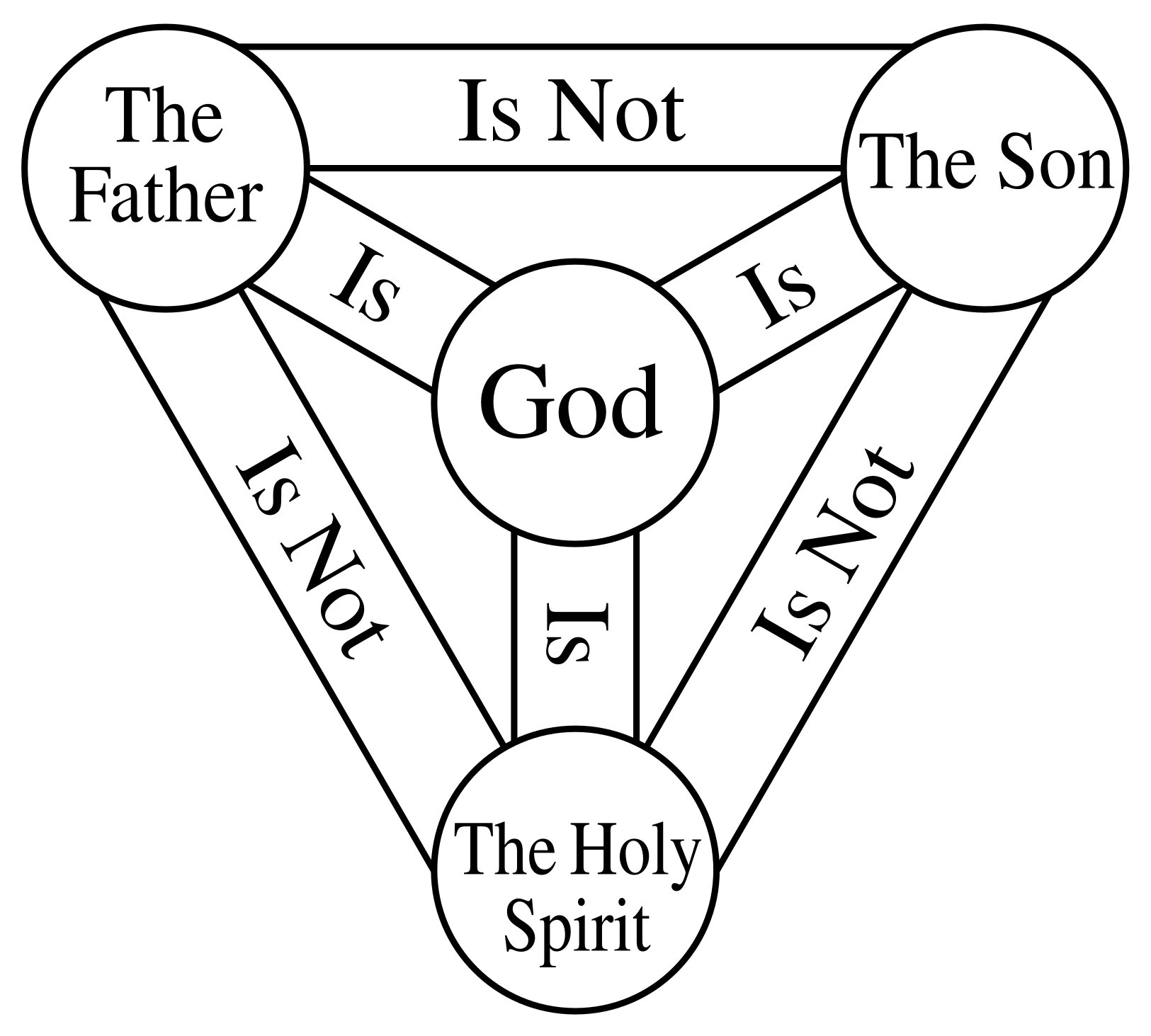
The Persons of the Trinity are not distinguished from one another in essence but only by opposed relations of origin: the Father is underived, the Son is eternally begotten of the Father as His Word, and the Holy Ghost proceeds through spiration from the Father and (or through) the Son. These processions are ‘opposed’ because they are logically contrary to one another, i.e. to be ‘unoriginated’ is logically contrary to being ‘begotten’ or ‘spirated’; this is the only way that the Persons differ from one another, but this causes no division in the one simple divine essence. (The image attached below shows this especially well.) These processions are not discrete events that happened at one point in time but eternal acts within the dynamic, living inner life of the Godhead.
The Son’s eternal procession is called ‘begotten’ not because of the Incarnation, which caused no change in God but only in Christ’s human nature, but rather because He proceeds from the Father, called ‘begetting’ because the Father, who is the underived Source of the Godhead, speaks the Word within Himself as a perfect likeness to Himself, like the son of a human father but infinitely more so. This is why St. Paul says, “For this cause I bow my knees to the Father of our Lord Jesus Christ, Of whom all paternity in heaven and earth is named” (Eph 3:14-15). Likewise, the Holy Ghost’s procession is called ‘spiration’ because He is the Breath of Life, who “moved over the waters” (Gen 1:2) at the beginning of Creation. Christ showed these two types of procession in the Gospels, calling the Father “Abba” with familial affection (Mk 14:36) and after His Resurrection, He “breathed on [the apostles]; and he said to them: Receive ye the Holy Ghost.” (Jn 20:22)
The mystery of the Most Holy Trinity should be the greatest object of contemplation for all of us, alongside the Incarnation of Christ, throughout our lives. We can never exhaust our study, prayer, meditation, and application of it in our lives. Reading the saints’ reflections on the doctrine of the Trinity reveals its infinite transcendence, its visibility throughout the natural world and in human nature, and the clarity it provides for all of reality precisely through its seemingly paradoxical nature.
Today, may we pray that the Holy Ghost, whose confirmation of our Baptism we celebrated last Sunday, will enlighten our minds and uplift our hearts to understand and to love the Trinity more perfectly, inspiring us to long more and more to see Him one day in the Beatific Vision.
Join the Fellowship at Saint Tolkien!
The best way to explain it .
Thank you.
God is wonderful in His Saints,
All Holy Trinity, have mercy on us,
MOST HOLY THEOTOKOS, save us...