
The Epiphany Miracles
Christ Revealing His Divine Identity to the Apostles

In modern-day scholarship, it is common for scholars to claim that the Christ of the Gospels is not the Christ of Faith. They desire to make a distinction between the two and go so far as to claim that any miraculous event recorded in the Gospels is a fabrication of the early Church as a response to the Resurrection. Thus, the post-resurrection Jesus is a different reality than the pre-resurrection Jesus. Among biblical scholars, this also creates a dichotomy between what is recorded as “historical” and what is recorded as “miraculous.” Specifically, this happens with the Gospels being put at odds with one another: the Synoptics vs. John. Many modern-day scholars outright reject John, seeing it as a later fabrication that seeks to make Jesus of Nazareth into God. Much of this thought process stems from the fact that John is almost universally regarded as being a much later writing than the Synoptics.1
While the dating of the Gospels is quite a bit of a subject of disagreement, the most likely dating places the Synoptics as written almost certainly before the fall of the Temple in AD 70, with the most likely range for each being the mid 50s to early 60s. As for John, the most likely dating of this Gospel is in the 90s. Due to this gap, John is seen as a text inspired by the Synoptics with added miraculous events and divine claims to sensationalize the life of Jesus. Much of modern scholarship claims that Jesus did not consider Himself to be divine and that the early church merely projected onto Him this status. Take these quotes, for example:
“If Jesus went around Galilee proclaiming himself to be a divine being sent from God— one who existed before the creation of the world who was in fact equal to God--- could anything else that he might say be so breathtaking and thunderously important? And yet none of these earlier sources [i.e., the Synoptics] says any such thing about him. Did they just decide not to mention the one thing that was most significant about Jesus? Almost certainly, the divine self claims in John are not historical.”2
“There is no evidence whatever that [Jesus] spoke or acted as if he believed himself to be ‘a God’ or ‘divine’.”3
“There is no indication that Jesus thought or spoke of himself as having pre-existed with God… We cannot claim that Jesus believed himself ot be the incarnate Son of God.”4
In reality, all four Gospels are united under one claim:
Jesus of Nazareth is God Incarnate.
I recently authored an article investigating the divine claims of Christ during Holy Week according to St. Matthew’s account. This was done from the perspective that Christ was publicly revealing His divine nature as a climax toward the crucifixion. You can find that here. Similarly, in this article, I want to explore what are referred to as the Epiphany Miracles and show how each has a distinctly divine claim behind it. These will be taken from the Synoptics to show that modern claims of a sensationalist reading of John are a rupture from the united revelation of the four canonical Gospels as a whole. Where it is helpful, John will be referenced.
The Son of Man Coming on the Clouds
Jesus of Nazareth must be understood in the context of Second Temple Judaism and their expectations for the Messiah. It is this belief that legitimizes Christ’s claim to be the Messiah as well as the records kept by the Gospel writers. While multiple strains of thought dominated the theological landscape, there was an authentic tradition that viewed the Messiah as a heavenly figure, seen as equal to God and standing next to Him on equal footing. This was an authentic interpretation of the time period. This is not merely a figure; it is an identification of the Messiah as God. This Messianic understanding is taken from a vision of the Prophet Daniel:
“I saw in the night visions, and behold, with the clouds of heaven there came one like a son of man, and he came to the Ancient of Days and was presented before him. And to him was given dominion and glory and kingdom, that all peoples, nations, and languages should serve him; his dominion is an everlasting dominion, which shall not pass away, and his kingdom one that shall not be destroyed. Daniel 7:13–14.
While this is not the exclusive interpretation of who the Messiah would be, this divine figure, on the same level as the Ancient of Days, informed much of First-Century Judaism as to who they ought to expect. I bring this up because this is the precise identity that Christ assumes for Himself, as it was expressed to the Sanhedrin at His trial. All three Synoptic Gospels record this in substance:
“But Jesus was silent. And the high priest said to him, “I adjure you by the living God, tell us if you are the Christ, the Son of God.” Jesus said to him, “You have said so. But I tell you, hereafter you will see the Son of man seated at the right hand of Power, and coming on the clouds of heaven.” Matthew 26:63-64.
“Again, the high priest asked him, “Are you the Christ, the Son of the Blessed?” And Jesus said, “I am; and you will see the Son of Man sitting at the right hand of Power, and coming with the clouds of heaven.” Mark 14:61–62.
“And then they will see the Son of Man coming in a cloud with power and great glory.” Luke 21:27.
This is a divine claim, as evidenced by the fact that the Sanhedrin no longer tries to find any evidence against him. They are satisfied that the condemnation for blasphemy can be passed—He deserves death.5 By the fact that Christ openly equates Himself with the Son of Man, seated at the right hand of Power, i.e., the Ancient of Days, the Sanhedrin take Him as claiming divinity, i.e., that He made Himself the Son of God.6
The Epiphany Miracles
The public affirmation of Christ’s Divine Identity is one thing. But are there instances before Holy Week that show the cognizant belief of Christ and those around Him that He is divine? It is here that we encounter what are called the Epiphany Miracles. The Epiphany Miracles are wonders done by Christ to reveal Himself to the Apostles; in particular, they are revelatory miracles that show that He is divine. These are not simply healings or multiplications of food; as great as those miracles are, they are essentially divine acts that point to the true identity of Jesus as the Son of Man, coming on the clouds.
I will address three of these miracles: the Stilling of the Sea, the Walking on Water, and the Transfiguration. Each of them is found in multiple Gospels, and at least two Synoptic Gospels. And each of them is characterized by three qualities:
a. A distinctly divine action being done
b. The Apostles responding with Fear/Awe
c. The question of Jesus’ Identity
With each of these miracles, I will cite Old Testament passages that clarify the divine identity being revealed. Again, the understanding of the Second-Temple Judaic mindset is key. This is the context in which these Gospels were written. If we lose that premise, we lose the substance of the Gospel narratives and the motivations behind them.
St. Thomas’ doctrine on miracles is helpful here, as he teaches that “true miracles cannot be wrought save by divine power: because God alone can change the order of nature.”7 Miracles, as such, are proofs of the working of God in a particular person, even more in Christ, who is God Incarnate.8 St. Thomas gives three reasons as to why the miracles that are performed by Christ show forth His Godhead:
First, as to the very nature of the works, which surpassed the entire capability of created power, and therefore could not be done save by Divine power… Secondly, as to the way in which He worked miracles—namely, because He worked miracles as though of His own power, and not by praying, as others do… Thirdly, from the very fact that He taught that He was God; for unless this were true, it would not be confirmed by the miracles worked by Divine power.9
The Epiphany Miracles, more than any other, are going to show forth these three reasons, as well as the aforementioned changing of the order of nature. These three miracles that will be dealt with have a distinctly divine claim attached to them, as we will see as we get into them. They are clear instances that inspire in the Apostles a reaction to the Divine.
The Stilling of the Sea
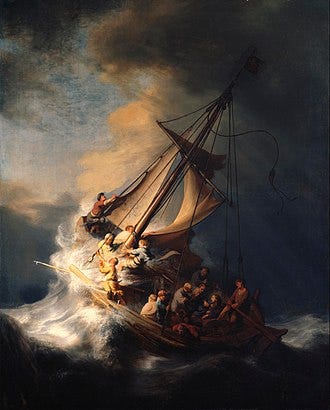
“And when he got into the boat, his disciples followed him. And behold, there arose a great storm on the sea, so that the boat was being swamped by the waves; but he was asleep. And they went and woke him, saying, “Save us, Lord; we are perishing.” And he said to them, “Why are you afraid, O men of little faith?” Then he rose and rebuked the winds and the sea; and there was a great calm. And the men marveled, saying, “What sort of man is this, that even winds and sea obey him?” Matthew 8:23–27.10
This is found in all three synoptic Gospels, and the details are very similar.
a. Jesus is asleep (human nature)
b. There is a sudden storm
c. Apostles are afraid
d. Jesus wakes and immediately calms it
e. He rebukes them for their lack of faith
f. They question His identity
The calming of the storm is a distinctly divine action, evidenced by the Old Testament as an action that only God can do:
“The pillars of heaven tremble and are astounded at his rebuke. By his power, he stilled the sea; by his understanding, he struck Rahab.” Job 26:11-12
“You set the earth on its foundations, so that it should never be shaken. You covered it with the deep as with a garment; the waters stood above the mountains. At your rebuke, they fled; at the sound of your thunder, they took to flight.” Psalm 104:5–7.
Here, Christ is showing both His human and divine natures. In the first place, Christ is asleep in the boat while the Apostles are fearing for their lives. Then, the Lord arises, rebukes the storm, and everything immediately becomes calm. This is an action that only God can do, according to the Jewish faith, as evidenced by the Scripture passages quoted above. More than that, St. Thomas speaks of the miracles in the lower creatures, “Now it belongs to the Divine Power that every creature be subject thereto… Christ also worked miracles befitting to Himself in the air and water…”11 God alone has control over the forces of nature, and so He can command their peace at a moment’s notice.
This causes the Apostles to react with Awe/Fear of the Lord and then question who this man is. This also gives evidence to the divine claim. The Synoptic record shows that the Apostles were struck with fear and marveled at this great sign. This is a reaction that presupposes the Jewish understanding of Scripture and Divine power. Again, only God can do what the Apostles just saw Jesus of Nazareth do. This causes them to question what sort of man this is. Brant Pitre speaks to this, “In Jewish Scripture, such fear is a standard human response to a theophany to figures such as Adam, Abraham, Jacob, Moses, Isaiah, and Daniel.”12 Again, we have to read the Gospels in the context of Judaism, that is to say, the men experiencing these miracles are formed through the lived Jewish experience, and so they are going to respond according to that reality. Thus, the question of Jesus’ identity is an important one because the Apostles know that no ordinary man could calm the storm through their knowledge of the Psalms; only God can. They are awed that this may be the divine messiah before them.
The Walking on Water
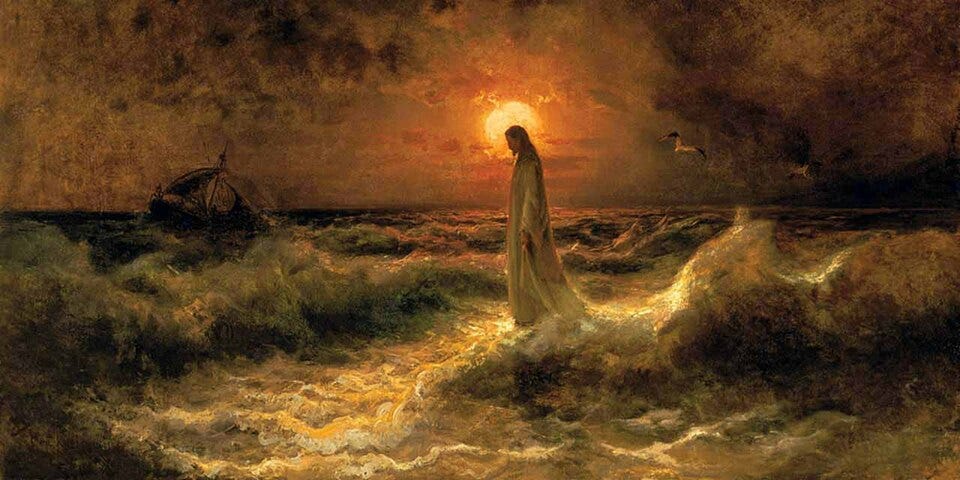
“Then he made the disciples get into the boat and go before him to the other side, while he dismissed the crowds. And after he had dismissed the crowds, he went up into the hills by himself to pray. When evening came, he was there alone, but the boat by this time was many furlongs distant from the land, beaten by the waves; for the wind was against them. And in the fourth watch of the night, he came to them, walking on the sea. But when the disciples saw him walking on the sea, they were terrified, saying, “It is a ghost!” And they cried out for fear. But immediately he spoke to them, saying, “Take heart, it is I; have no fear.” Matthew 14:22–27.13
There are two immensely important aspects to this miracle. The first is the actual walking on water, which Scripture says only God can do: “[God] alone stretched out the sky and walks on the sea as on dry ground…”14 The apostles clearly see Him walking on water, and they are afraid since it is not something a normal human can do. Both St. Matthew and St. John make mention of the great distance that the boat is out on the water, very late at night. This removes the ability for this to be merely walking on the seashore or on a sandbar, etc. The Evangelists emphasize the miraculous act of walking on the water’s surface. To add to the miraculousness of the event, St. Matthew records Peter being called out to walk on the waves as well.15 Peter, moved by his faith, steps out onto the sea and, momentarily, walks along the surface of waves until he loses that faith and begins to sink. Not only is Christ’s divine identity revealed here through this miracle, but it is also strengthened by the fact that He allows Peter to do something that transcends the laws of nature.
The second, and more important, is Christ’s revelation. He says to them:
Take heart, I AM (ego eimi): do not be afraid.
All three Gospels record the same phrase spoken by Christ. There are two parts to what He says:
1. Do not be afraid
This is Christ comforting the Apostles. The Apostles are experiencing a phenomenon that they have never seen before. They are struck with Fear of the Lord, and so the Lord reassures them of who He is, which leads to the second.
2. The self-revelation of I AM--- the name of God.
In the Greek of the Gospels, all three accounts record the same phrase: ego eimi. He says to them I AM with no predicate. Again, the Jewish context is important here. The name I AM is the name of God given to Moses at Sinai, “Then Moses said to God, ‘If I come to the sons of Israel and say to them, ‘The God of your fathers has sent me to you,’ and they ask me, ‘What is his name?’ what shall I say to them?” God said to Moses, “I am who I am.”16 This is not the only time Our Lord uses this Name. One of the more extreme uses occurs in John:
“Jesus said to them, ‘Truly, truly, I say to you, before Abraham was, I AM.’” Jn 8:58.
In the Thomistic sense, I AM is expressed in the phrase Ipsum Esse Subsistens—Being Itself. God does not have being in the sense that He does not receive His being from another, the way that created things do. Instead, He is Being Itself, uncreated, immutable, simple: Being. He alone is I AM. For Jesus Christ to take the name I AM, He is revealing a clear truth about Himself: He considers Himself to be God. And it is important to recognize that the Apostles interpreted Him to say just that, and this is seen in their response to Him. St. Matthew puts it simply and powerfully:
“And those in the boat worshiped him, saying, “Truly you are the Son of God.” Matthew 14:33.
This act of worship by the Apostles indicates their experience of both the miracle, which is one only God can do, and Christ’s taking of the Divine Name, I AM. The Apostles must have regarded the Lord as Divine, or they would not have fallen down to worship Him, as that would have been a violation of the 1st Commandment. Clearly, they viewed Him as equal to God from this experience.
The Confession of Peter and the Transfiguration
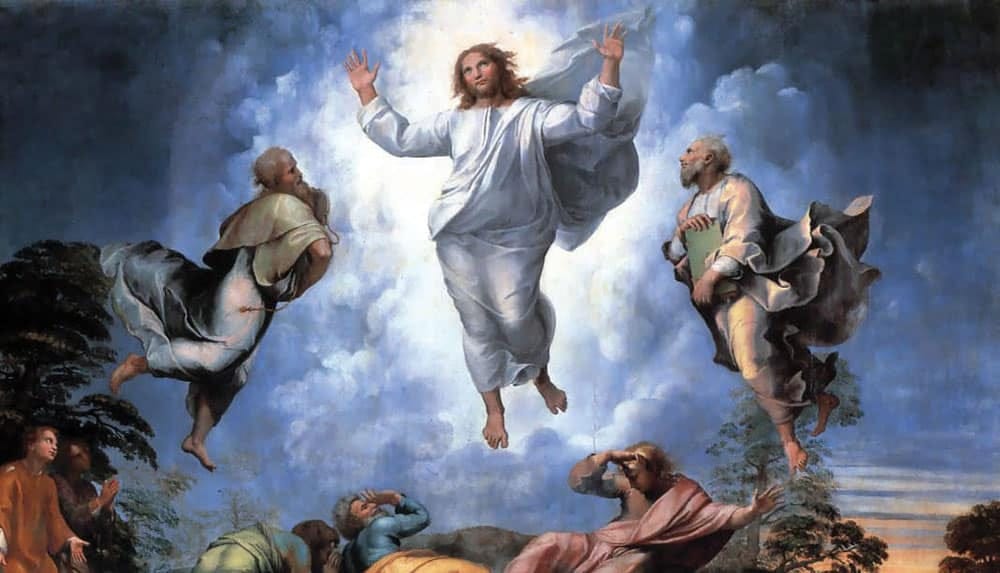
And after six days, Jesus took with him Peter and James and John his brother, and led them up a high mountain apart. And he was transfigured before them, and his face shone like the sun, and his garments became white as light. And behold, there appeared to them Moses and Elijah, talking with him. And Peter said to Jesus, “Lord, it is well that we are here; if you wish, I will make three booths here, one for you and one for Moses and one for Elijah.” He was still speaking when, behold, a bright cloud overshadowed them, and a voice from the cloud said, “This is my beloved Son, with whom I am well pleased; listen to him.” When the disciples heard this, they fell on their faces and were filled with awe. But Jesus came and touched them, saying, “Rise, and have no fear.” And when they lifted up their eyes, they saw no one but Jesus only. And as they were coming down the mountain, Jesus commanded them, “Tell no one the vision, until the Son of man is raised from the dead.” And the disciples asked him, “Then why do the scribes say that first Elijah must come?” He replied, “Elijah does come, and he is to restore all things; but I tell you that Elijah has already come, and they did not know him, but did to him whatever they pleased. So also the Son of man will suffer at their hands.” Then the disciples understood that he was speaking to them of John the Baptist. Matthew 17:1–13.17
Finally, we turn to the Transfiguration, a miracle that displays the Divine Nature of Christ in all of His glory. Again, like the previous two miracles, there is a succession of events that takes place that affirm the revelation of the Divine Nature:
Jesus takes His inner circle of three to the top of a mountain
He is transfigured before them
Peter offers to build booths or tents for Christ, Moses, and Elijah
The Apostles are struck with fear
There is a revelation of identity
The Old Testament foreshadowing is strong in this passage. Christ acts as a New Moses, taking three companions to the top of a mountain, on the seventh day, encountering God, and having their countenance transformed.18 The difference, of course, is that Moses and His companions encounter the Living God before them, while, in this case, the New Moses is the living God.
Our Lord is transfigured before the eyes of the Apostles, and the glory of the Only-Begotten Son is revealed to these men. Along with the Lord, we find Moses and Elijah standing next to Him and conversing with Him. Moses represents the Law and Elijah represents the prophets; Christ, in dialogue with them, shows that He is the perfection of both.19 In response to this great revelation, St. Peter offers to build three booths or tents for Christ and His precursors.
To understand the significance of this, we have to return to the understanding of the Jewish ethos that surrounded the Apostles. According to St. Matthew, the Transfiguration happened on the seventh day. This is a temporal checkpoint reference in the Jewish Feasts that the Transfiguration, and right before it, the Confession of St. Peter, happen in conjunction with. Six days prior to the Transfiguration, Christ asks His Apostles who they say that He is. Under the inspiration of God, St. Peter utters his confession of faith:
“Simon Peter replied, ‘You are the Christ, the Son of the Living God.’” Matthew 16:16.
It is in response to this confession that Christ gives to Peter the Keys and the Office of the Papacy.20 It is precisely the Jewish connections that shed light on all of this.
The Confession of Peter and the Transfiguration happen over two Jewish feast days: The Feast of Atonement, Yom Kippur, and the Feast of Tabernacles, Sukkoth. This is theologically significant as Pope Benedict XVI writes:
This would mean that Peter’s confession fell on the Great Day of Atonement and should be interpreted theologically against the backdrop of this feast, on which, for the one time in the year, the high priest solemnly pronounced the name YHWH in the Temple’s Holy of Holies.21
This connection cannot be overstated. At the confession of Peter, the Prince of the Apostles takes the position of High Priest and solemnly pronounces the name of Jesus of Nazareth: You are the Christ, the Son of the Living God! He is affirming a two-fold truth here. Not only is Jesus of Nazareth the long-awaited Messiah, but He is also the Son of God; that is, Peter is affirming the Divine Identity of Jesus Christ. We have to look at the entire context of this event. Our Lord does nothing by accident. The Feast of Atonement is not coincidentally and tangentially connected here. It is intentional. Our Lord asks His Twelve the essential question of His identity, and it is under divine inspiration, “For flesh and blood has not revealed this to you, but my Father who is in heaven,”22 that Peter, over and above the other eleven, answers as the High Priest.
Likewise, there is an intentionality that Our Lord, seven days later, takes His three priestly followers with Him to the Mount of the Transfiguration over the Feast of Tabernacles. It is this feast that punctuates the assertion of Peter to build three tabernacles or dwelling places, for the three wonderful figures before them. This feast is a Jewish memorial of the dwelling of God with the people during the desert wanderings, but also a future anticipation of the Messianic age. Pope Benedict writes, quoting Jean Danielou:
By experiencing the Transfiguration during the Feast of Tabernacles, Peter, in his ecstasy, was able to recognize “that the realities prefigured by the Feast were accomplished… The scene of the Transfiguration marks the fact that messianic times have come.23
The Godhead overflows in the soul of Christ, and then over to the body, transfiguring it and showing forth the glory of God in the flesh. This is a visible affirmation of the truth that Peter had confessed just a week prior. It is a revelatory confirmation of the Divine Identity of Christ situated in the midst of two Jewish Feasts which recognize the Divine Identity of YHWH. Brant Pitre speaks to this very well:
If this assessment is correct, then the Synoptic accounts of the transfiguration suggest that Jesus is not merely a human being, he is also a heavenly being—one who temporarily lifts the visible appearance of his humanity to give his disciples a glimpse of his heavenly glory.24
Conclusion
Dr. Pitre concludes his analysis of the Transfiguration by addressing the phenomenon of the dense cloud that descends along with the auditory voice of God being heard. He connects this to the apocalyptic secret of Jesus’ Divinity. I find it to be an important way to end my own article on these events. At the Transfiguration, just at Mt. Sinai, we find the same cloud and voice. Pitre writes:
For the Jewish Scripture, the way God visibly and audibly manifests himself to the Israelites during their time at Mount Sinai is by descending from heaven under the appearance of a “dense cloud” and speaking to Moses and the Israelites from the cloud.25
I agree with Dr. Pitre that this cloud both reveals and conceals the divine presence and that this theophany reveals that Jesus Christ is the heavenly Son of God.26 The transfiguration lies as a threshold experience, falling just months before the events of Holy Week. The transfiguration is a revelation of preparation for what is to come through the cross. The purpose of these Epiphany Miracles is to reveal to the Apostles alone what Christ would explicitly reveal during Holy Week to the rest of the people. This truth is continuously affirmed by all four canonical Gospels.
Jesus of Nazareth is God Incarnate.
For more from Dr. McGovern, visit his Substack at A Thomist, Dedicated to the Theological tradition of St. Thomas Aquinas. Exploring Thomas’ Spiritual Theology and topics in Christology and Mariology.
As I mentioned in my article on Matthew’s Gospel, I am indebted to the great work that Dr. Brant Pitre has done in his masterful work, Jesus and Divine Christology. While the Epiphany Miracles are covered in only one chapter, the entire text is one of the best accounts of the most necessary “Christology from above” that I would argue must be employed when reading the entire Bible. Dr. Pitre has done the church an immense service with this text.
Bart Ehrman, How Jesus Became God, 125.
A.E. Harvey, Jesus and the Constraints of History, 168.
James D.G. Gunn, Christology in the Making: A New Testament Inquiry into the Origins of the Doctrine of the Incarnation, 254.
Matthew 26:66.
John 19:7.
St. Thomas Aquinas, Summa Theologiae IIIa q. 43, a. 2.
Cf. ST IIIa q. 43, a. 1.
ST IIIa q. 43, a. 4.
Also found in Mark 4:35–41 and Luke 8:22-25.
ST IIIa q. 44, a. 4.
Brant Pitre, Jesus and Divine Christology, 53. Dr. Pitre gives the citations as follows: Genesis 3:10; 15:1; 28:7; Exodus 3:6; 20:18-20; Isaiah 6:5; Daniel 10:11-12.
Also found in Mark 6:45–50 and John 6:16–20.
Job 9:8, LXX.
Cf. Matthew 14:28-32.
Exodus 3:13–14. See also Isaiah 43:1,10 and 25.
Also found in Mark 9:2-13 and Luke 9:28-36.
Cf. Exodus 24:1-29. Brant Pitre makes a great connection between the two events in his treatment, “In other words, just as Moses took the three priestly figures of Aaron, Nadab, and Abihu (two brothers) with him to the top of Mount Sinai in order to see the God of Israel, so now Jesus takes Peter, James, and John (two brothers) with Him to the top of the mountain in Galilee in order to see Jesus transfigured.” Divine Christology, 89-90.
Cf. ST IIIa q. 45, a. 3, ad. 3.
Cf. Matthew 16:18-19.
Pope Benedict XVI, Jesus of Nazareth, 306.
Matthew 16:17.
Jesus of Nazareth, 315.
Divine Christology, 91.
Divine Christology, 95. Cf. Exodus 19:9. Compare this with Matthew 17:5.
Ibid.
Here is an irony—
The ‘historical Jesus’ presented by the consensus of scholarship is a concept that needs blind faith; whereas, the Jesus presented in the gospels at least has the only primary sources (actual history) in His favor.