
The Dwelling Place of the Lord
Mary as the New Ark

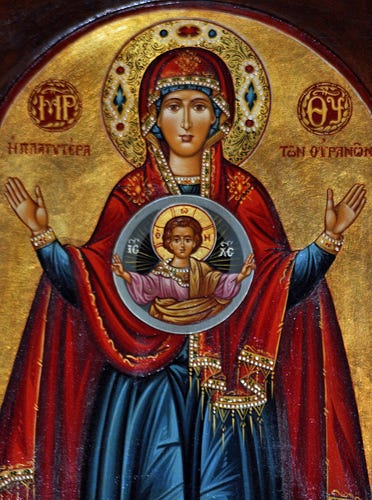
Introduction
“They shall make an ark of acacia wood…And you shall overlay it with pure gold…And you shall put into the ark the covenant which I shall give you. Then you shall make a mercy seat of pure gold… And you shall put the mercy seat on the top of the ark; and in the ark you shall put the covenant that I shall give you. There I will meet with you, and from above the mercy seat, from between the two cherubim that are upon the ark of the covenant, I will speak with you of all that I will give you in commandment for the sons of Israel.” Exodus 25:10-11, 16-17, 21-22.
As God leads the Hebrew people through the wilderness of Sinai, He commands Moses to make an ark to contain the covenant that God has made with the people. Within the ark, the people place three objects: the tablets of the Law,1 a jar of the manna that was sent from heaven,2 and the rod of Aaron.3 Each of these items has an important role in the liberation of the people from slavery in Egypt, and more than that, foreshadows what is to come in the New Covenant in Jesus Christ.
In an allegorical sense, the Ark of the Covenant foreshadows the Blessed Virgin Mary. The Evangelist Luke draws numerous parallels between the bringing of the Ark to Jerusalem and Mary’s visit to Elizabeth after the conception of Jesus Christ. The parallels in both the journey and the contents of the Ark and the Blessed Virgin are important exegetical realities. Truly, God veils in the shadow of the Old Testament, the light that is coming in the New Testament. To that end, St. Luke’s usage of these parallels will be considered, and the connection between the Old and New Covenants will be shown below.
Finally, I want to conclude in the Book of Revelation and look at the Woman clothed with the sun.4 While she is a figure who is frequently commented on, what is often missed is the mention of the Ark of the Covenant immediately preceding her at the end of Chapter Eleven. I want to draw the parallels between the Ark being seen in Heaven and the Assumption of the Blessed Virgin Mary into Heaven.
The Ark of the Covenant
“So the people sent to Shiloh, and brought from the ark of the covenant of the Lord of hosts, who is enthroned on the cherubim…” 1 Samuel 4:4
The Ark of the Covenant, as given to the people of Israel, is the mercy seat of God from which He meets with Moses and speaks to him. It is the throne of God upon the Cherubim angels,5 signifying His presence among the people. While the people wander in the desert, before coming into the Promised Land, the Ark dwells within the Holy of Holies in the Tabernacle.6 Prior to the construction of the Tabernacle, the Ark would be placed in the Tent of Meeting, where the Lord would descend and speak to Moses:
“When Moses entered the tent, the pillar of cloud would descend and stand at the door of the tent, and the Lord would speak to Moses… Thus the Lord would speak to Moses face to face, as a man speaks to his friend.” Exodus 33:9, 11.
Here, we can see that the Ark was far more than just a container; it was the dwelling place of God, where Moses would go to speak with God, face to face. Moreover, once Joshua takes up the mantle from Moses, we can see the Ark leading the people in their conquest of the Promised Land, not more famously known than the fall of Jericho:
“So, when the people set out from their tents, to pass over the Jordan with the priests bearing the ark of the covenant before the people, and when those who bore the ark had come to the Jordan, and the feet of the priests bearing the ark were dipped in the brink of the water (the Jordan overflows all its banks throughout the time of harvest), the waters coming down from above stood and rose up in a heap far off, at Adam, the city that is beside Zarethan, and those flowing down toward the sea of the Arabah, the Salt Sea, were wholly cut off; and the people passed over opposite Jericho. And while all Israel were passing over on dry ground, the priests who bore the ark of the covenant of the Lord stood on dry ground in the midst of the Jordan, until all the nation finished passing over the Jordan.” Joshua 3:14–17.
The fall of the walls of Jericho follows. Numerous other passages can be listed, but the common theme that is found here is that the Ark of the Covenant is a visible sign of the dwelling of God. It should not be interpreted that the Ark is God. But, instead, God has given His people a sensible reality which foreshadows the incarnational reality to come. Speaking on things like these ceremonial precepts, such as the building of the Ark, St. Thomas writes:
“Now the end of the ceremonial precepts was twofold: for they were ordained to the Divine worship, for that particular time, and to the foreshadowing of Christ; just as the words of the prophets regarded the time being in such a way as to be utterances figurative of the time to come…”7
The building of the Ark is one such ceremonial precept. It is not merely coincidental that these things were commanded by God; it was all a preparation for Christ and what was to come.
As listed above, three significant items are placed in the Ark according to the command of God. The fact that God has commanded such a thing should be considered important since God does not command anything or act in a certain way randomly or without a providential purpose. To that end, the common exegetical tradition in the Catholic Church is that the contents of the Ark foreshadow Jesus Christ. Beginning with Christ is necessary since all things concerning Mary begin with her Son. If He is the perfection and fulfillment of the contents of the Ark, then she must be the perfection and fulfillment of the Ark itself.
The Tablets of the Law
The first object placed in the Ark was the tablets upon which the Law of God was written. Originally, these tablets had been solely the work of God.8 But once Moses comes down from Sinai and sees that the people have already broken the Law of God, in his anger, he smashes the tablets before the people.9 In response to this, God commands Moses to cut two more tablets out of stone so that God could rewrite the law on them.10 This is succinctly recorded later on in the Book of Deuteronomy:
“At that time the Lord said to me, ‘Hew two tables of stone like the first, and come up to me on the mountain, and make an ark of wood. And I will write on the tables the words that were on the first tables which you broke, and you shall put them in the ark.’ So I made an ark of acacia wood, and hewed two tables of stone like the first, and went up the mountain with the two tables in my hand. And he wrote on the tables, as at the first writing, the ten commandments which the Lord had spoken to you on the mountain out of the midst of the fire on the day of the assembly; and the Lord gave them to me. Then I turned and came down from the mountain, and put the tables in the ark which I had made; and there they are, as the Lord commanded me.” Deuteronomy 10:1-5
The Books of Moses make clear that the tablets which contain the Ten Commandments are placed within the Ark and carried with the people. This law is the covenant between God and His people. Fidelity to the law is the sign of love the people have for God. In a perfect sense, Christ is the law that comes to man. He is the fulfillment of all that was commanded and promised in the Law of Moses. Christ Himself affirms this fulfillment:
“Do not think that I have come to abolish the law and the prophets; I have come not to abolish them but to fulfil them. For truly, I say to you, till heaven and earth pass away, not an iota, not a dot, will pass from the law until all is accomplished.” Matthew 5:17–18.
Here, we can see that Christ did two things with the Law: first, He fulfilled it, and second, He expounded upon it, not adding or taking away anything. Concerning fulfillment, St. Thomas lists five ways in which Christ fulfilled the Law of Moses:
First, because those things that were prefigured in the law and the prophets concerning Christ, he fulfilled in his actions: what is written must be fulfilled in me (Luke 22:37). Second, by observing the legal requirements to the letter, when the fullness of time had come, God sent his son (Gal 4:4). Third, by working through grace, which the law of nature could not do: for every law is for the sake of making us just men, but Christ did this by the Holy Spirit: for what the law could not do, God has done by sending his own Son (Rom 8:3). Fourth, according to Augustine, by satisfying for the sins by which we were made transgressors of the law; hence having borne the transgression he is said to have fulfilled the law: whom God proposed to be a propitiation (Rom 3:29). Fifth, by applying certain perfections to the law which were either for the understanding of the law or for the greater perfection of justice, for the law brought nothing to perfection (Heb 7:19); and these things seem to be the intention of Christ, since, when he made mention of all legal restrictions, he added be you therefore perfect (Matt 5:48).11
Along with the fulfillment of the Law, Christ also expounded upon it. He opened man’s eyes to how to keep the law in its perfection, aided by grace. For example, when speaking on adultery, He expounds on the sixth commandment. Not only does it forbid bodily adultery, but it also forbids adultery of the heart:
“You have heard that it was said, ‘You shall not commit adultery.’ But I say to you that everyone who looks at a woman lustfully has already committed adultery with her in his heart.” Matthew 5:27–28.
The Law that was originally laid up in the Ark was a preparation for what was to come in Christ. The Law was not intended to remain on stone tablets but to be written on the very heart of man by the Incarnate Law Himself.
The Jar of Manna
During the wandering in the desert, the people complained to Moses that they were hungry, and so God provided for them heavenly bread that fell every morning.12 This Manna, as it was called, came to be known as the bread from heaven, “and He rained down upon them manna to eat, and gave them the bread of heaven.”13 This bread from heaven was miraculous and was considered a sign from God of His provision for His people as they wandered in the wilderness of sin.
This Manna held such a high significance to the Israelite people that they cited it as a sure sign of the working of God in the time of Christ: “So they said to him, ‘Then what sign do you do, that we may see, and believe you? What work do you perform? Our fathers ate the manna in the wilderness; as it is written, ‘He gave them bread from heaven to eat.’”14 When in doubt about Christ, the people ask for a sign like the bread from heaven. However, Christ responds to the people by reminding them of the limitations of the Manna. Their fathers did, indeed, eat the Manna in the desert, but in the end, they still died.15 Instead, the bread that Christ promises to give brings the eater to eternal life. Christ Himself, just as He did with the Law, affirms that He is the true bread from heaven:
“This is the bread which comes down from heaven, that a man may eat of it and not die. I am the living bread which came down from heaven; if anyone eats of this bread, he will live for ever; and the bread which I shall give for the life of the world is my flesh.” John 6:50–51.
Just like with the Law, Christ surpasses what was given in the Old Testament with something that both fulfills and expounds upon what was originally given. God gave the people bread from heaven. This bread was meant to give them physical sustenance on their journey to the Promised Land. But with Christ, this bread from heaven is not simple bread; it is the flesh of Christ given for the life of the world. It is not given for bodily sustenance but instead, for spiritual sustenance. Their fathers ate Manna in the desert and died, but the true food that Christ gives brings eternal life:
“Truly, truly, I say to you, unless you eat the flesh of the Son of man and drink his blood, you have no life in you; he who eats my flesh and drinks my blood has eternal life, and I will raise him up at the last day. For my flesh is food indeed, and my blood is drink indeed. He who eats my flesh and drinks my blood abides in me, and I in him.” John 6:53–56.
Christ does not give us bread; He gives us His flesh and blood in the Holy Eucharist.
The Rod of Aaron
The final object in the Ark is the rod of Aaron, the brother of Moses. This staff was used multiple times in the Exodus story to perform numerous miracles, such as turning it into a serpent,16 the parting of the Red Sea,17 and drawing water from the rock.18 In addition to these miracles, the Rod of Aaron was a sign of his priesthood. Aaron was instituted by God as the first priest of the Israelite people, ordained to offer sacrifice on behalf of the people.
Our Lord fulfills this as well since He is the true high priest of the people of God. The writer of the Letter to the Hebrews beautifully draws this out:
So also Christ did not exalt himself to be made a high priest, but was appointed by him who said to him, “You are my Son, today I have begotten you”; as he says also in another place, “You are a priest for ever, according to the order of Melchizedek.” Hebrews 5:5–6
Citing both Psalm 2 and 110, the writer of Hebrews connects Jesus Christ to the Old Testament priesthood and yet draws a greater significance from it. His priesthood is not identical to that of the Old Testament; Christ both fulfills and expounds upon the priesthood that was instituted in Aaron. Where the Old Testament priests offered sacrifice on behalf of the people, so too does Christ offer sacrifice. But this sacrifice is not just any lamb; He offers Himself. He then expounds upon this priesthood and this sacrifice, in that what He offers is a singular sacrifice:
“For it was fitting that we should have such a high priest, holy, blameless, unstained, separated from sinners, exalted above the heavens. He has no need, like those high priests, to offer sacrifices daily, first for his own sins and then for those of the people; he did this once for all when he offered up himself.” Hebrews 7:26–27.
This, of course, is perpetuated in the Holy Sacrifice of the Mass, which makes present that one sacrifice to all people throughout all time with the ordained priest acting in persona Christi.
The Visitation
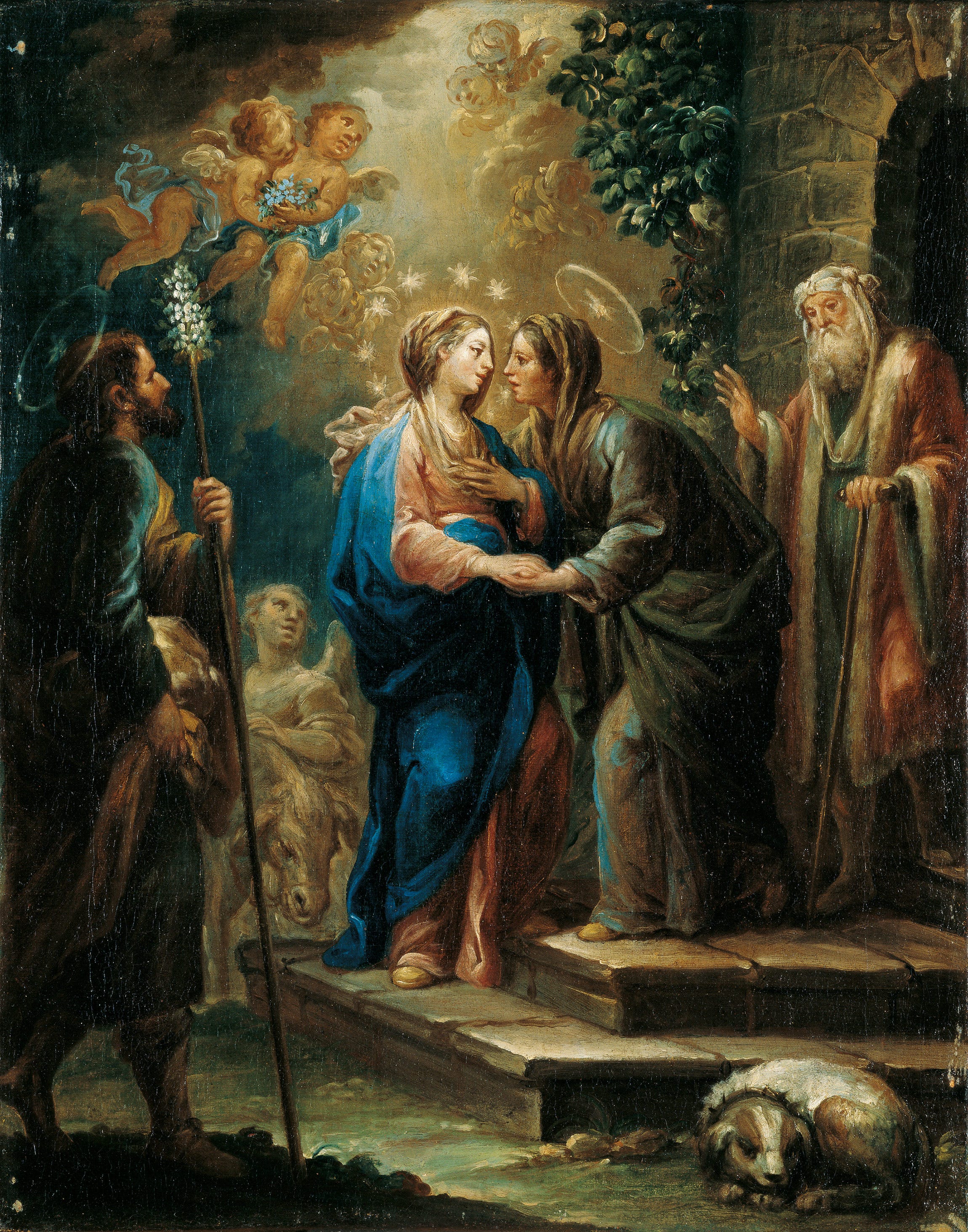
“In those days, Mary arose and went with haste into the hill country, to a city of Judah, and she entered the house of Zechariah and greeted Elizabeth. Luke 1:39–40.
The Angel Gabriel reveals to Mary that her cousin, Elizabeth, has miraculously conceived a child, and so the first thing that Scripture records that Mary does after the Annunciation is journey from Nazareth to the hill country of Judah and visit Elizabeth. This detail forms just two verses in the Lukan narrative and seems to be overshadowed by the Visitation itself. But there is immense significance to this journey as detailed by St. Luke.
Here, we want to draw the parallels between the Visitation narrative in Luke and the bringing of the Ark to Jerusalem in 2 Samuel:
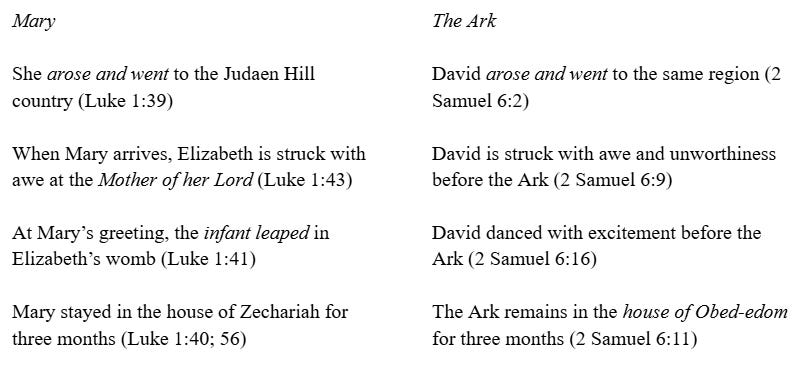
St. Luke draws upon the written tradition in 2 Samuel to bring out the similarities between Mary and the Ark of the Covenant. But the parallels are not limited to these occurrences. St. Luke, under the inspiration of the Holy Spirit, places an even more explicit connection to the Ark in the response of Elizabeth to Mary’s greeting.
“And when Elizabeth heard the greeting of Mary, the child leaped in her womb; and Elizabeth was filled with the Holy Spirit, and she exclaimed with a loud cry, ‘Blessed are you among women, and blessed is the fruit of your womb!’” Luke 1:41–42.
St. Luke uses a unique Greek word in this passage that is translated as exclaimed. The Greek ανεφωνησεν is noted by Scott Hahn as only being used in this singular instance in the New Testament.19 More significantly, it is only used five times in the entire Old Testament, and it is always in connection to the Ark. Hahn writes:
In particular, it refers to the melodic sounds made by Levitical singers and musicians when they glorify the Lord in song. It thus describes the “exulting” voice of instruments that were played before the Ark as David carried it in procession to Jerusalem (1 Chronicles 15:28; 16:4-5) and as Solomon transferred the Ark to its final resting place in the temple (2 Chronicles 5:13).20
St. Luke is communicating to his readers that Mary’s journey with the newly conceived Christ in her womb is a liturgical procession in which we find the exulting voice of praise being given to the New Ark of the Covenant and the fulfillment of the Law, Manna, and Priesthood that she carries within her Immaculate Womb.
The Woman of Revelation
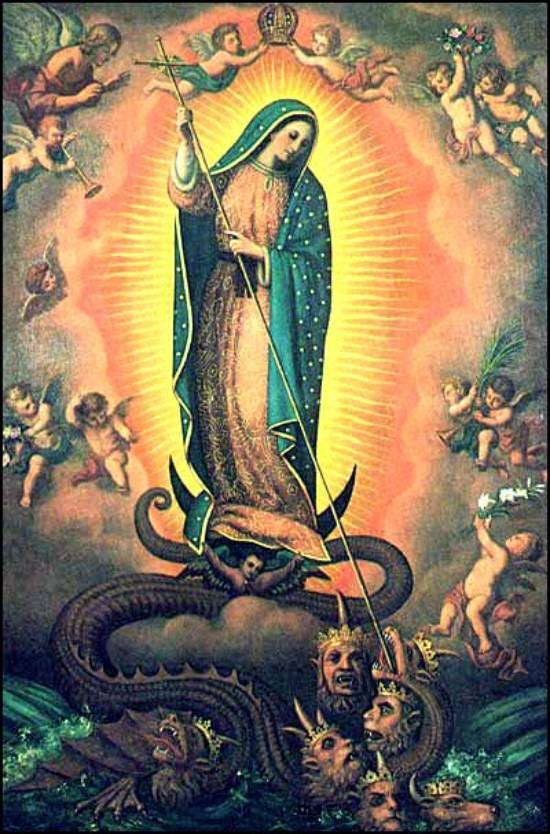
“And a great sign appeared in heaven, a woman clothed with the sun, with the moon under her feet, and on her head a crown of twelve stars, she was with child, and she cried out in her pangs of birth, in anguish for delivery” Revelation 12:1-2
The woman of Revelation stands as one of the most prominent Marian symbols in the New Testament outside of the Gospels themselves. The woman is seen as a symbol for numerous things at once: The Virgin Mary, the Faithful of the Church, and the Church herself. Here, I want to concentrate on the Marian image.
In this passage, we find the Woman depicted as a parallel to the Woman of Genesis at odds with the great serpent that she was predestined to war with:
“I will put enmities between thee and the woman, and thy seed and her seed: she shall crush thy head, and thou shalt lie in wait for her heel.” Genesis 3:15, D-R.21
St. John envisions that which Genesis foretold, the Woman who crushes the head of the serpent through her Seed, Jesus Christ. The connection between the Woman of Genesis and the Woman of Revelation is undeniable. The Woman in both passages is tied intimately to her Seed and is put at odds with the great serpent, the devil. She, representing the whole body of the Church and Israel, crushes the serpent and is victorious over him.
Where does the Ark come in then? At the conclusion of chapter eleven, immediately before the Woman is seen in chapter twelve, St. John sees the Ark of the Covenant:
“Then God’s temple in heaven was opened, and the ark of his covenant was seen within his temple; and there were flashes of lightning, loud noises, peals of thunder, an earthquake, and heavy hail.” Revelation 11:19
This curious addition to chapter eleven almost seems out of place, as it comes after the cataclysms of the seven seals and the seven trumpets. In addition to this, historically, the Ark of the Covenant hadn’t been seen for centuries. With the destruction of the First Temple in 586 BC by the Babylonians, the prophet Jeremiah takes the Ark and hides it to keep it safe according to the command of God.22 In this interesting move, Jeremiah hides the Ark, and when he finds that some try to mark the location, he rebukes them and keeps the location secret, saying, “The place shall be unknown until God gathers His people together and shows them His mercy.”23 This is a curious act. Why would Jeremiah hide the Ark, and specifically keep its location hidden from those with him and subsequent generations? This is the last time before the vision in Revelation that the Ark of the Covenant is seen by God’s people.
The answer to this question lies in Jeremiah’s response. The resting place of the Ark will remain unknown until God gathers His people together and shows His mercy. There are two clauses here that indicate the return of the Ark:
God gathering His people
God showing His mercy
Both of these things happen through Jesus Christ, and they have a particular tie to the Virgin Mary as seen in Revelation 12. The gathering of the people is symbolized by the Woman clothed with the sun having a crown of twelve stars. This crown of twelve stars represents two things:
The twelve tribes of Israel reconstituted
This reconstitution in the Church under the twelve Apostles.
God showing His mercy to His people is then seen in the bringing forth of the Child who is destined to rule the people. This Child is, of course, Christ, who has come to bring salvation to His people. The bringing forth of the Child is the central act of the Woman through which the infernal serpent is put under foot.
Jeremiah rightly prophesies that these two things must come to pass before the Ark will be seen again. It can be argued that these two things are embodied in the Woman of Revelation, which is why St. John sees the Ark in immediate proximity to the Woman. This seamless transition from the Ark to the Woman is a revelation of identity. The Ark is the Woman. It is here that we also find an allusion to the Assumption of the Blessed Virgin. The incorruptible Ark is taken from earth and brought into God’s temple to rest there for all eternity.
Conclusion
In conclusion, I want to return to the hiding and loss of the Ark of the Covenant. This is a significant fact in the overall connection between the Ark and Mary. This event should not be seen as an absent-minded accident. This was a providentially ordered event that God moved Jeremiah to accomplish for a specific reason. That reason was that the Ark was no longer needed in the state that it was in. As I said above, it was a sensible sign and contained within it items which foreshadowed what was to come. That which foreshadows is necessarily less than what is actualized later. Just as He who is the fulfillment of the Law, the true bread from heaven, and the perfection of the priesthood is greater than the objects within the Ark, so too must be that which contains Him be greater than what came before.
The people no longer needed the Ark of the Covenant, as it was at the time of the Exile. Something greater was coming. God was preparing the people, even as they labored in their sin and seeming abandonment, for the fulfillment of all that He promised. The Prophet Micah foretells this Exile-Return fulfillment in the same prophecy in which He foretells the coming of the Messiah in connection to His mother:
“But you, O Bethlehem Ephrathah, who are little to be among the clans of Judah, from you shall come forth for me one who is to be ruler in Israel, whose origin is from of old, from ancient days. Therefore, he shall give them up until the time when she who has labor pains has brought forth; then the rest of his brethren shall return to the sons of Israel.” Micah 5:2-3
The prophecy from Micah fits perfectly with the prophecy from Jeremiah concerning the return of the Ark. It is in the gathering of the people and God showing His great mercy that the Ark will be revealed again. This great mercy is further magnified and prophesied by Mary herself:
“And Mary said, ‘My soul magnifies the Lord, and my spirit rejoices in God my Savior, for he has regarded the low estate of his handmaiden. For behold, henceforth all generations will call me blessed; for he who is mighty has done great things for me, and holy is his name. And his mercy is on those who fear him from generation to generation. He has shown strength with his arm, he has scattered the proud in the imagination of their hearts, he has put down the mighty from their thrones, and exalted those of low degree; he has filled the hungry with good things, and the rich he has sent empty away. He has helped his servant Israel, in remembrance of his mercy, as he spoke to our fathers, to Abraham and to his posterity for ever.’” Luke 1:46-55.
Mary affirms herself, in the very meeting foreshadowed by the Ark coming to Jerusalem, that the scattering of the people is over, their exile is being healed, and the dawn of mercy has broken. The true and everlasting Ark has come, and she has brought with her God’s presence to His people. No longer in sign but in person.

For more from Dr. McGovern, visit his Substack at A Thomist, Dedicated to the Theological tradition of St. Thomas Aquinas. Exploring Thomas’ Spiritual Theology and topics in Christology and Mariology.
Cf. Exodus 25:16.
Cf. Exodus 16:33-34.
Cf. Numbers 17:10.
Cf. Revelation 12.
Cf. Isaiah 37:16.
Cf. Exodus 26:34.
St. Thomas Aquinas, Summa Theologiae I-II q. 102, a. 2.
Cf. Exodus 32:16.
Cf. Exodus 32:19.
Cf. Exodus 34:1.
St. Thomas Aquinas, Commentary on the Gospel According to St. Matthew, C. 5, L. 6, n. 469.
Cf. Exodus 16:4.
Psalm 78:24.
John 6:30-31.
Cf. John 6:49.
Cf. Exodus 7:8-13.
Cf. Exodus 14:16.
Cf. Exodus 17:1-7.
Cf. Mary, Ark of the Covenant, Ignatius Catholic Study Bible.
Ibid.
Latin: “Inimicitias ponam inter te et mulierem, et semen tuum et semen illius: ipsa conteret caput tuum, et tu insidiaberis calcaneo ejus.” Genesis 3:15.
Cf. 2 Maccabees 2:4-7.
2 Macabees 2:7.