
The Divine Identity of Christ Revealed In Holy Week
A Commentary on the Gospel According to St. Matthew

A common error that has been circulating around modern Christendom is that the Synoptic Gospels of Matthew, Mark, and Luke do not teach that Jesus Christ is divine.1 As to the Gospel of John, it has more widely been asserted that since John is a later composition, likely in the 90s AD, the divine claims in it are of “later theological reflections”2 and have no tie to the historical Jesus. Essentially, these “scholars”, to varying degrees, call into question the authenticity of the Gospel of John and lean into the Synoptics as being more historically reliable.
In light of this, I wanted to visit the Gospel of Matthew and bring out the clearly divine claims that are made by Our Lord, or by those around Him responding to Him with a clear belief that He is asserting divinity. Since we are in the season of Lent at the writing of this article, I wanted to focus this on Holy Week.
While these events and exchanges that I have chosen are certainly not an exhaustion of what could be looked at, these are all events that happen during Holy Week, which has a particular emphasis on Jesus’ divine nature. Many of the divine claims in the Synoptics that happen before Holy Week are meant only for the Apostles,3 but once we cross the threshold of the Entrance into Jerusalem, these instances get both more pronounced and more public. To that end, I have chosen four points during Holy Week to offer commentary on.
It is important to note that the Gospel of Matthew was written by a Jewish man and is written to the Jews.4 This means that we have to read it in the context of Second-Temple Judaism and their beliefs, and not through modern assumptions that have since been proven wrong. The most important one for this present work is this: we need to finally reject the error that Second-Temple Judaism exclusively anticipated a human Messiah. While this was certainly one interpretation/anticipation, it was not the exclusive interpretation. We need to look no further than the one like a Son of Man found in the Prophet Daniel.5 Dr. Brant Pitre has a masterful treatment of this in Jesus and Divine Christology. He writes:
…in contrast to the age-old assumption that at the time of Jesus, most Jewish people were waiting for a merely human Messiah, recent scholarship suggests that “the divinity of the messiah” was a significant part of the early Jewish messianic landscape. Indeed, it is quite telling that several recent surveys of early Jewish messianism add the category of “heavenly” messiah… Hence, the popular notion that all Jewish messianic expectations involved a merely human (and often military) figure needs to be abandoned once and for all.6
This is the context we must consider in this present work. The Jews of Jesus’ time did anticipate a Divine Messiah, and this accounts for why many Jews came to this actual belief. Thus, Matthew writes from this explicit expectation.
The Entrance into Jerusalem
“And the crowds that went before Him and that followed Him shouted, ‘Hosanna to the Son of David! Blessed is He who comes in the name of the Lord! Hosanna in the highest!… But when the chief priests and the scribes saw the wonderful things that He did, and the children crying out in the temple, “Hosanna to the Son of David!” They were indignant, and they said to Him, “Do you hear what these are saying?” And Jesus said to them, “Yes; have you never read, ‘Out of the oaths of babies and infants you have brought perfect praise.’?” Matthew 21:9, 15-16.
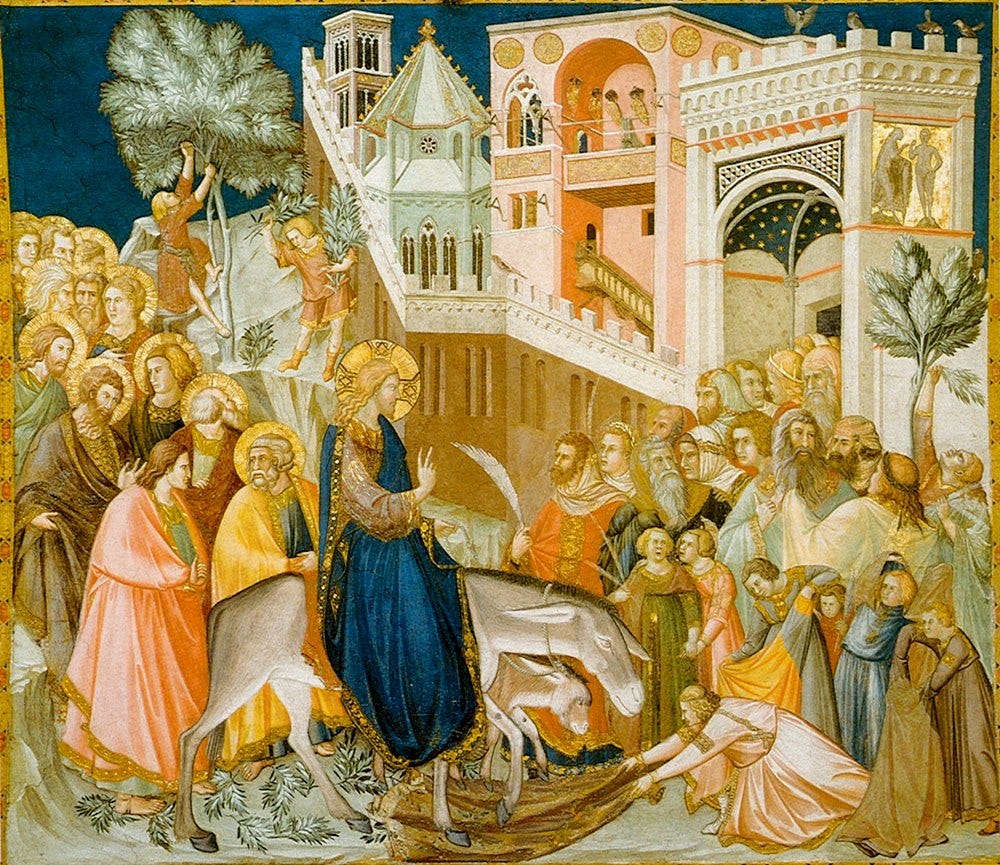
To begin, we find Our Lord entering the Holy City, prior to Passover, anticipating His passion. As He rides into Jerusalem, He is hailed by the people as Hosanna and the Son of David, and they exclaim blessed is He who comes in the name of the Lord. The first part of this hailing is the term Hosanna. This is a Hebrew acclamation that means: save us. The Jewish people are shouting and begging for Our Lord, the Son of David, to save them. By referring to Jesus as the Son of David, they are explicitly affirming their belief that He is the Messiah.7 This acclamation, as well as the phrase Blessed is He who comes in the name of the Lord, “ is directly lifted out of Psalm 118. The Psalm reads:
“Save us, we beg you, O Lord! O Lord, we beg you, give us success! Blessed is he who enters in the name of the Lord!” Psalm 118:25-26
This Psalm is being addressed to God, and the Psalmist is begging the Lord to come to His rescue. The entirety of Psalm 118 is a song of praise to God for His great mercy. The people of Jerusalem are taking words from their Scripture and applying them to Christ. Hailing Him like this certainly points to a Messianic affirmation. But where does the divine claim come in? Upon His entry to the city, Our Lord goes to the temple, and we hear that He cleanses the temple of the money-changers.8 After clearing them out, the priests and scribes attempt to goad Our Lord into denying these words of praise. Instead of condemning them, Our Lord affirms them through a very particular quotation from Scripture:
“O Lord, our Lord, how majestic is your name in all the earth! You whose glory above the heavens is chanted by the mouths of babes and infants…” Psalm 8:1-2
Our Lord quotes the Greek Septuagint, but the meaning remains the same. The context of this Psalm, which Our Lord is applying to Himself, is that the babies and infants bring perfect praise to God Himself. The children are glorifying God in this Psalm, and by taking it upon Himself, He is affirming that He ought to receive that glory. This is a divine claim in the presence of the priests and scribes.
Jesus Questions the Pharisees
Now, while the Pharisees were gathered together, Jesus asked them a question, saying, “What do you think of the Christ? Whose son is he?” They said to him, “The son of David.” He said to them, “How is it then that David, inspired by the Spirit, calls him Lord, saying, ‘The Lord said to my Lord, Sit at my right hand, till I put your enemies under your feet’? If David thus calls him Lord, how is he his son?” Matthew 22:41–45
If we follow the timeline given to us by St. Matthew, this exchange happens on the Monday of Holy Week. Our Lord is questioned multiple times by both the Pharisees and Sadducees. After He deals with each of their inquiries, in the midst of them attempting to trap Him, He returns their question with one of His own about the Christ.
“Whose Son is the Christ”
This question touches on the very fabric of what the Jews expected concerning the Messiah. For the Pharisees, their answer shows a very limited view of who the Christ was going to be. St. Thomas points this out in his commentary on Matthew. He says that the question was fitting for the Pharisees “because they had the opinion that he was a mere man, and they did not want to believe that he was God…”9 This fittingness cited by St. Thomas is important because it points to Our Blessed Lord’s intention in asking the question: He wanted to answer their questions with a revelation that He is God and, as such, “You shall not put the Lord your God to the test, as you tested him at Massah.”10 If they realized who was before them, then they would not be testing Him.
This is why Our Lord, in answering His own question, quotes Psalm 110. If the Messiah is the Son of David, which was the case as was cited above, how then does David refer to his Son as My Lord? This is the crux of the question. St. Thomas gives the conclusion that the Pharisees perhaps began to realize:
It says in the law that the father is greater than the son. Therefore, a son is not the lord of his father. Therefore, either Christ is not the son of David, or in Him is something greater than David, since he calls Him Lord.11
Our Lord uses the Scriptures to open the eyes of the Pharisees. Either they have to deny what is written in 2 Samuel 7, that the Messiah would come from David’s line, or they have to admit that the Messiah is more than a mere man, that is, He has a two-fold nativity: one from David’s line according to His humanity and one from eternity.
It is precisely this ultimatum that brought about the effect: “And no one was able to answer him a word, nor from that day did anyone dare to ask him any more questions.”12 They had to encounter that this man, who claims to be the Messiah, is also claiming to be divine.
The Lament Over Jerusalem
“O Jerusalem, Jerusalem, killing the prophets and stoning those who are sent to you! How often would I have gathered your children together as a hen gathers her brood under her wings, and you would not! Behold, your house is forsaken and desolate. For I tell you, you will not see me again, until you say, ‘Blessed is he who comes in the name of the Lord.’” Matthew 23:37-39.
From the Pharisees’ silence, Our Lord enters into a long condemnation of the hypocrisy that plagues the Pharisaical office at the time. To that, He issues seven woes of condemnation.13 After issuing these seven woes, in the face of the animosity of the Pharisees, Our Lord laments over the Holy City and takes His leave of the temple for the final time. This leaving of the temple and going to the Mount of Olives is the event I want to concentrate on here. There are three elements to this revelation of Our Lord’s Divinity: Revealing the temple as forsaken, God leaving the temple, and then going to the Mount of Olives.
First, at the end of His condemnation of the hypocrisy of the Pharisees, Our Lord says that the temple is “forsaken and desolate.” This is both a reference to the past and a prophecy of the future. Both are tied to the Prophet Jeremiah:14
“I have forsaken my house, I have abandoned my heritage; I have given the beloved of my soul into the hands of her enemies.” Jeremiah 12:7
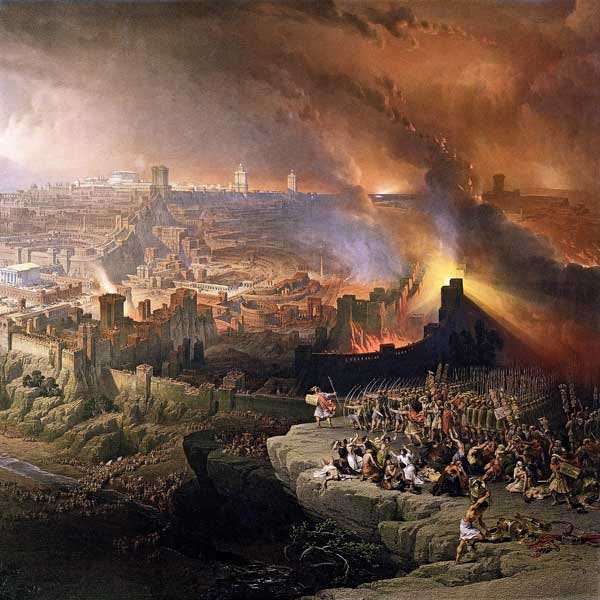
The prophet is foretelling the coming destruction of the temple in 586 BC by the Babylonians on the way to the Exile. God abandons the Israelite people to this captivity as a punishment for their many sins. God Incarnate is likewise foretelling the same abandonment. He is abandoning the descendants of these same Israelites for their unbelief. This time, it is not the Babylonians coming in; it is the Romans coming to destroy the Second Temple in AD 70. Thus, Jesus is placing Himself as the divine judge over Jerusalem, just as He did in the time of Jeremiah.
This goes deeper, however. The second part of this divine claim is found in Christ taking His leave of the temple. This time, the Prophet Ezekiel witnesses the Glory of the Lord leaving the temple prior to its destruction, and in the same breath, foretells the leaving of God’s Glory in the Flesh:
“Then the glory of the Lord went forth from the threshold of the house…And the glory of the Lord went up from the midst of the city, and stood upon the mountain which is on the east side of the city.” Ezekiel 10:18; 11:23
Ezekiel sees the Lord leave the city of Jerusalem as a way of visibly showing His abandonment of the people, for a time, to the exile in Babylon. It is important to note the belief of the Jewish people that God dwells in the temple, His house, and for Ezekiel to see God leave brings fear of apocalyptic events. This same fear is felt by the Christians and Jews of AD 70 when the Romans destroyed the Second Temple.
Our Lord does the same thing in Matthew that we see the Glory of the Lord do in Ezekiel: He leaves toward the eastern gate and goes out to the mountain on the eastern side of the city, the Mount of Olives. The beauty here is staggering:
As the Glory of the Lord leaves by way of the eastern gate toward the Mount of Olives, the Jews believed that the Lord would one day return to them by that same gate. We hear later on in the Prophet Ezekiel:
“Afterward, he brought me to the gate, the gate facing east. And behold, the glory of the God of Israel came from the east; and the sound of his coming was like the sound of many waters; and the earth shone with his glory.” Ezekiel 43:1-2
At Our Lord’s entry into Jerusalem on Palm Sunday, He came through the eastern gate from the Mount of Olives! This was the glorious return of the Glory of the God of Israel!15 This is why Our Lord mourns. They were supposed to recognize He who comes in the name of the Lord. They were supposed to recognize how the Lord returns through the eastern gate, but because they don’t, He leaves the way He comes in. He came and dwelt with them in an even greater way than previously, as St. Thomas teaches:
Hence, to leave is said through inhabitance; therefore, you will not see me from now, because I was with you by the power of the divinity, and afterwards I was with you bodily, but I will withdraw from you. But your house is already left deserted, you will not see me henceforth, neither bodily, namely after the passion, nor spiritually.16
And this leaving signals the same catastrophe that happened the first time He left. Our Lord goes out to the Mount of Olives, which overlooks the city, and gives the Olivet Discourse17 in which He gives the prophecy that would be fulfilled about 40 years later:
“You see all these stones, do you not? Truly, I say to you, there will not be left here one stone upon another, that will not be thrown down.” Matthew 24:2
Just like in 586 BC, the temple was destroyed because the Glory of God took His leave, so too, in AD 70, the temple was destroyed because the Glory of God took His leave.
The Son of Man
“And the High Priest said to Him, ‘I adjure you by the living God, tell us if you are the Christ, the Son of God.’ Jesus said to him, “You have said so. But I tell you, hereafter you will see the Son of Man seated at the right hand of Power, and coming on the clouds of Heaven.’ Then the High Priest tore his robes, and said, ‘He has uttered blasphemy. Why do we still need witnesses? You have not heard His blasphemy. What is your judgment?’ They answered, ‘He deserves death.’” Matthew 26:63-66
The final passage to be considered is from the trial of Our Lord before the Sanhedrin. After attempting to get false testimony, the witnesses disagreeing, etc., the High Priest outright asks Our Lord if He is the Messiah, the Son of God. Invoked under oath, Our Lord finally speaks. There are two essential parts to this answer:
He affirms that He is the Christ
The first part of Our Lord’s answer is an affirmation of the question, are you the Christ?18 St. Mark preserves a more direct answer as He simply says, “I am.”19 There is no reason to think that the two evangelists disagree, since both follow their respective recordings with the same prophecy. Simply, Our Lord is revealing to the Sanhedrin that He is the Messiah foretold to come.
He draws from Scripture to emphasize that as the Son of God, He is divine.
This second part is the most important for this work. Our Lord does not simply affirm that He is the Messiah, as it was said above, many in the Sanhedrin potentially only expected a human Messiah. It is possible that Caiaphas was at least familiar with the Jewish theory of a Divine Christ, as he adds, Son of God to the end of his question. Whether he personally anticipated a Divine Messiah, I do not know, but his question brings an even greater answer out of Our Lord. This answer is inspired by two places in Scripture already referenced in this work:
“The Lord said to my says to my lord, ‘Sit at my right hand, till I make your enemies your footstool.” Psalm 110:1
“I saw in the night visions, and behold, with the clouds of heaven there came one like a Son of Man, and He came to the Ancient of Days and was presented before Him. And to Him was given dominion and glory and kingdom, that all peoples, nations, and languages should serve Him; His dominion is an everlasting dominion, which shall not pass away, and his kingdom one that shall not be destroyed.” Daniel 7:13-14.
Here, we see the combination of two prophecies: The Lord sitting at the right hand of Power, that is, the Ancient of Days, as well as Christ identifying Himself as the Son of Man who receives authority from the Ancient of Days and exercises dominion over all the earth. By identifying Himself as the Son and Man seated at the right hand of God in conjunction with the action of coming on the clouds of heaven, He is taking upon Himself the judgment of mankind. St. Thomas comments, “...to sit at the right hand is to be in the full beatitude of power, or in the more powerful goods: for the right hand is the nobler part, so it signifies greater dignity…”20 He places Himself as equal to God and claims an authority greater than any mere man would be able to exercise. Make no mistake, Jesus of Nazareth is claiming divine identity here.
The final proof of this is the reaction of Caiaphas and the Sanhedrin. Beginning with Caiaphas, the High Priest rips his robes and proclaims that Our Lord has uttered blasphemy. The two actions here are indicative that the capital offense of Blasphemy has been committed, as Christ has made Himself equal to God.21 First, the High Priest rends his garments, of which St. Thomas teaches:
However, the one condemning expressed Christ’s guilt both by deed and by word: by deed, because he rent his garments. He tore his garments in the same fury in which a little while before he rose from his seat, for it was customary that one who heard blasphemy tore his garments as a sign that he could not bear to hear it.22
This action is directly a result of the High Priest considering what Christ said to be blasphemy. He proclaims to the whole assembly that Our Lord is guilty of blasphemy. This is important context. Not only are we making the claim that Christ Himself considered Himself divine and, by extension, claimed it, but we are looking at the reactions of those who are around Him. Caiaphas clearly interpreted Christ’s words and use of Scripture to mean that He was claiming divinity. Ultimately, this is proved by the Sanhedrin’s reaction:
They condemn Him to death.
The reality is this: there are only a small number of offenses that a Jewish man could commit in First-Century Judea under the law that would get them condemned to death. The only one remotely close happens to be the one that is clearly spoken of: Blasphemy.
This is the unequivocal certainty that Jesus Christ claimed divinity. Not only did He claim it, but those whom He encountered thought He did as well.
Conclusion
While only four events are touched on in this work, it is hoped that these shed some light on the misconceptions and erroneous beliefs that have permeated modern biblical scholarship. Jesus of Nazareth claimed to be both the Jewish Messiah that had been prophesied in the Old Testament, while at the same time, claimed to be the Divine Son of Man, who is seated at the right hand of the Ancient of Days. I would argue that no other interpretation takes into account the beliefs and history of Second Temple Judaism, paired with Scriptural context. Truly, the death of Our Lord is the greatest witness. The Jewish authorities do not hand over a brother to the Roman procurator to be crucified if they do not believe He legitimately deserved death.
All four canonical Gospels bear witness to the fact that Jesus Christ is the Incarnate Son of God. This is the very foundation of Christianity, and it is attested to by Christ Himself, the Apostles, and the early Church. There is no other plausible interpretation of what has been presented above.
Praised be Jesus Christ, now and forever.
For more from Dr. McGovern, visit his Substack at A Thomist, Dedicated to the Theological tradition of St. Thomas Aquinas. Exploring Thomas’ Spiritual Theology and topics in Christology and Mariology.
There are numerous scholars who have claimed this over the last number of decades: James D.G. Dunn, Giza Vermes, A.E. Harvey, etc. All of them can essentially be summed up in Bart Ehrman. He writes in How Jesus Became God: “Jesus did not spend his ministry declaring himself to be divine… One of the enduring findings of modern scholarship on the New Testament and early Christianity over the past two centuries is that the followers of Jesus, during his life, understood him to be human through and through, not God.” 88, 44.
See Gerald O’Collins, SJ, Christology: A Biblical, Historical, and Systematic Study of Jesus, 66-67.
Here, I am thinking of the so-called Epiphany Miracles. Many of these, like the Walking on Water or the Transfiguration, are only witnessed by the Twelve or by select Apostles.
Virtually all of Christian tradition holds the author of the Gospel of Matthew to be St. Matthew the Apostle. This is uncontested from Patristic times up through the Tridentine reforms, etc. It is only in modern times that scholars began to question this authorship. There is virtually no evidence to back this up aside from a nebulous belief that Matthew’s Gospel was based on Mark. Even in that, the modern scholars still hold that it was written by a Jewish man. The purpose of this article is not to debate authorship or the written order of the Gospels. For the record, I fully believe the Gospel of Matthew to be written by St. Matthew and to be the first of the canonical Gospels to be written.
Cf. Daniel 7:13-14.
Brant Pitre, Jesus and Divine Christology, 14. This is a text well worth reading. Dr. Pitre has written a masterful work proving that the early Church did, in fact, firmly believe and consider Jesus Christ to be the Divine Son of God.
It was universally believed that the Messiah would come from the House and line of King David. Numerous Old Testament prophecies affirm this. The principal promise to David is made in 2 Samuel: “When your days are fulfilled, and you lie down with your fathers, I will raise up your offspring after you, who shall come forth from your body, and I will establish his kingdom. He shall build a house for my name, and I will establish the throne of his kingdom forever. I will be his father, and he shall be my son.” 2 Samuel 7:12-14. Christ is shown to fulfill the necessity of being the descendant of David by St. Matthew in the opening chapter of his Gospel. See the Genealogy of Jesus in Matthew 1:1-16.
Cf. Matthew 21:12-16.
St. Thomas Aquinas, Commentary on the Gospel According to St. Matthew, C. 22, L. 4, 1822.
Deuteronomy 6:16.
Commentary on Matthew, 1824.
Matthew 22:46.
Cf. Matthew 23:1-36. The issuing of the seven woes is also a sign of His divinity. I chose to leave it out of this work simply because it got too long, and I have previously covered it in other places. You can find it here.
See also Daniel 9:17.
Cf. Matthew 21:1.
Commentary on Matthew, 1901.
Cf. Matthew 24:1-25:46.
St. Thomas offers that this can be read assertively, i.e., “it is true; it is clear, because it says, I am (Mark 14:26). Commentary on Matthew, 2282.
Cf. Mark 14:62.
Commentary on Matthew, 2283.
John 5:18.
Commentary on Matthew, 2287.
I think many of these so-called Scripture scholars questioning the divine self-awareness of Jesus are not adequately familiar with the whole of scripture and especially the Psalms. Praying the Liturgy of the Hours regularly (for several years) has led me to deeper awareness of the extraordinary connectedness of the prophetic books and the New Testament writings especially the Gospels. They say theology should be studied on your knees. I humbly suggest for Scripture studies at the least standing praying the Office daily for one or two years.