
The Debt We Cannot See
Daily Gospel & Readings Reflection for Tuesday, March 10, 2026

Tuesday of the Third Week of Lent | Daniel 3:25, 34-43 | Psalm 25 | Matthew 18:21-35

There is a man standing in a furnace with nothing left to offer.
His name is Azariah. Thrown into the flames by Nebuchadnezzar, he prays, and what arrests us is not that he prays from inside a fire, though that alone is extraordinary. It is what he confesses he no longer has.
“We have in our day no prince, prophet, or leader, no burnt offering, sacrifice, oblation, or incense, no place to offer first fruits, to find favor with you.”
He names, one by one, every mediating structure of Israelite worship. Gone; stripped away. And yet he continues: “But with contrite heart and humble spirit let us be received; as though it were burnt offerings of rams and bullocks... so let our sacrifice be in your presence today.”
The interior disposition is offered as sacrifice. The contrite heart becomes the oblation.
This is not improvisation. It is a revelation that traces a long arc through Israel’s worship - what Joseph Ratzinger, in The Spirit of the Liturgy, identifies as the progressive “interiorization” of sacrifice, by which God draws His people toward understanding that the material offering was never the point in itself, but always the exterior expression of an interior self-giving.1 Azariah, stripped of every external instrument, arrives at the essence of true worship: a covenant-remembering heart, offered in trust. And from that offering, as the rest of Daniel 3 records, a fourth figure appears in the fire with him - one “like a son of God.”
The Mass is doing this same work every time we gather. The anamnesis, the great memorial at the heart of the Eucharistic prayer, is not a psychological exercise in recalling the Last Supper. It is our participation in the one sacrifice, made present. We are brought, with Azariah, to the place where what remains is a contrite heart and the God who keeps covenant.
Into this liturgical frame, the Gospel places a parable that should disturb us.
Peter asks how often he must forgive his brother. Seven times? It is a generous offer - rabbinic tradition typically cited three. Jesus answers: not seven, but seventy-seven. The Greek hebdomēkontakis hepta deliberately inverts the boast of Lamech in Genesis 4:24, who vowed revenge seventy-sevenfold on anyone who struck him.2 Jesus is not raising a numerical ceiling. He is overturning the primordial logic of retribution, replacing Lamech’s arithmetic of vengeance with an arithmetic of mercy that exceeds every human calculus.
Then the parable. A servant owes his master ten thousand talents - the largest numeral in Greek combined with the largest unit of currency, a sum no individual could repay in multiple lifetimes. Jesus is signaling: this debt is beyond reckoning. The servant falls down, promises the impossible, and the master - moved with compassion - forgives the whole weight of it.
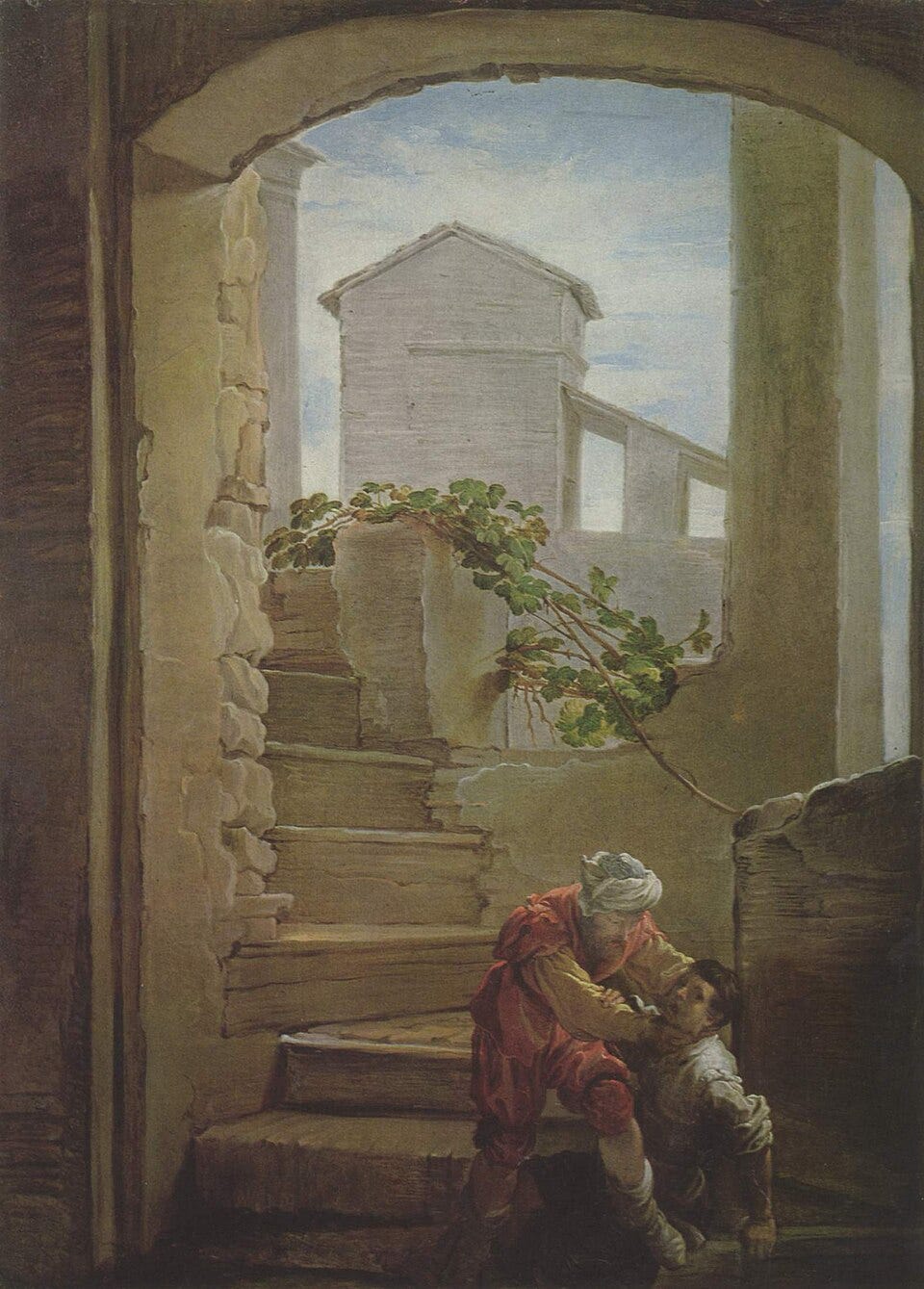
The servant walks out and finds a fellow servant who owes him a hundred denarii, roughly three months’ wages. He seizes him by the throat.
St. John Chrysostom, in his homilies on Matthew, does not soften what has happened: the servant who walks from the throne room to the chokehold has not merely failed a moral test, he has refused a transformation.3 He received the forgiveness formally but did not let it touch him. He walked out the same man he walked in. And Chrysostom draws the liturgical implication directly: we cannot approach the altar with unreconciled hearts and expect to receive what the altar offers. The Eucharist presupposes, and forms, a people who know themselves forgiven.
This is the Lenten challenge: We forget what we have been forgiven, even if not always consciously. The servant knew, objectively, that the debt had been cancelled. He had stood in the throne room and received the decree. But he did not carry the memory of it into his next encounter. The mercy of the moment had not become the mercy of his life.
Lent is the furnace that makes this visible. The forty days are not primarily about moral improvement, though conversion of life matters deeply. They are about standing long enough in the fire - in prayer, fasting, and almsgiving - to be stripped of the illusion that we are the ones who hold the ledger. Azariah knew he was not a creditor. He was a man in a furnace, reduced to a contrite heart, reminding himself and God of the covenant that preceded him. The Psalm refrain today is that same act of covenant-memory turned to petition: “Remember your mercies, O Lord.” We ask God to remember. And in the asking, we train our own memory.
The unforgiving servant went home after the throne room, back to his daily transactions, his network of debts owed and favors calculated. The mercy did not travel with him. This is not only a danger for individuals, it is a danger for households. The domestic church is precisely where the memory of mercy is either passed on or quietly abandoned. Families that pray together - around the table, at the end of the day, through the rhythms of the Church’s calendar - are practicing anamnesis. They are rehearsing the story. They are reminding each other, and their children, that the ledger has already been settled.
For those later on in life, this Lenten excavation can cut especially deep: old wounds, old resentments carried for decades, old debts that may have even calcified into identity.
The question these readings press is not “have you forgiven enough?” It is “do you know what you have been forgiven?” That knowledge - really known, carried in the body through liturgy and prayer and the daily life of the household - is what the fire is trying to give us.
A deacon serves at the threshold between sanctuary and street, between altar and home. This Sunday, when I prepare the altar, I will carry Azariah with me: we bring what we have, which is never enough, and we offer it from a contrite heart. The fire, it turns out, is the mercy.
If you are looking for a structure for daily prayer and formation within your household during Lent and beyond, Hearth & Altar offers daily reflections for Catholic families, and Eventide & Altar accompanies those in the second half of life through the Church’s prayer. Both are rooted in the conviction that what happens at home is not separate from the mission of the Church - it is the first school of faith.
Deacon Michael Halbrook is a permanent deacon of the Diocese of Springfield in Illinois, husband to Suzanne, and father of four sons. He serves at St. Elizabeth Parish in Granite City. He is the founder of Domus Formation, a collection of Catholic prayer and formation resources for every stage of life, and he writes at DeaconMichael.net.
Joseph Ratzinger, The Spirit of the Liturgy, trans. John Saward (San Francisco: Ignatius Press, 2000), 35-47.
See R.T. France, The Gospel of Matthew, NICNT (Grand Rapids: Eerdmans, 2007), 703.
John Chrysostom, Homilies on the Gospel of Matthew, Homily 61.
Wow. How I wish we could hear sermons like this.
"The fire, it turns out, is the mercy". This blew me away. Superb and unique (to me) reflection Michael, thank you.