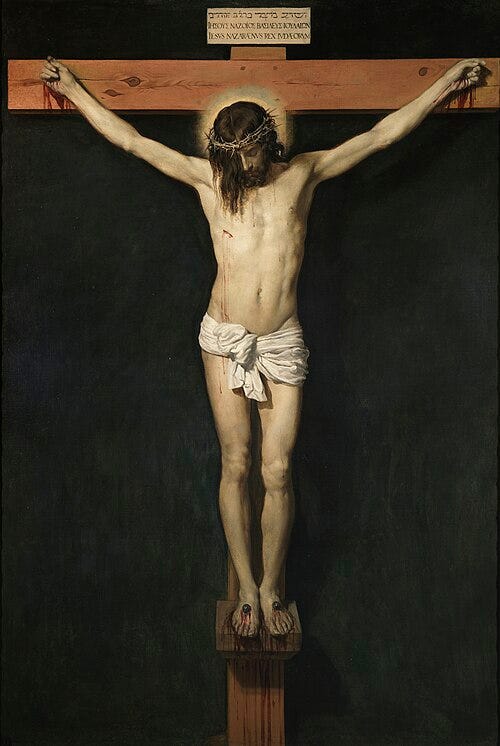
The Cross: Christ's Eternal Covenant of Love
Saturday, Marcy 28th Readings Reflection: Saturday of the Fifth Week of Lent

Today’s Epistle contains beautiful promises made by God to His people through the prophet Ezekiel. God promised to deliver His people from their idolatries and to “save them out of all the places in which they have sinned” (Ezek 7:23 DRB). He promised to give them one Shepherd and to establish an “everlasting covenant with them…and I will be their God, and they shall be [M]y people” (Ezek 7:26-27).
Today’s Epistle can seem out of place in the midst of our Passiontide observances. We expect to hear a passage more explicitly pertaining to Christ’s Passion—perhaps a Suffering Servant prophecy from Isaiah—but instead, the Church gives us this promise of hope and forgiveness and an everlasting covenant. In doing so, we are reminded of the reason for our Lenten observances and even for Christ’s Passion and Death.
It is easy to think, as the disciples did on that first Good Friday, that all hope is lost in the darkness of Christ’s Passion. It seems that evil triumphed that day, as Life Itself handed over His life and lay dead in a tomb. However, today’s Epistle reminds us that evil did not have the final word in Christ’s Passion, and that because of Christ’s Passion, it does not have the final word in our lives either.
The Church has a beautiful tradition of reminding us of this fact after granting us absolution in the confessional. Priests have the option of praying a prayer after imparting absolution asking that all the good and evil the person endures may be a remedy for sin, an increase of grace, and the reward of eternal life through the merits of Christ’s Passion. Through the Cross of Christ, our own crosses are transformed and become a means by which we can attain eternal life.
As we hear in today’s Epistle, God has saved us out of all the places in which we have sinned. The love of Christ on the Cross pierces even the darkest recesses of our hearts where we have built up walls of shame, transforming the wounds of our sins and making them privileged places of encounter with His love. As the Prophet Isaiah famously tells us, we are healed by His stripes, by His wounds (cf. Isa 53:5).
The promise of a new covenant and of healing, this assurance of hope that we hear in today’s Epistle, is precisely the reason why Christ underwent His Passion and Death. This, too, is why the Church continues to commemorate Christ’s Passion, Death, and Resurrection through her yearly observances of Holy Week and Easter. Each of the Holy Week liturgies, especially the sacred Triduum, enables us to unite ourselves more closely with Christ in His Passion so that we might more perfectly embrace our own crosses.
On Good Friday, we kiss the Cross, and traditionally, the priest wears black as the liturgical color for Good Friday. This emphasis on the Cross is not a morbid fascination with suffering or a grim resignation to the trials of this earth; rather, it is a physical reminder that only through the Cross of Christ can we come to the glory of His Resurrection. It is only by embracing our own crosses that we can more fully experience the love that Christ poured forth on the whole world through His own Cross.
As we enter this holiest week of the year, may we do so with hope in our hearts, remembering the love and the promise of eternal life that is found within the sacred events that we commemorate.