
The Church Built on the Apostles
Gospel Reflection for Wednesday, August 12th, 2026

“If your brother sins against you, go and tell him his fault, between you and him alone. If he listens to you, you have gained your brother. But if he does not listen, take one or two others along with you, that every word may be confirmed by the evidence of two or three witnesses. If he refuses to listen to them, tell it to the Church; and if he refuses to listen even to the Church, let him be to you as a Gentile and a tax collector. Truly, I say to you, whatever you bind on earth shall be bound in heaven, and whatever you loose on earth shall be loosed in heaven.” Matthew 18:15–18.
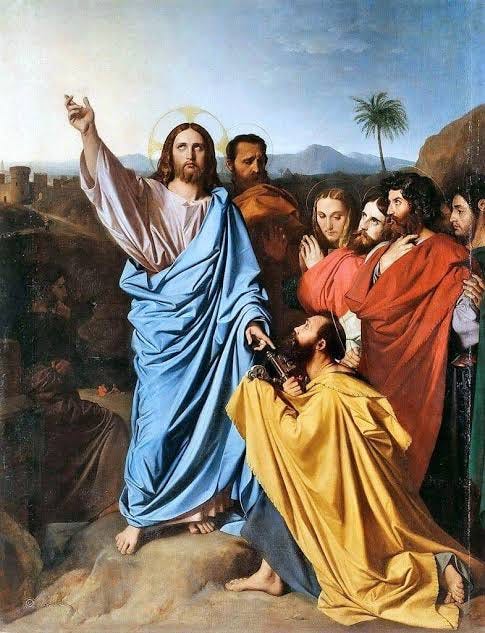
Today’s Gospel needs to be read in the context of the founding of the Church on the Rock of St. Peter, which happens two chapters earlier in the Gospel of Matthew:
“And I tell you, you are Peter, and on this rock I will build my Church, and the gates of Hades shall not prevail against it. I will give you the keys of the kingdom of heaven, and whatever you bind on earth shall be bound in heaven, and whatever you loose on earth shall be loosed in heaven.” Matthew 16:18–19.
Two important themes are shared in these two passages:
The Church as a concrete reality
The authority of binding and loosing
First, we have the reality of an instituted and concrete Church. Some would like to claim that the Church is merely a spiritual reality that is loosely and nominally applied to those who have faith in Christ to one degree or another. The advantage of believing this error is that the person believes that they do not have to be visibly united to a particular Church. If we take church to only be something nominal, then the individual de facto becomes their own church. In both passages from Matthew, however, Our Lord dispels this error by instituting a Church and placing St. Peter as the visible head. This is further confirmed in today’s passage. Our Lord tells His followers that one who is in error must be brought to the Church, and it is the Church that will ultimately correct him if he refuses to listen to both the individual and the group of witnesses. This is an important confirmation of the existence and function of the Church. If there was no visible instituted Church, there could be no legitimate correction to give to the person in error. The penalty for remaining obstinate in the error is likewise a proof of the church. If the erroneous person refuses obedience to the Church, they are to be cut off.
Cut off from what exactly?
One cannot be cut off from something that is only nominally present. There has to be a concrete reality that one is both brought into and a member of in an authentic and visible way. Only then can there be a penalty that is also authentic and visible.
Second, we find the language of binding and loosing. This authority is first given to St. Peter and is founded upon his confession of faith. He is given the keys and the authority to bind and loose on earth, with the lasting effect coming in heaven. This authority is then shared with the other eleven Apostles in the passage for today. This authority has been passed down through the succession of the Office of St. Peter and extended to all who are successors of the Apostles. Our Lord is very clear: what Peter and the Eleven bind on earth is also bound in heaven, and whatever they loose on earth is loosed in heaven. This holds true throughout the history of the Church up through present times. The existence of the one Church of Jesus Christ and the authority that She wields does not end with the death of the Apostles. What would be the purpose of that? Why would Christ institute something for only a short time and not mean for it to endure until His second coming?
This is what is meant by the promise that the gates of hell shall not prevail against it. The Church remains through every generation, under the care of the Successor of St. Peter and his brother bishops. The Church remains a concrete and visible body that one is incorporated into through the sacrament of Baptism, and must remain in for their salvation.
Pray for our Holy Father, Pope Leo XIV, and his brother bishops in their shepherding of the Holy Catholic Church.

For more from Dr. McGovern, visit his Substack at A Thomist, Dedicated to the Theological tradition of St. Thomas Aquinas. Exploring Thomas’ Spiritual Theology and topics in Christology and Mariology.