
The Authority of the Resurrection
Gospel Reflection for Wednesday, March 18th, 2026

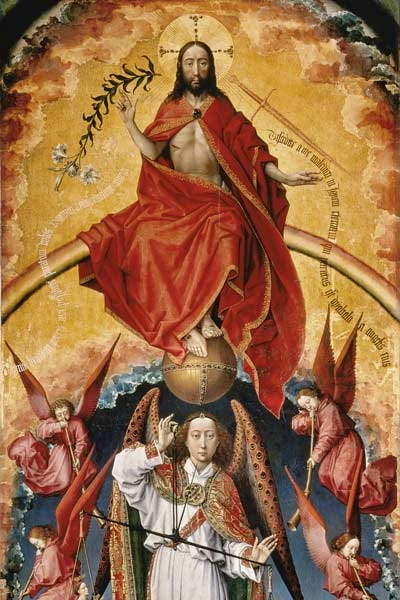
“Do not be amazed at this, because the hour is coming in which all who are in the tombs will hear his voice and will come out, those who have done good deeds to the resurrection of life, but those who have done wicked deeds to the resurrection of condemnation.” John 5:28-29
Today, we find Our Lord being challenged by the Jewish authorities in response to His healing of the cippled man on the Sabbath.1 This healing was forbidden according to the Jewish Authorities since it constituted work on the Sabbath and was interpreted as a violation of the third commandment. Because of this, the Jews sought to persecute Him.2 Against this charge, Our Lord cites His authority as the Son of Man, making Himself equal to God. As a result, they sought to kill Him.3
In the face of this persecution, Our Lord expands upon the authority He possesses from the Father. The Father has given to the Son all that He is; the Son receives from the Father the divine nature and divine life that He possesses as a result of the eternal begetting of the Son.4 The authority that follows upon this is a complete authority, which is perfected in the resurrection and judgment over man. Thus, there are two aspects to this authority which show the Divine Nature of the Son:
That of the authority to raise the dead
That of the authority to judge mankind
These two aspects of Christ’s authority can only be possessed by He who is divine, since only God can raise the dead and only God can judge mankind. This is a significant claim by Christ in the face of a blasphemy accusation. In first-century Judaism, blasphemy was a capital crime and was one of nine crimes that were punishable by stoning.5 Making oneself equal to God is blasphemy. Thus, it is significant that knowing this, Our Lord makes sure to claim an exclusively divine authority to leave no doubt of His divine claims.
The first of these claims is the power to resurrect. There are two prophecies from the Old Testament that form the backdrop to this claim: Daniel 12:2 and Ezekiel 37:1-4.
“And many of those who sleep in the dust of the earth shall awake, some to everlasting life, and some to shame and everlasting contempt.” Daniel 12:2
The book of Daniel is especially Christological with its reference to the prophecy of the Son of Man standing equal with the Ancient of Days,6 as well as the illusion to Christ standing amongst the fiery furnace.7 In addition to the Christological oracles, Daniel also foretells the resurrection of the dead and the judgment that comes to them. In the context of Daniel, we ought to attribute the resurrection and judgment of the dead to this Son of Man, as Daniel ascribes to Him “an everlasting dominion, which shall not pass away…”8 This is a complete dominion given by the Ancient of Days to the Son of Man.
In Ezekiel, we find the prophet as a type for Christ, being called Son of Man and being told to prophesy to the dead bones in front of him to rise and live again. This is again a Christological prophecy that the Son of Man would come to give life back to the “whole house of Israel.”9 The Son of Man speaks, and the dead shall rise:
“And you shall know that I am the Lord, when I open your graves, and raise you from your graves, O my people… I, the Lord, have spoken, and I have done it, says the Lord.” Ezekiel 37:13-14.
Both prophets attribute the resurrection of the dead to the coming Son of Man. Christ, assuming the identity of the Son of Man, reminds the Jewish authorities of the true authority He has.
Along with the resurrection of the dead, Christ, the Son of Man, also claims authority to judge all of mankind. St. Thomas gives us three reasons why Christ, as man, is given authority by the Father to judge:
In order that He might be seen by all: for it is necessary that a judge be seen by all who are to be judged… And the good will see Christ in His divinity and in His humanity; while the wicked will not be able to see Him in His divinity, because this vision is the happiness of the saints and is seen only by the pure in heart.
Because by the self-abasement of His passion He merited the glory of exaltation… He who was falsely found guilty will condemn the truly guilty.
Christ, as man, was given judiciary power to suggest the compassion of the judge. For it is very terrifying to be judged by God… but it produces confidence for a man to have another man as his judge. Accordingly, so you can experience the compassion of your judge, you will have a man as judge…10
St. Thomas gives us three beautiful and yet striking reasons as to why it has been given to the Son of Man to be our judge. This two-fold authority possessed by the Son of resurrection and judgment corresponds very beautifully to His dual natures united in His one person. Both are possessed by the Son in fullness.
The Father has given all into the hands of the Son and, as such, He will raise us and judge us. Some will be united to Him for all eternity, forever beholding the Hypostatic beauty that sits before them, united to the Father and Spirit, one God. The others will be cast into eternal darkness, devoid of all love, since they did not desire to be saved by Christ’s sacred humanity.
Mercy and justice have kissed in this Gospel passage. Let us immerse ourselves in the compassion of God, since He has sent His son, as a man, to be our judge and our bridge to the glory of the Godhead.
For more from Dr. McGovern, visit his Substack at A Thomist, Dedicated to the Theological tradition of St. Thomas Aquinas. Exploring Thomas’ Spiritual Theology and topics in Christology and Mariology.
Cf. John 5:1-16.
Cf. John 5:16.
Cf. John 5:18.
Cf. John 1:14 and Creed of the First Ecumenical Council at Nicea (325), Denz. 125.
Cf. Leviticus 24:13-23.
Cf. Daniel 7:13-14.
Cf. Daniel 3:25. St. Jerome is among the Fathers who interpret the fourth figure as Jesus Christ in His descent into the Father’s Limbo on Holy Saturday. (See St. Jerome, Commentary on Daniel 3, 25.)
Daniel 7:14.
Ezekiel 37:11.
St. Thomas Aquinas, Commentary on the Gospel According to St. John, 789.
What an extraordinary title “Ancient of Days”
This was an amazing reflection.