
The Annunciation
Gospel Reflection for Wednesday, March 25th: The Solemnity of the Annunciation to the Blessed Virgin Mary

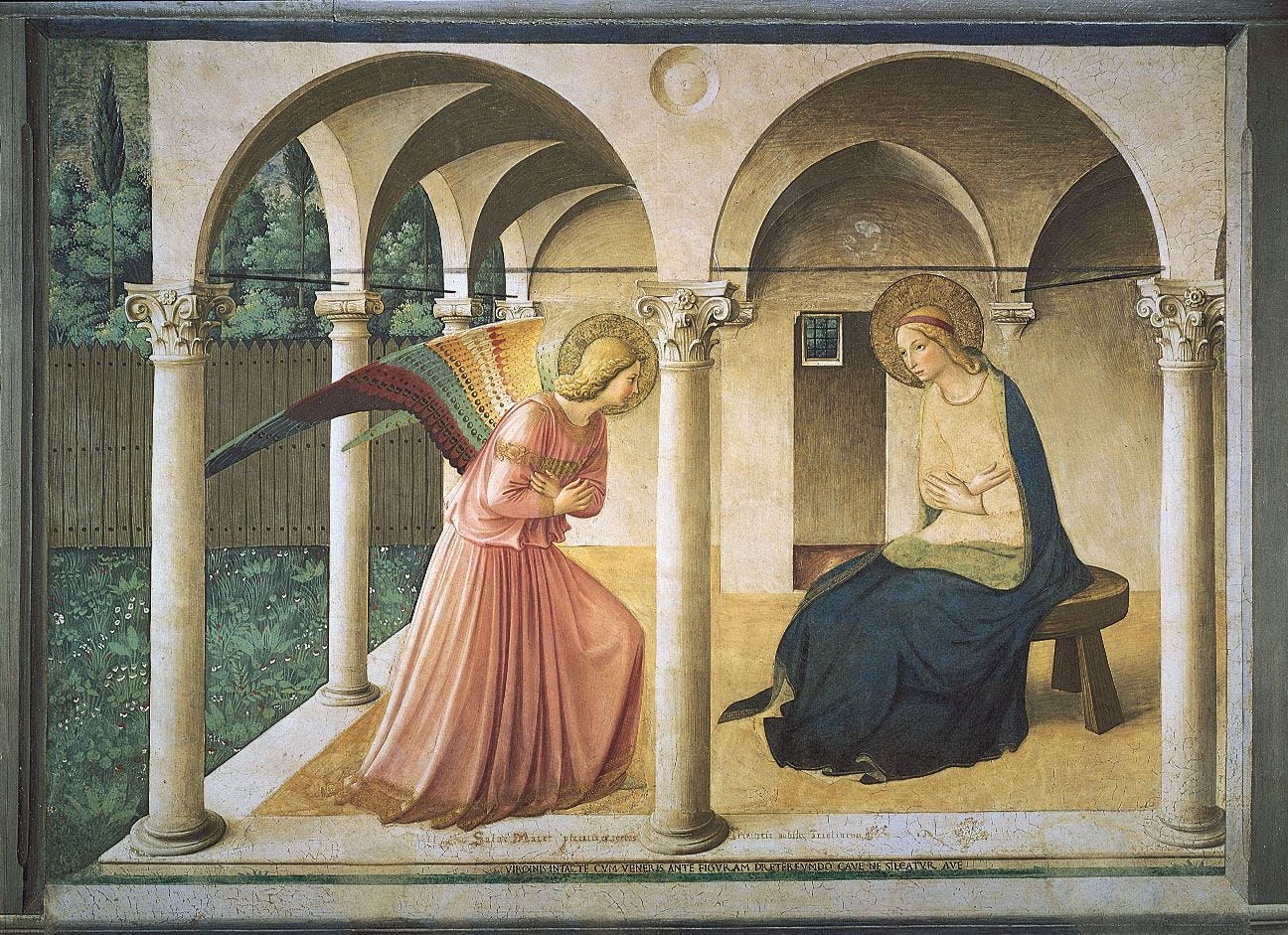
With today’s Solemnity, the Church celebrates the great mystery of the faith: The Incarnation of Christ in the womb of the Blessed Virgin Mary. Connected to this mystery are the mysteries of the Immaculate Conception, seen in the greeting of the Angel:
“And he came to her and said, ‘Hail, full of Grace, the Lord is with you.” Luke 1:28, RSVSCE1
As well as the Perpetual Virginity, prophesied in today’s first reading:
“Therefore, the Lord Himself will give you a sign. Behold, a virgin shall conceive and bear a son, and shall call his name Immanuel.” Isaiah 7:14, RSVSCE
And then confirmed by the Angel Gabriel:
“And the Angel said to her, ‘The Holy Spirit will come upon you, and the power of the Most High will overshadow you; therefore the child to be born will be called holy, the Son of God.” Luke 1:35, RSVSCE2
In the midst of these Marian Dogmas, resides the very core of Christianity, that the second person of the Trinity became incarnate of the Virgin Mary and became man. Today’s Verse Before the Gospel draws from the Prologue of St. John:
“The Word of God became flesh and made His dwelling among us; and we saw His glory”3
The Solemnity of the Annunciation is the commemoration of when the Word became flesh. It should not be lost on us, however, the importance that the Virgin Mary has in this mystery. Christ was incarnate of her. This great act by God was willed from all eternity so that man would have an active role in his own redemption. Thus, Mary’s consent is sought by God on behalf of all mankind. St. Thomas treats the Annunciation in the Teria Pars, question 30. I want to draw from the first article and its four reasons why it was necessary for the Annunciation to happen.4
It is fitting that Mary be informed in mind of the Incarnation before conceiving Him in the flesh.
This first reason encompasses Mary’s faith in Christ. By the Angel announcing to the Virgin that the Incarnate Son of God was to be given to her, she is able to express the virtue of faith in Him prior to the conception in the womb. St. Thomas quotes St. Augustine here, who says very beautifully, “Her nearness as a mother would have been no profit to Mary, had she not borne Christ in her heart after a more blessed manner than in the flesh.”5 Had Mary not had faith in her Son, her status as Mother would have done no good for her. Through the annunciation, she is able to come to faith in Christ and conceive Him in her heart and then, through her fiat, conceive Him in the womb.
That she might be a more certain witness of this mystery, being instructed by God.
Mary is the first to witness to the Incarnation of Christ and to His divine identity. She is instructed by God and then takes that divine revelation and brings the Good News to others. Mary is, in a sense, the first evangelist in that she, as the New Ark of the Covenant, brings the perfection of the Law, Priesthood, and Manna to Jerusalem when she goes to see Elizabeth.6 Through Mary’s faith and her witness of this great miracle, there is no more certain believer than her.
That she might offer to God the free gift of her obedience.
Here, we encounter Mary’s fiat. She is totally submissive to God and utters the words that all of heaven and earth are yearning to hear:
“Behold, I am the Handmaid of the Lord, let it be to me according to your word.” Luke 1:38, RSVSCE
With this fiat, Mary consents to being the Mother of God. At the same time, she consents to the sorrows that come with it that are prophesied by St. Simeon.7 God was not going to save us without our consent, and this consent began with the Blessed Virgin in a total and free gift of self.
The consent of Mary was sought in place of that of the entire human race.
That consent is also given on behalf of the human race. As St. Thomas says, “there is a certain spiritual wedlock between the Son of God and human nature.”8 The Angelic Doctor is speaking of the Hypostatic Union, in which Christ assumes a human nature to His divine person in the Incarnation. This human nature is taken from Mary, but it is an identical human nature to all other humans. This means, through the Virgin, Christ comes to share in the humanity common to all through His specific humanity taken from Mary. This is a sublime teaching. Through Mary, He takes our nature, and through Mary, we give consent for it to happen.
The Word became flesh. He chose to be conceived and born of a woman. Strictly speaking, this could have happened in other ways, but our merciful God chose to condescend and become the very thing that had given so great an offense. The feast of the Annunciation and the Mystery of the Incarnation are evidence of the immense mercy of God. Today’s solemnity is also the beginning of the Cross. There is a certain fittingness, then, for it to occur in Lent in the years that it does. This year, we have the opportunity to contemplate the immensity of the Incarnation in the week prior to our journeying with Our Lord through Holy Week.
This solemnity also reminds us that the Virgin accompanies Our Blessed Lord from the very first moment of His conception to the laying of Him in the tomb.
Happy Solemnity.
For more from Dr. McGovern, visit his Substack at A Thomist, Dedicated to the Theological tradition of St. Thomas Aquinas. Exploring Thomas’ Spiritual Theology and topics in Christology and Mariology.
The title “Full of Grace” denotes a perfection in grace in which Mary is free from that which would empty her from grace, that being sin. Her conception without the stain of sin is Dogmatically Defined by Pope Pius IX in 1854.
The Dogma of the Perpetual Virginity was formally defined at the Lateran Synod in 649.
Cf. John 1:14.
ST IIIa q. 30, a. 1.
St. Augustine, De Sancta Virgin, III.
Cf. Luke 1:39-56.
Cf. Luke 2:35. I have written a series of articles on Our Lady of Sorrows. All of them can be found here.
ST IIIa q. 30, a. 1.
🌐 📯 Today, Salvation is become InCarne! 🧵🪡🩸🔥🪽
Grace and peace to you, Most Holy Theotokos save us....