
That They Should Know You
Tuesday of the Seventh Week of Easter | Acts 20:17-27 | Psalm 68 | John 17:1-11a

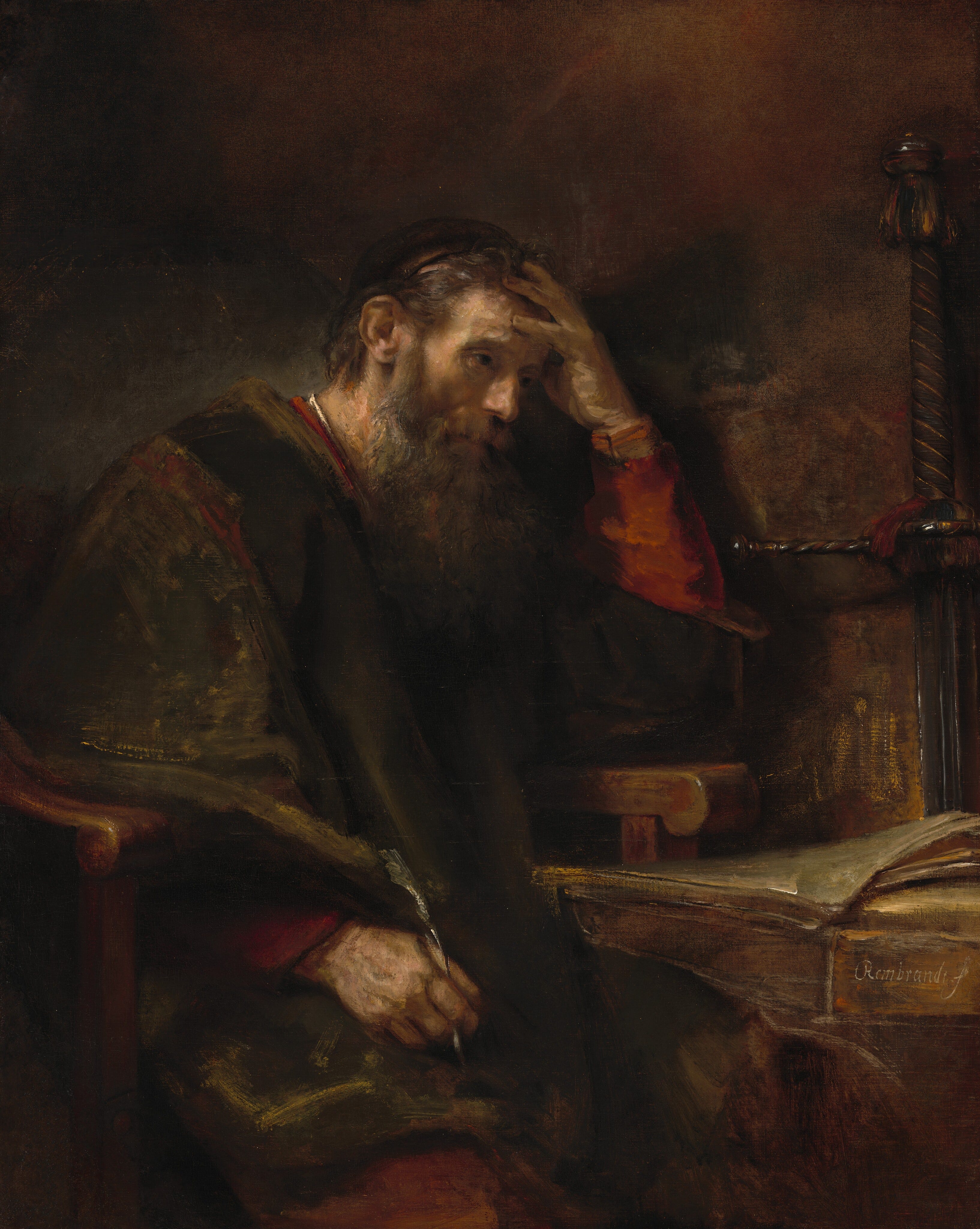
Paul is making his farewell.
He has summoned the elders of the church at Ephesus to meet him at Miletus, and he speaks to them the way a man speaks when he knows he will not see these faces again. The Spirit has been warning him in every city: imprisonment and hardships await in Jerusalem. He is going anyway. “Yet I consider life of no importance to me, if only I may finish my course and the ministry that I received from the Lord Jesus.”
The Greek is stronger than the translation: oudenos logou poioumai - I reckon it of no account, I count it as nothing. Not stoic indifference to life. The freedom of a man who has found and attached himself completely to something worth more than the world.
Those who have followed Paul through this Easter season will feel the weight of that sentence. We watched him give wholehearted approval to Stephen’s stoning. We watched Barnabas retrieve him from Tarsus. We watched him stoned at Lystra and get up. We watched him sing at midnight in a Philippian cell. The man who stands at Miletus making this farewell has been formed, over years and across beatings, into someone who can say I count my life as nothing and mean it as liberation rather than despair. The course he was given has cost him everything. He has not shrunk from it.
And then, almost in passing, he names where the ministry happened: “teaching you in public or in your homes.”
Both. The proclamation of the Gospel in Acts is never confined to the synagogue or the agora or the lecture hall. It happens in houses - in the jailer’s home at Philippi, in the households baptized throughout the journey, in the upper rooms and the domestic spaces where the early church gathered, ate, prayed, and kept faith with one another. Paul does not list the homes as a secondary venue, a fallback when the public forum was unavailable. He lists them alongside the public teaching as co-equal sites of the mission.
This is worth pondering as Pentecost approaches. The great feast of the Spirit’s outpouring is coming - the feast of proclamation, of tongues of fire, of three thousand baptized in a single day. And yet the Spirit who descends at Pentecost is the same Spirit who has been working all along in the homes: in the household of Cornelius, of Lydia, of the Philippian jailer, of the Ephesian elders gathered now on the shore at Miletus. The public and the domestic are not in tension in Acts. They are the same mission, carried out in different spheres.
Jesus, on the night before he died, raises his eyes to heaven and prays. Not for the world - he says this plainly - but for the ones the Father has given him. Specific people. Known by name. Entrusted back to the Father as the hour arrives.
And in the middle of that prayer, he offers a definition so compact it is easy to miss: “Now this is eternal life, that they should know you, the only true God, and the one whom you sent, Jesus Christ.”
The Greek ginōskōsin - to know - is not the knowing of information. It is the knowing of covenant, the intimate knowledge of a relationship sustained over time. It is the word used of Abraham knowing Sarah, of God knowing Israel, of the shepherd knowing his sheep. Eternal life, in John’s theology, is not primarily a quantity - endless duration - but a quality: this kind of knowing, this kind of being known, beginning now and continuing without end.
Aquinas, in his commentary on John, notes that eternal life does not wait for death to begin - it is already present wherever the soul is truly oriented toward God in this covenantal knowing.1 Paul has been living it at Lystra, at Philippi, at Miletus. He counts his life as nothing not because life has no value, but because he has already entered the life that cannot be taken from him.
Augustine makes the same point in his Tractates on John, reflecting on this verse: the knowledge of God that constitutes eternal life is not a philosophical achievement but a gift received in faith - and it is received, transmitted, and sustained in community, in the particular relationships of those who have been given to the Son and entrusted to one another.2
“They are in the world, while I am coming to you.”
Jesus’s final words in this passage are not a lament. They are a commission wrapped in a prayer. He is leaving. They are staying. And the ones who stay are the ones through whom the ginōskōsin - the knowing that is eternal life - will be passed forward.
This is the vocation of the domestic church in its plainest form. Not the dramatic farewell address at Miletus, not the midnight singing in the Philippian cell, not the stoning and the rising - though the household has its own versions of all of these. The daily transmission of knowing: the child who learns to pray because a parent prays beside them, the spouse who comes to faith because the other spouse kept faith through the long years, the grandparent who passes forward what was given to them before the grandchildren were born.
Paul taught in public and in homes. Jesus prays not for the world but for the named ones. The Spirit descends not only on crowds but on households. The course we have each been given to finish is specific, domestic, and irreplaceable - the knowing passed to the particular people who have been given to us, who will carry it forward into a world we will not live to see.
Pentecost is just days away. The season of Easter is nearly complete. What we have been given in these fifty days - in the readings, in the liturgy, in the daily formation of prayer and household life - is meant to be carried. Not archived, not merely remembered. Carried forward, in public and in homes, until the course is finished.
Domus Formation offers tracks of daily prayer formation for families, men, women, teens, and those in the second half of life. The first school of faith is the home, and every member of it deserves to be formed.
If Catholic fiction that takes the Communion of Saints seriously - as doctrine, not sentiment - is what you're looking for, I am writing two things. Lux Perpetua is a serial novel publishing weekly: a free Monday chapter and a paid Thursday chapter, set in Alton, Illinois, at the edge of the Mississippi - a story of custody and fidelity and a flame passed forward across centuries. And Two Lamps is a weekly short story on Substack, each one braiding two saints from different centuries into a single imagined meeting - this Friday, Saint Vincent of Lérins and Blessed John Henry Newman, in a first-class compartment between Birmingham and London, in autumn 1888. Free to read. Both are for the kind of reader who believes the imagination is also a faculty of faith.
Deacon Michael Halbrook is husband to Suzanne, father of four sons, and a permanent deacon of the Diocese of Springfield in Illinois. He serves at St. Elizabeth Parish in Granite City. He is the founder of Domus Formation, a collection of Catholic prayer and formation resources for every stage of life, and he writes at DeaconMichael.net.
Thomas Aquinas, Commentary on the Gospel of John, Chapter 17, Lecture 1.
Augustine of Hippo, Tractates on the Gospel of John, Tractate 105.3.
I started following your Two Lamps sub-stack, and really like it.
What stayed with me most was the quiet insistence that transmission does not happen only in great moments or public declarations, but inside ordinary continuity.
“Teaching you in public or in your homes.”
There is something deeply true in that.
Faith, presence, even memory itself often survive through small domestic gestures carried faithfully over time.