
Sweet as Honey in My Mouth
Tuesday of the Nineteenth Week in Ordinary Time | Memorial of Saint Clare, Virgin Ezekiel 2:8-3:4 | Psalm 119 | Matthew 18:1-5, 10, 12-14

Note: Today is the Memorial of Saint Clare of Assisi, Virgin. The Church provides proper readings for this memorial; I have chosen to reflect on the weekday readings, though Clare appears where the readings invite her.
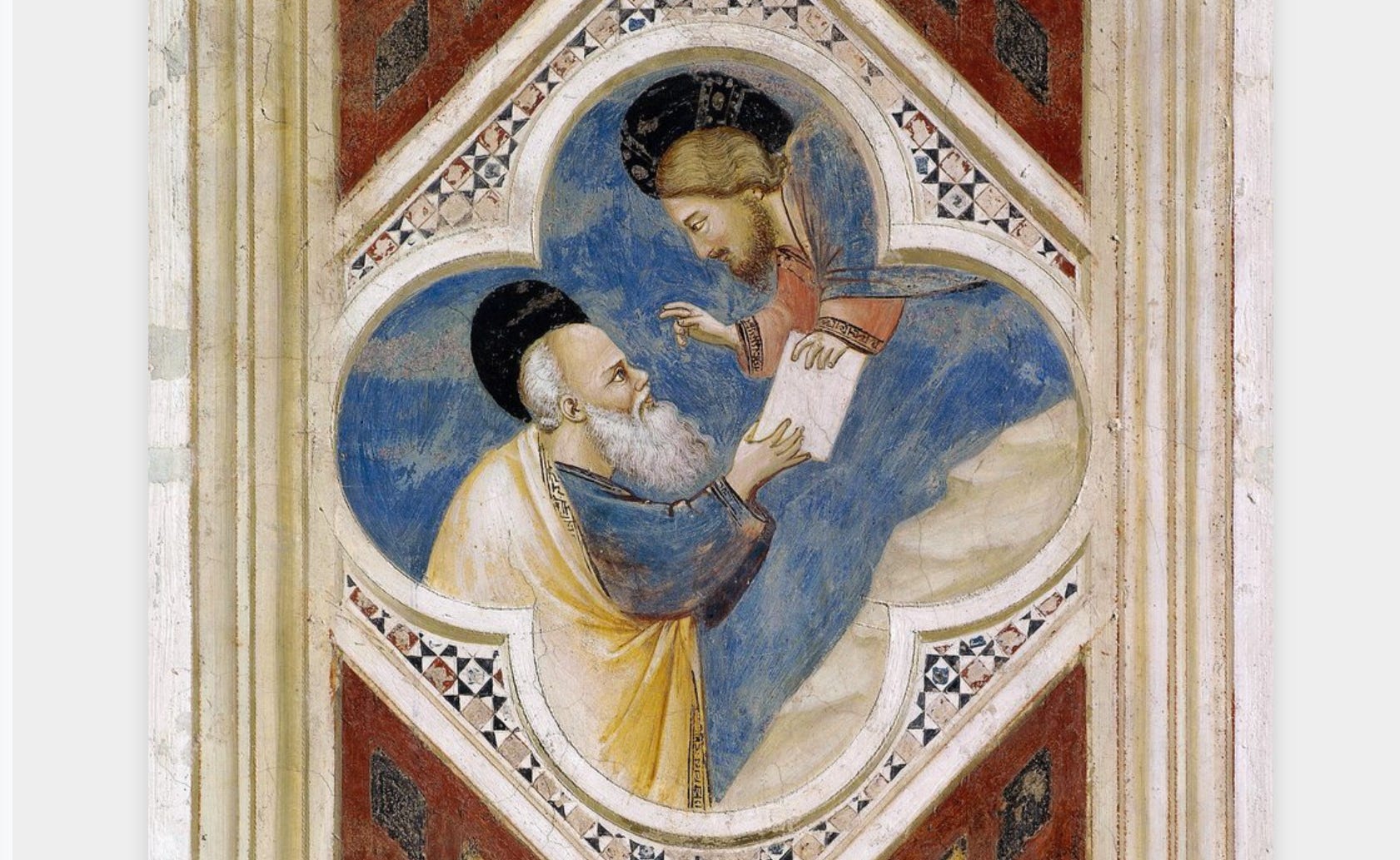
A hand stretches out to Ezekiel, holding a scroll. It is covered with writing front and back - lamentation and wailing and woe. God commands the prophet: eat this. Not read or study, but eat it. Fill your belly with it. And then go speak to the house of Israel.
Ezekiel obeys. He opens his mouth, takes the scroll, and consumes it. And we hear: “It was as sweet as honey in my mouth.”
The scroll covered in lamentation tasted like honey. The word full of woe became, in the eating, something sweet.
The lamentations remain lamentations, but the prophet who has eaten the word, who has taken it as nourishment to be digested, assimilated, allowed to become part of his very body - discovers that the Word of God is sweet not despite its difficulty but because of whose Word it is.
St. John Chrysostom named the distinction that Ezekiel’s eating enacts - the assimilation of the Word into our very being: “The Holy Scriptures were not given to us that we should enclose them in books, but that we should engrave them upon our hearts.”1 The Word in the hand is not the point. The Word in the belly and in the heart is the point. The Word that lives in us rather than merely beside us is the word that can be spoken into a rebellious house.
Today the Church celebrates Clare of Assisi, who entered the life of radical poverty with Francis in 1212 and spent the next forty-two years at San Damiano - never leaving its walls, holding the vision in place while the brothers went out.
She had eaten the scroll.
Not metaphorically. She had received the form of life the Gospel proposed - poverty so complete that she fought for it for decades against Church authorities who kept trying to give her mitigated rules that would have softened it - and she had let it become her. She did not merely follow a rule. Francis himself said she was the living form of the Gospel.
Paul, in Philippians 3:8 - which the Church assigns as the proper first reading for her memorial today - named what she had done in a single sentence: “I consider everything as a loss because of the supreme good of knowing Christ Jesus my Lord.” Clare lived this, for forty-two years, straining forward to what lies ahead.
The disciples, meanwhile, are asking the wrong question (again).
“Who is the greatest in the Kingdom of heaven?”
They are still thinking in categories of position and precedence. They want to know the social architecture of the Kingdom. They expect an answer about hierarchy.
Jesus calls a child over and places it in their midst.
Chrysostom, in his homily on this passage, notes that Jesus does something unexpected here: “He unveils their conscience, and replies to their feeling, not merely to their words.”2 He is not answering the question they asked. He is answering the question underneath it - the competitive craving for primacy that prompted it - and he answers it with a child. The child is a person of no legal or social standing, no leverage, no claim to precedence. “Since both from envy the little child is pure, and from vainglory, and from longing for the first place; and he is possessed of the greatest of virtues, simplicity, and whatever is artless and lowly.”3
And then He extends the image of the child into a Word spoken to their hearts: “Whoever receives one child such as this in my name receives me,” and “It is not the will of your heavenly Father that one of these little ones be lost.”
The Kingdom is not built by those who have secured the greatest position. It is built by those who receive the little ones - who see the irreplaceable one, the particular person in front of them - and refuse to let them be lost in the crowd.
Luke Burgis, in his recent book The One and the Ninety-Nine, offers a reading of the lost sheep parable that has stayed with me since I finished the book a couple of weekends ago. We usually read it as a rescue mission: the shepherd leaves the ninety-nine to retrieve the wanderer and restore the flock to wholeness. But Burgis suggests another layer: the shepherd goes after the one not merely to reintegrate them into the flock, but to protect the one’s particularity within the whole. Each one matters as the one - not as a data point to be returned to the average, but as an irreplaceable person whose individuality the shepherd knows and guards.4
The group of the ninety-nine, Burgis notes, always pulls toward conformity. The crowd wants everyone to look alike, move together, stay in line. But the shepherd leaves because the one cannot be replaced by the ninety-nine. The Father’s will is not that one of these little ones be absorbed. His will is that not one be lost.
The household is the first place where particular persons are received - where children are known by name, where the irreplaceable one is not lost in the crowd. The domestic church does not form a mass. It forms persons. And the formation begins not in the delivery of words, but in what Chrysostom says about the Scriptures and what Ezekiel enacts with the scroll: that the word that is eaten, not merely read; the Gospel that is lived, not merely known. The honey is found not in the book but in the belly.
The Psalm refrain today is the refrain of the person who has eaten the scroll and found it sweet: “How sweet to my taste is your promise!” Not information about God’s promise. The promise itself, tasted, swallowed, alive in the one who has consumed it.
Eat this scroll. Then go speak to the house of Israel.
That is still the order. The going and the speaking are real and necessary, but the eating comes first. And the eating, as Ezekiel and Clare and every person who has let the Gospel become their nourishment will tell you, is the sweetest thing there is.
The domestic church doesn’t form itself. Domus Formation’s & Altar app gives your household a daily rhythm of Catholic prayer and formation - tracks for families, men, women, teens, and those in the second half of life. Start a free trial at WeAreDomus.com/start.
If Catholic fiction that takes the Communion of Saints seriously - as doctrine, not sentiment - is what you are looking for, I am writing two things. Lux Perpetua is a serial novel publishing weekly in two tracks, set in Alton, Illinois, at the edge of the Mississippi - a story of custody and fidelity and a flame passed forward across centuries. And Two Lamps is a weekly short story on Substack, each one braiding two saints from different centuries into a single imagined meeting. Both are for the kind of reader who believes the imagination is also a faculty of faith.
Deacon Michael Halbrook is husband to Suzanne, father of four sons, and a permanent deacon of the Diocese of Springfield in Illinois. He serves at St. Elizabeth Parish in Granite City. He is the founder of Domus Formation, a collection of Catholic prayer and formation resources for every stage of life, and he writes at DeaconMichael.net.
John Chrysostom, Homilies on Colossians; widely attested in the patristic tradition.
John Chrysostom, Homilies on the Gospel of Matthew, Homily 58 (on Matthew 18:1-5); available at New Advent, newadvent.org.
Ibid.
Luke Burgis, The One and the Ninety-Nine: Forging Identity in the Age of Social Contagion (New York: St. Martin's Press, 2026). I wrote more about the book's argument and its resonance with parish life at DeaconMichael.net.