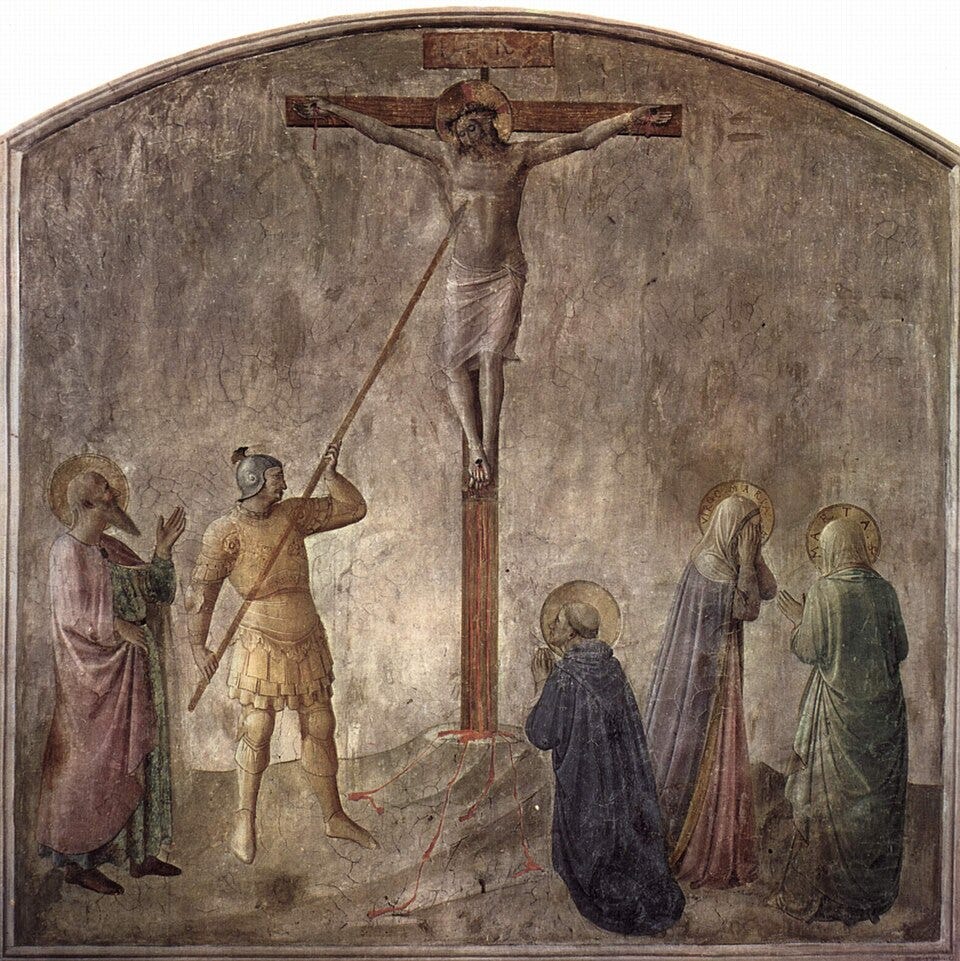
St. Longinus: Mercy at the Foot of the Cross
Saturday, March 13th Readings Reflection: Saturday of the Third Week of Lent

“If today you hear [H]is voice, harden not your hearts.”
This familiar Psalm verse, which the Church gives us today before the Gospel, sums up the theme of today’s Gospel, where we hear the parable of the Pharisee and tax collector praying in the Temple. The Pharisee’s self-righteous prayer was not heard by God, while the tax collector’s humble prayer for mercy was heard and answered.
Since today is traditionally the Feast of St. Longinus, I would like to highlight how the message in today’s parable is beautifully exemplified in the life of this saint. St. Longinus is the Roman centurion who pierced Our Lord’s side with a lance. According to tradition, the centurion suffered from very poor eyesight; however, as the Blood and water poured forth from Christ’s side, some touched his eyes, and immediately, the centurion’s vision was fully restored. At that moment, as we know from the Gospels, he professed his newfound faith that Christ is truly the Son of God (cf. Mk 15:39).
From tradition, we know that St. Longinus left the Roman army and became a monk in Cappadocia. He was later arrested for being a Christian, suffering horrible tortures that included the removal of his teeth and tongue. Despite this, St. Longinus miraculously retained his ability to speak clearly and destroyed several of the governor’s idols, through which the governor had become blind by demonic oppression. St. Longinus was ultimately beheaded for his faith around the year 45 AD. During his martyrdom, his blood is said to have touched the blind governor’s eyes, miraculously restoring the man’s eyesight just as St. Longinus’s sight was miraculously restored through Christ’s Blood (Catholic.org).
St. Longinus’s life is a beautiful example of the power of God’s infinite mercy, personifying St. Paul’s words about the depths of Christ’s love in dying for us while we were still sinners (cf. Rom 5:8-9). Here was this soldier assisting in the very act of crucifying God, yet after Christ had died, when He poured forth Blood and water from His side as a fount of mercy for all mankind, He drew this soldier to Himself and welcomed Him into the life of grace. St. Longinus is the only recorded conversion among those who crucified Our Lord, not because Christ refused to forgive the others (which the Gospels tell us is false) but because the others did not open their hearts to His mercy and forgiveness.
Fr. Louis Chardon, a 17th century French Dominican, wrote that certain disciples hold special distinctions in their experiences with Christ during His earthly ministry. St. John the Beloved lay close to His Sacred Heart at the Last Supper, St. Thomas the Apostle placed his hand in Christ’s pierced side, and St. Mary Magdalen anointed His feet. Using this same logic, we can recognize a unique distinction in St. Longinus, namely, that he physically stood at the foot of the Cross as Christ’s mercy physically poured onto him as Blood and water.
Certain saints, like St. Therese of Lisieux, have written of mystically and spiritually standing at the foot of the Cross to collect every drop of Christ’s Blood and pour it upon the souls of sinners. St. Longinus did this as a sinner himself and received the graces of divine mercy that baptized him into the life of grace. As we commemorate his feast today, may we pray for the grace to spiritually stand with him at the foot of the Cross in these last weeks of Lent, with hearts open to receiving Christ’s mercy and forgiveness in order to merit a share in the glory of His Resurrection.
St. Longinus, ora pro nobis!