
Songs in the Night
Tuesday of the Sixth Week of Easter | Acts 16:22-34 | Psalm 138 | John 16:5-11

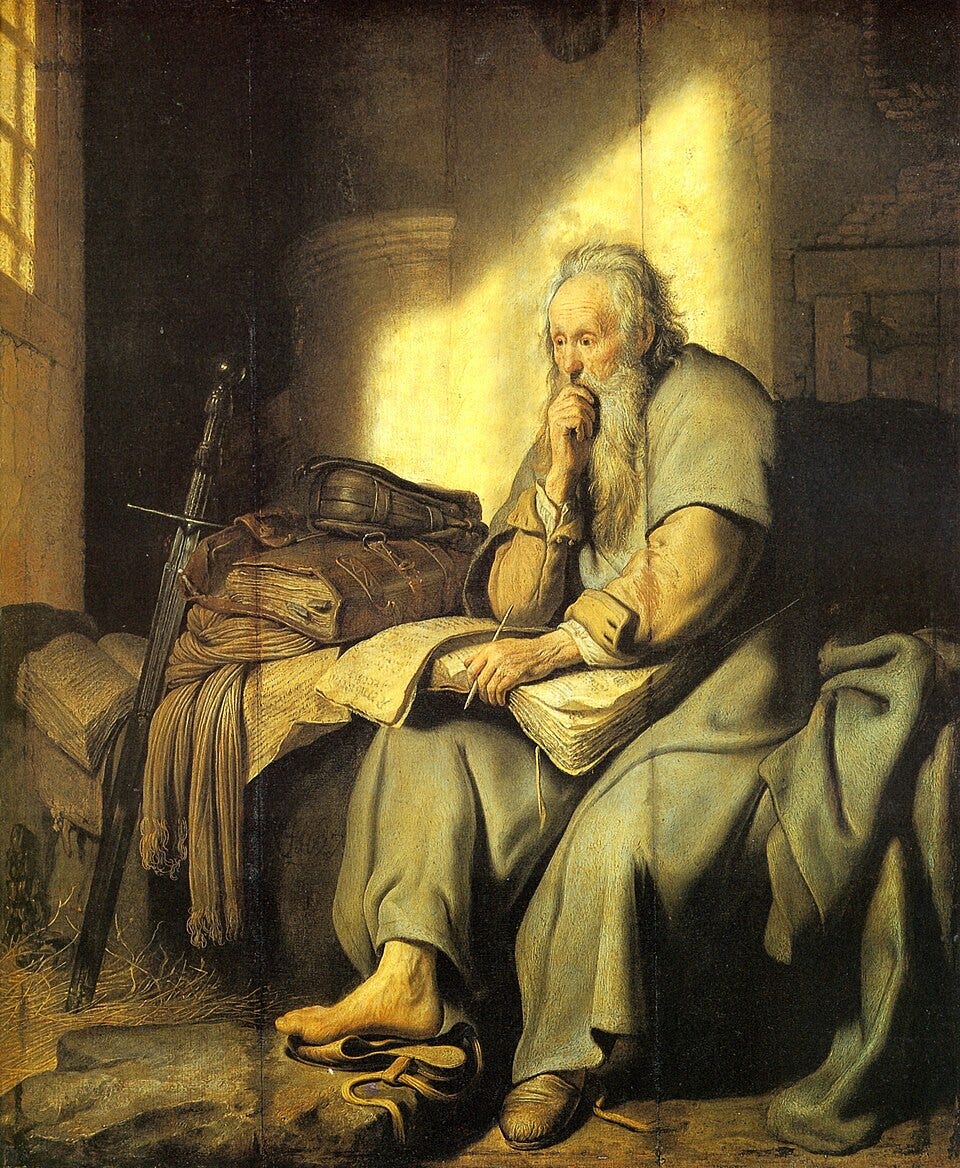
“Where is God my maker, who gives songs in the night?”
The question belongs to Job - or rather, to Elihu, who asks it as an accusation: why do the suffering not turn to the God who can do this, who can give songs precisely in the dark? The psalm writer echoes it from the other side: “I remember my song in the night; I meditate in my heart.” (Ps. 77:6) The tradition of midnight praise is old and hard-won. It is not the praise of people who have been spared the darkness. It is the praise of people who have gone down into it and found, somehow, that God was already there.
Paul and Silas are in the innermost cell. They have been stripped and beaten with rods. Their feet are in stocks. They have no advocate before the magistrates, no appeal process, no recourse. By every external measure, this is the lowest point of their mission so far. And about midnight - the word is precise, deliberate - they begin to pray and sing hymns to God.
The other prisoners were listening.
St. John Chrysostom, preached on this passage. “What could equal these souls?” he asks his listeners. He lists what Paul and Silas have just endured - scourged, misused, in peril of their lives, thrust into the inner prison - and then names what they do instead of sleeping or weeping or nursing their wounds. They keep vigil. They sing. And Chrysostom turns the scene on his own listeners: “Let us compare with that night these nights of ours, with their revellings, their drunkenness and wanton excesses, with their sleep which might as well be death.”1
The contrast is not between the suffering apostles and comfortable pagans. It is between two kinds of midnight: one that produces praise, one that produces nothing. The question is not whether we will spend the dark hours in something - everyone does. The question is what that something will be.
The Church learned this lesson and built it into her bones. St. Ambrose of Milan, in the fourth century, composed hymns expressly for the night hours - among them Aeterne rerum conditor, the great dawn hymn that has been sung at Lauds for sixteen centuries, a song about singing in the darkness before the light returns. Augustine, who was converted under Ambrose’s preaching, records in the Confessions that when the church in Milan was besieged by the Empress Justina and her Arian faction, Ambrose gathered the people inside and kept them there day and night, singing hymns - “lest the people should languish in cheerless monotony.”2 The singing was resistance. The singing was formation. The singing was the community discovering that it could hold together in the dark by doing together what Paul and Silas had done alone in a cell.
The Divine Office - the Liturgy of the Hours - is the institutionalization of this discovery. The Church does not trust her people to praise God only when it is easy. She builds the praise into the structure of the day, including the night, so that when the darkness of life comes, the muscle memory of continuing to offer to God is already there.
Jesus, in the farewell discourse, has just told his disciples: “It is better for you that I go.” The grief that fills their hearts at this news - the grief of anticipated absence, of losing the one they can see and touch and follow - is understandable. But Jesus names it as a kind of limitation. If he does not go, the Advocate will not come. The Spirit of truth cannot arrive until the Son has departed. And when the Spirit comes, he will convict the world - not with arguments, but with the interior certainty that comes from the one who “will guide you to all truth.”
Paul and Silas sing because the Advocate has come. Their midnight praise is not bravado. It is the fruit of the Spirit’s presence in the innermost cell. The world looking at them sees two beaten men in stocks. The Spirit in them sees something else entirely - the God who gives songs in the night, the maker who has not abandoned them, the Advocate who is more real in the darkness than the darkness itself.
The earthquake comes, the doors open, the chains fall, and Paul stays.
Chrysostom notes this with particular care: the jailer was about to kill himself, supposing the prisoners had fled. He assumed, reasonably, that any sane man would have run. Paul’s shout - “Do no harm to yourself; we are all here” - astonishes him more than the earthquake. “He wondered more at Paul’s kindness,” Chrysostom writes, “than at the miracle itself.”3 The miracle opened the doors. The staying opened the jailer’s heart. “Sirs, what must I do to be saved?”
And then the household.
“Believe in the Lord Jesus, and you and your household will be saved.” Paul and Silas do not baptize the jailer in the public square. They go into his house. He washes their wounds - tending the very wounds his imprisonment caused - and his whole family is baptized that same hour. They share a meal. “He rejoiced with his whole household at having come to faith in God.”
Luke returns to the household again and again throughout Acts. Salvation, in his telling, does not arrive primarily to isolated individuals making private decisions. It arrives to households, in the night, at the table, in the ordinary space of domestic life. The jailer’s home becomes a church in the same hour his chains become a baptismal font.
This is the question the passage presses on the household - the domestic church: what songs fill the house at midnight? Not only at literal midnight - though the tradition of night prayer is worth recovering for families willing to try it - but in the dark seasons, the long stretches of difficulty, the years when the household is in the innermost cell and the feet are in stocks. What do the people who live together do with that darkness? What the household sings in its hard seasons is both its witness to itself and its witness to anyone who happens to be listening.
The other prisoners heard. They always hear.
Domus Formation brings daily Catholic prayer and formation into the rhythms of the household, with tracks for families, men, women, teens, and those in the second half of life. Because the first school of faith is the home, and every member of it deserves to be formed.
If the idea of a long story passed forward across centuries - of custody and fidelity and a flame that refuses to go out - resonates with you, I am writing it. Lux Perpetua is a serial novel publishing weekly: a free Monday chapter and a paid Thursday chapter, set in Alton, Illinois, at the edge of the Mississippi. The first chapters are live. Free readers are welcome. LuxPerpetua.net
Deacon Michael Halbrook is husband to Suzanne, father of four sons, and a permanent deacon of the Diocese of Springfield in Illinois. He serves at St. Elizabeth Parish in Granite City. He is the founder of Domus Formation, a collection of Catholic prayer and formation resources for every stage of life, and he writes at DeaconMichael.net.
John Chrysostom, Homilies on the Acts of the Apostles, Homily 36.
Augustine of Hippo, Confessions, IX.vii; see also the Catholic Encyclopedia, Ambrosian Liturgy and Rite, citing Paulinus the Deacon, Vita S. Ambrosii, §13.
John Chrysostom, Homilies on the Acts of the Apostles, Homily 36.