
Son of Encouragement
Tuesday of the Second Week of Easter | Acts 4:32-37 | Psalm 93 | John 3:7b-15

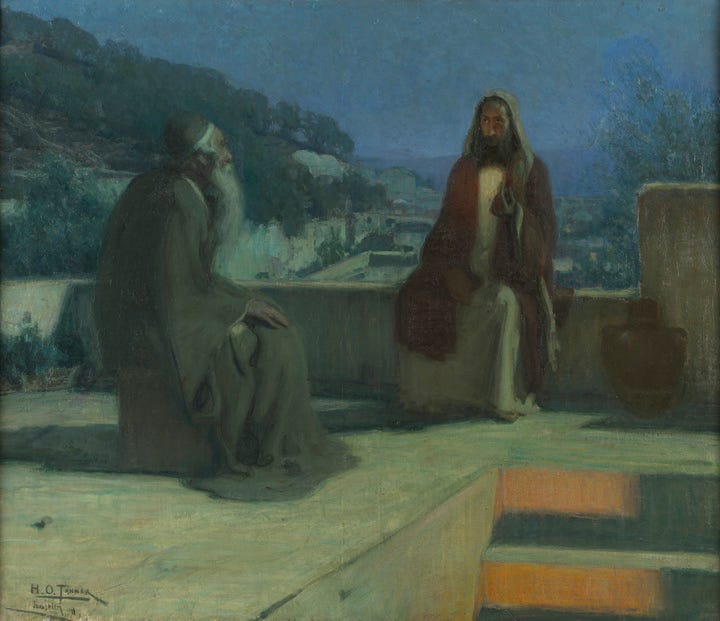
He comes at night.
Nicodemus is a Pharisee, a ruler of the Jews, a man of education and standing - and he comes to Jesus in the dark, privately, carefully, with real questions. “Rabbi, we know that you are a teacher who has come from God.” He is drawn. He is serious. He is not yet ready to be seen.
Jesus receives him and immediately says something that confounds him completely: you must be born from above. Nicodemus, the careful man, the man who manages his approach and his timing and his public reputation, hears this and asks the only question available to him: “How can this happen?”
And Jesus answers with an image that cannot be managed at all.
“The wind blows where it wills, and you can hear the sound it makes, but you do not know where it comes from or where it goes; so it is with everyone who is born of the Spirit.”
You cannot predict it. You cannot control it. You cannot schedule a private meeting with it under cover of darkness and ask it careful questions. The wind blows where it wills. The Spirit moves as it chooses. The only posture available to a person before that reality is not comprehension but surrender - not how can this happen but let it happen to me.
Nicodemus is not a villain in this scene. He is a man in the moment just before the wind reaches him. He is asking the last question available to a person who is still, just barely, standing outside.
Set beside him, three chapters and three years later in the life of the early Church, is a man named Joseph.
Luke tells us almost nothing about him except this: the apostles called him Barnabas, which means son of encouragement. He was a Levite, a Cypriot by birth, a man of some property. He sold a field he owned, brought the money, and laid it at the apostles’ feet.
That is the whole story. One sentence. And yet Luke includes it, by name, in his account of the Jerusalem community - a community in which no one claimed that any of his possessions was his own, in which there was no needy person among them, in which the resurrection had so thoroughly rearranged the relationship between people and their things that property simply moved to where it was needed.
Barnabas did not invent this community. He inhabited it. But he inhabited it in a way that was visible, that was named, that put courage into those around him by acting first. The son of encouragement earns his name not by saying encouraging things but by doing an encouraging thing - a concrete, costly, irreversible act that showed everyone watching what it looked like to live as though the resurrection were actually true.
Nicodemus and Barnabas are not usually read together. But the lectionary places them in the same week of Eastertide, and I think it is asking us to see them as a pair - not opposites, but a before and after.
Nicodemus gets there. John includes him twice more: at the arrest, where he quietly asks whether Jesus deserves a hearing (7:50-51), and at the tomb, where he comes with a hundred pounds of spices to anoint the body of the one he had visited in the night (19:39). He arrives slowly, carefully, in the dark - but he arrives. The wind, it turns out, had already reached him. He just needed time to know it.
What Barnabas represents is what it looks like when the wind is fully at work within a person. Not a heroic personality type, not a spiritual gift, not a charism available only to the unusually generous. Just a man so thoroughly yielded to the resurrection that a field no longer seemed worth keeping when someone else needed the money from it.
St. John Chrysostom, reflecting on this passage in his Homilies on Acts, marvels not at the size of the gift but at the totality of the interior freedom it reveals - that a man could hold property and then simply not hold it anymore, because the thing that once gave security had been replaced by something that actually gave it.1
This is the Easter question the second week presses, quietly but insistently: has the resurrection actually rearranged anything?
Not in some grand, heroic, sell-all-your-fields sense - though for some people, at some moments, that is exactly what it asks. But in the ordinary life of the household: in what we hold and what we release, in who we encourage and what it costs us, in whether the people nearest to us would say that something in us is different since Easter, or whether we have returned to exactly the life we were living before Holy Week.
Encouragement - the word carries its roots with it: to put courage into. Barnabas did not merely give money. He gave courage to everyone who watched him act. The household member who prays first, who forgives first, who gives first, who names the faith first in a room where it might not be welcomed - is doing the same thing. Putting courage into the people nearest to them by showing what it looks like to live as though the resurrection were actually true.
The wind blows where it wills. You cannot schedule a meeting with it. But you can - in the small, visible, costly choices of daily life - show the people in your home what it sounds like when it moves through a person.
That is what a son of encouragement does.
The domestic church doesn’t form itself. It needs daily content, daily prayer, and daily encounter with Scripture, rooted in the Church’s liturgical life, shaped for the rhythms of a real household. Domus Formation is built for exactly this. One app & site. Tracks for Catholic families (Hearth & Altar), men, women, teens, and those in the second half of life (Eventide & Altar). Daily reflections, audio, and formation that follow the liturgical year — for every member of the household, together. This is what it looks like to put courage into the people living under your roof. WeAreDomus.com
If the idea of a long story passed forward across centuries - of custody and fidelity and a flame that refuses to go out - resonates with you, I am writing it. Lux Perpetua is a serial novel publishing weekly on my own platform: a free Monday chapter and a paid Thursday chapter, set in Alton, Illinois, at the edge of the Mississippi. The first chapters are live. Free readers are welcome. LuxPerpetua.net
Deacon Michael Halbrook is husband to Suzanne, father of four sons, and a permanent deacon of the Diocese of Springfield in Illinois. He serves at St. Elizabeth Parish in Granite City. He is the founder of Domus Formation, a collection of Catholic prayer and formation resources for every stage of life, and he writes at DeaconMichael.net.
John Chrysostom, Homilies on the Acts of the Apostles, Homily 11.
Inspiring insight Michael, thank you
Wow, this is so so so good