

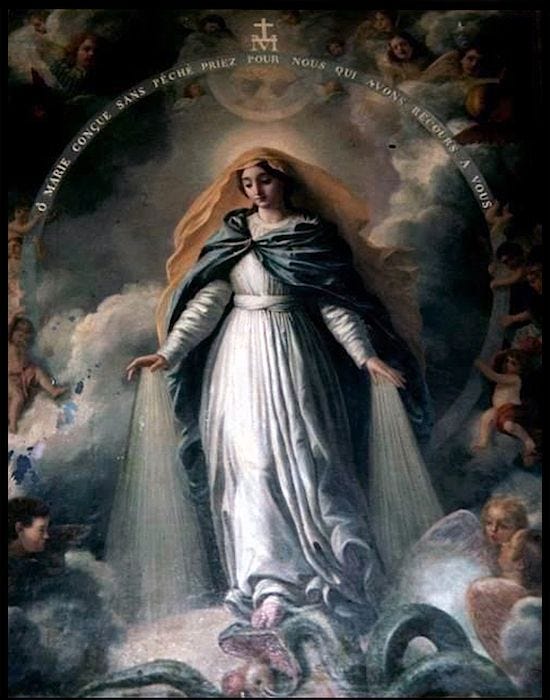
Today is the feast day of Our Lady of Lourdes, and so I have opted to comment on the optional Gospel for today. The Church puts forward the narrative of the Miracle at Cana as the optional Gospel for the day, as this is a beautiful text with a deeply Marian dimension to it.
Most know that the Miracle at Cana, the changing of water into wine, is the first of Our Lord’s signs that He performs. In many ways, it inaugurates the Messianic Age and sets His ministry in motion. This is precisely what I want to reflect on today.
“There was a wedding at Cana in Galilee, and the mother of Jesus was there. Jesus and his disciples were also invited to the wedding. When the wine ran short, the mother of Jesus said to him, ‘They have no wine.’ And Jesus said to her, ‘Woman, how does your concern affect me? My hour has not yet come.’ His mother said to the servants, ‘Do whatever he tells you.’” John 2:1-5
While there is much that can be written on this event from the sacramental side, both Eucharistic and Matrimonial, as well as considering the miracle itself, the Marian dimension stands above as a preeminent reading of this passage of Scripture. We find this interpretation in the exchange between Mother and Son.
We first have the problem: the wine has run short, far earlier in the wedding feast than was anticipated. In Jewish culture, it is considered a cultural embarrassment not provide the necessary wine for a wedding feast. Thus, we see a need that is aided through the intercession of the Blessed Virgin.
But more than that, we find a deeper exchange between the Incarnate Son of God, the New Adam, and His most Holy Mother, the New Eve. As she intercedes for the newly married couple, the Lord responds in a way that would seem very odd and even disrespectful to 21st-century readers. Here, there are two parts:
Woman
In many circles today, the calling of one’s mother, woman, seems outright disrespectful. In many cases, this is how this exchange is viewed. But that could not be further from the truth. We need to take a step back and realize that the Incarnate Son of God is not going to break the 4th commandment and disrespect His mother. Very simply, that is not a possible reading of this scripture. It does not fit with who we know Jesus Christ to be. This means that there is another interpretation. We find the source of Our Lord referring to Mary as woman in Genesis 3:15, that which we refer to as the Protoevangelium, or First Gospel.
“I will put enmity between you and the woman, and between your seed and her seed; she shall crush your head, and you shall strike at the heel.” Genesis 3:15
The earliest Christian commentators give this passage from Genesis a Marian interpretation that the woman who is prophesied to be at odds with the serpent, and in the Latin, with crush the head of the serpent, is the Blessed Virgin Mary. While some may want to say that the woman of Genesis 3:15 is Eve, I don’t find that to be tenable for the simple reason that the woman in this passage has victory, through her seed, and they crush the head of the serpent. The Woman is victorious over the serpent. It is clear that Eve does not conquer the serpent; instead, she is conquered by him. Thus, there is another. This is where the Blessed Virgin enters and fulfills this prophecy.
Our Lord refers to her as Woman, not as a sign of disrespect but as a title and as an identity. Mary is the Woman of Genesis who is at odds with the serpent and will ultimately conquer through her seed. This is again referenced by St. John in two other places in his writings:
“But standing by the cross of Jesus were his mother, and his mother’s sister, Mary the wife of Clopas, and Mary Magdalene. When Jesus saw his mother and the disciple whom he loved standing near, he said to his mother, ‘Woman, behold, your son!’ Then he said to the disciple, ‘Behold, your mother!’ And from that hour, the disciple took her to his own home.” John 19:25–27.
And
“And a great sign appeared in heaven, a woman clothed with the sun, with the moon under her feet, and on her head a crown of twelve stars; she was with child, and she cried out in her pangs of birth, in anguish for delivery. And another sign appeared in heaven; behold, a great red dragon, with seven heads and ten horns, and seven diadems upon his heads.” Revelation 12:1–3.
In both instances, we have the title of Woman being used. At the crucifixion, Jesus again refers to His mother as woman in giving her into the care of John. John later writes down his vision in which he sees the woman battling that ancient serpent, the great red dragon. John brings the identity of the woman of Genesis to her final conclusion, the crushing of the serpent’s head.
The Hour
This leads to the second part of the Cana passage. Christ’s reference to His hour. First, He asks what can only be described as an awkward question. The reason it is awkward is that the translation into English is very hard, as it is a Hebrew idiom. Many differing translations can be found, but the essential literal translation is “what to me and to you.” When said in response to a request, it indicates either an agreement to the request or a denial of it. In this case, there is a clear agreement to it since Our Lord works the miracle. But there is a deeper level here.
The idiom is used almost as a question to Mary herself with respect to the aforementioned hour. The hour referenced here is not a literal 60-minute period. Instead, it is the hour of redemption, the Messianic mission to be initiated here at the Wedding of Cana. Essentially, Christ is asking His mother if she is prepared for the Hour to begin. This is why we find Mary present as Woman both at the beginning of the hour of redemption: The Wedding at Cana, and as the end of the hour of redemption: The Foot of the Cross.
Under the inspiration of the Holy Spirit, St. John is careful to place Mary at the beginning and at the end of the crushing of the head of the serpent, by the Woman, through her Seed. It is here that we see the Virgin as the unique and supreme cooperator with the Redeemer. She inaugurates the hour of redemption with the words “Do whatever He tells you.” Our Lord then capitulates to His mother’s request and performs the first of His signs to begin the Messianic mission of Redemption.
For more from Dr. McGovern, visit his Substack at A Thomist, Dedicated to the Theological tradition of St. Thomas Aquinas. Exploring Thomas’ Spiritual Theology and topics in Christology and Mariology.