
Poured Out First
Tuesday of the Tenth Week in Ordinary Time | 1 Kings 17:7-16 | Psalm 4 | Matthew 5:13-16

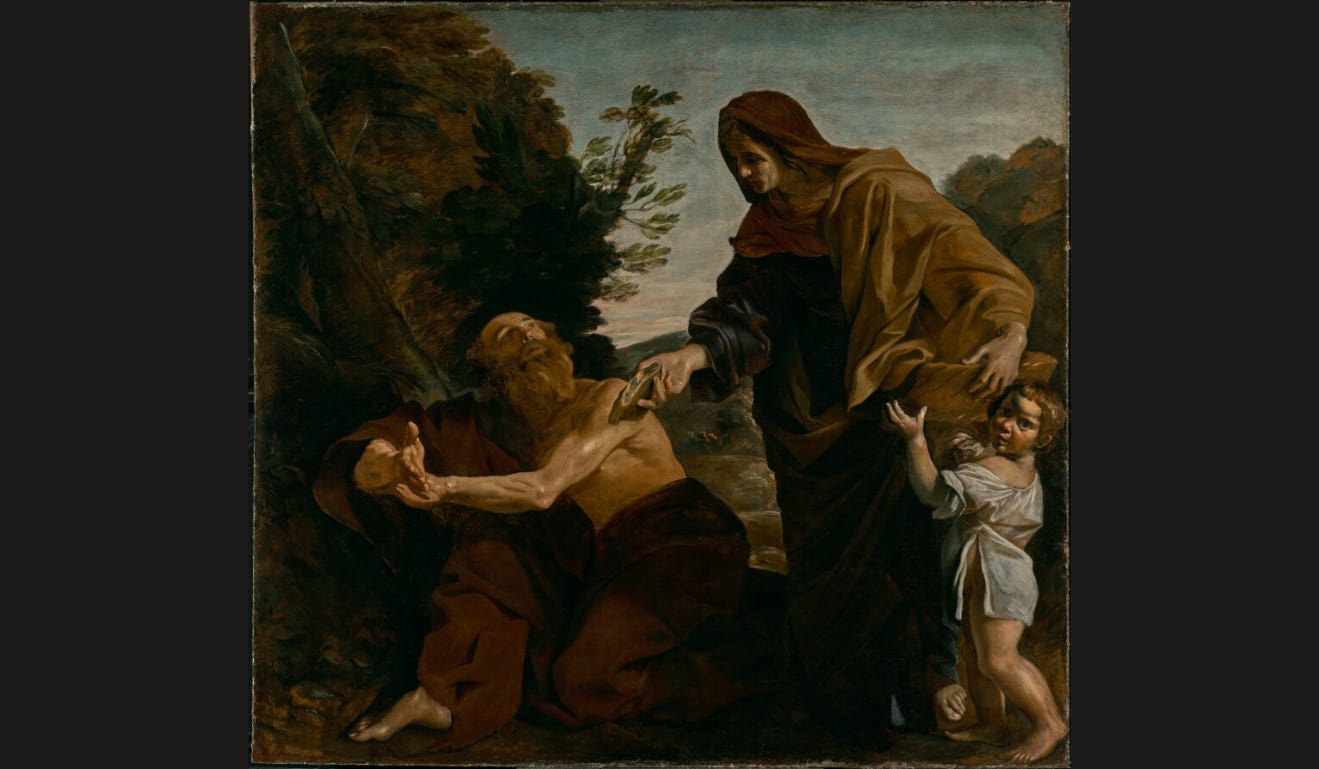
Note: Today also marks the Optional Memorial of Saint Ephrem, Deacon and Doctor of the Church - a fitting day to reflect on how the ordinary and the domestic become sites of grace.
The brook has run dry.
Elijah has been hiding at Cherith, fed by ravens, drinking from the stream - and now the stream is gone. The drought he called down on Ahab has consumed even his own hiding place. God sends him further, deeper into enemy territory: to Zarephath, in Sidon, the homeland of Jezebel herself. And there, at the gate of the city, he finds the woman God has designated to provide for him.
She is gathering sticks.
She has a handful of flour and a little oil. She is preparing what she believes will be the last meal for herself and her son. She tells Elijah this with the flat clarity of someone who has exhausted hope: “When we have eaten it, we shall die.”
And Elijah says: Do not be afraid. Go. Make the cake.
But first make me a little cake and bring it to me.
First. Before herself and her son. Before the certainty of tomorrow’s hunger. Before any visible sign that the promise is true. She is asked to give away the last of what she has on the word of a stranger - and to do it first.
She does.
The jar of flour did not go empty, nor the jug of oil run dry.
The miracle is quiet and domestic. Not fire from heaven, not parting waters. Just a jar that, when she reached into it the next morning, still had something in it. And the morning after. And the morning after that. For a year, she reached into the jar and it was not empty. The abundance was invisible until the moment of need, and then it was simply there.
The early Church read this scene as a figure of inexhaustible grace. The widow’s son gathering sticks was seen as a type of Christ carrying the cross; his later raising from death by Elijah as a prefiguration of the resurrection.1
But the miracle of the jar and the jug carries its own typological weight: it is the image of a household sustained by an unseen hand, renewed daily, never running out - the logic of manna in the desert pressed into the ordinary space of a kitchen.
The hinge is that single word: First.
Elijah does not ask the widow to share what she has after she has secured herself and her son. He asks her to give first, on the promise alone. This is the logic of the Kingdom turned into a domestic act. The household that orders its life toward God before securing itself - that gives first, prays first, opens its table first - is the household the promise is made to. Not because it earns the abundance, but because the giving first is itself the act of faith that opens the jar.
Jesus, in the Sermon on the Mount, says two things about his disciples that are presented not as commands but as declarations of fact.
You are the salt of the earth. You are the light of the world.
Not “try to be” or “you might become.” You are. The identity precedes the task. St. John Chrysostom, preaching on this passage, notes that the salt-and-light calling is not given for the disciples’ own sake but for the world’s: “It is not for your own sake but for the world’s sake that the word is entrusted to you.”2 The disciples are not told to become something. They are told to be what they already are, visibly, without concealing it.
Chrysostom also notes the paradox of the light under the basket: it is possible to have the light and choose not to let it reach anyone. Not through malice but through a kind of self-protection, a domestication of the gift. You keep the jar sealed, the lamp covered, the flour for yourself. And what was meant to give light to all who are in the house illuminates nothing.
The widow of Zarephath did not keep the flour sealed. She opened the jar first, for a stranger, on a word she had no human reason to trust. And the jar did not go empty.
This week, on Thursday, the Church in the United States gathers for the national consecration to the Sacred Heart of Jesus - a consecration that follows nine days of prayer beginning on the feast of Pentecost and culminating on the Solemnity of the Sacred Heart. It is fitting that these readings fall in this week.
The devotion to the Sacred Heart is, at its center, the contemplation of a love that gave itself first - not after we had made ourselves worthy of it, not in response to our merit, but poured out from the poverty of the cross before we had done anything to deserve it. Pius XII, in Haurietis Aquas, described the Heart of Christ as “the love of God for the human race which He has taken upon himself” - a love that empties itself not from surplus but from the inexhaustible gift of a self that holds nothing back.3
This is the jar that does not go empty. Not because it is always full, but because what pours from it is not measured by what remains. The widow gave from poverty. Christ gave from poverty. And in both cases, what was given first became the ground of an abundance no one could have calculated.
The household that consecrates itself to the Sacred Heart is making the same gesture as the widow of Zarephath - turning first toward the one who asks, before the morning’s supply is confirmed, on the word of a promise. Not with certainty about the outcome, but with the quiet daily act of reaching into the jar and trusting that it will not be empty.
Salt does not announce itself. Light does not explain itself. The jar of flour does not display a miracle - it simply, each morning, has enough. The domestic church that prays together, that opens its table, that raises its children in the faith, that stays faithful through the long dry seasons when the brook has run dry - is doing all of this. And the abundance it passes forward is often invisible until someone reaches for it and finds it there.
Lord, let your face shine on us - the Psalm refrain today, which is also the prayer of every household that has ever reached into a jar and hoped.
Domus Formation offers tracks of daily prayer and formation for families, men, women, teens, and those in the second half of life. The first school of faith is the home, and every member of it deserves to be formed. WeAreDomus.com
If Catholic fiction that takes the Communion of Saints seriously - as doctrine, not sentiment - is what you are looking for, I am writing two things. Lux Perpetua is a serial novel publishing weekly in two tracks, set in Alton, Illinois, at the edge of the Mississippi - a story of custody and fidelity and a flame passed forward across centuries. And Two Lamps is a weekly short story on Substack, each one braiding two saints from different centuries into a single imagined meeting. Both are for the kind of reader who believes the imagination is also a faculty of faith.
Deacon Michael Halbrook is husband to Suzanne, father of four sons, and a permanent deacon of the Diocese of Springfield in Illinois. He serves at St. Elizabeth Parish in Granite City. He is the founder of Domus Formation, a collection of Catholic prayer and formation resources for every stage of life, and he writes at DeaconMichael.net.
The typological reading of the widow’s son gathering sticks as a figure of Christ carrying the cross, and his raising as a prefiguration of the resurrection, runs through Origen’s Homilies on Kings and the broader patristic tradition; see also the iconographic program of Giovanni Lanfranco’s Elijah Receiving Bread from the Widow of Zarephath (1621-1625), painted for the Chapel of the Holy Sacrament in San Paolo fuori le Mura, Rome.
John Chrysostom, Homilies on the Gospel of Matthew, Homily 15 (PG 57, 231-232).
Pius XII, Haurietis Aquas (1956), no. 59, 109, 116, and others.