
Parable Caveats: The Sower
Gospel Reflection for July 12, 2026 - Matthew 13:1-23

1 The same day Jesus going out of the house, sat by the sea side.
2 And great multitudes were gathered unto him, so that he went up into a boat and sat: and all the multitude stood on the shore.
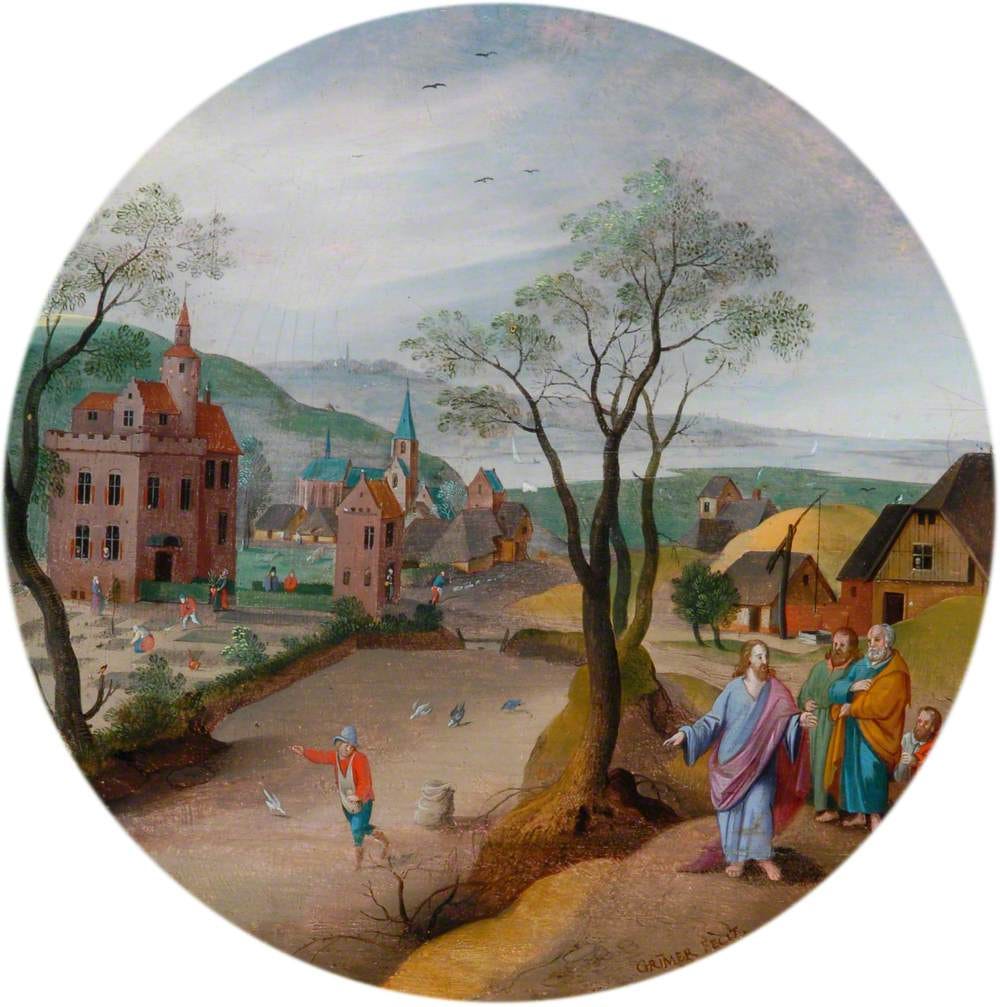
3 And he spoke to them many things in parables, saying: Behold the sower went forth to sow.
4 And whilst he soweth some fell by the way side, and the birds of the air came and ate them up.
5 And other some fell upon stony ground, where they had not much earth: and they sprung up immediately, because they had no deepness of earth.
6 And when the sun was up they were scorched: and because they had not root, they withered away.
7 And others fell among thorns: and the thorns grew up and choked them.
8 And others fell upon good ground: and they brought forth fruit, some an hundredfold, some sixtyfold, and some thirtyfold.
9 He that hath ears to hear, let him hear.
10 And his disciples came and said to him: Why speakest thou to them in parables?
11 Who answered and said to them: Because to you it is given to know the mysteries of the kingdom of heaven: but to them it is not given.
12 For he that hath, to him shall be given, and he shall abound: but he that hath not, from him shall be taken away that also which he hath.
13 Therefore do I speak to them in parables: because seeing they see not, and hearing they hear not, neither do they understand.
14 And the prophecy of Isaias is fulfilled in them, who saith: By hearing you shall hear, and shall not understand: and seeing you shall see, and shall not perceive.
15 For the heart of this people is grown gross, and with their ears they have been dull of hearing, and their eyes they have shut: lest at any time they should see with their eyes, and hear with their ears, and understand with their heart, and be converted, and I should heal them.
16 But blessed are your eyes, because they see, and your ears, because they hear.
17 For, amen, I say to you, many prophets and just men have desired to see the things that you see, and have not seen them, and to hear the things that you hear and have not heard them.
18 Hear you therefore the parable of the sower.
19 When any one heareth the word of the kingdom, and understandeth it not, there cometh the wicked one, and catcheth away that which was sown in his heart: this is he that received the seed by the way side.
20 And he that received the seed upon stony ground, is he that heareth the word, and immediately receiveth it with joy.
21 Yet hath he not root in himself, but is only for a time: and when there ariseth tribulation and persecution because of the word, he is presently scandalized.
22 And he that received the seed among thorns, is he that heareth the word, and the care of this world and the deceitfulness of riches choketh up the word, and he becometh fruitless.
23 But he that received the seed upon good ground, is he that heareth the word, and understandeth, and beareth fruit, and yieldeth the one an hundredfold, and another sixty, and another thirty.
(Matthew 13:1-23 DRA)
Our Lord’s parables, including today’s Parable of the Sower, are some of the most commented-upon passages in Scripture, and due to their intrinsically mysterious character, they have been interpreted and applied in countless ways throughout the centuries, more or less true to their intended message.
For this reflection, I would like to give a few tips or caveats to help us understand this Parable of the Sower, not to interpret it so much as to help us interpret it with a full picture and to point out elements that are sometimes overlooked in popular commentaries on it.
1. What is Christ’s Answer to the Disciples’ Question?
After Our Lord delivers His parable, the apostles ask for Him to interpret it for them, and He does so, but they also asked why He preached in parables at all. Christ’s answer seems to be simply, “because you can and are willing to understand, but they are not”. But one might wonder, why preach to those whose ears are closed to the truth at all, and why seemingly make it harder for them to understand by using ambiguous, symbolic parables instead of clear, doctrinal statements? This leads to our second caveat:
2. God is the Sower
The identity of the sower in Christ’s parable isn’t told explicitly, as the seeds are simply described as being distributed on various types of soil, but it may be inferred that God is the sower, as Scripture and Tradition attest. This indicates an answer to our first question: Christ preached to those without ears to hear – who, we should remember, were His followers, i.e. proto-Christians, those who went to listen to Him preach, not His opponents – because, as God, He honors our free will. He distributes His seeds, i.e. the Word of God who is Christ Himself, to all men, giving every person a chance to hear, understand, and follow Him and thus to be saved, even those whom He knows will ultimately not receive His Word.
3. The Soil is Not a Static Image
It should also be noted that the different types of soil, or levels of spiritual receptivity, which are described by Christ in a static way, but with human nature and free will, we grow (or diminish) over time. What was initially rocky ground could someday become fertile soil, or vice versa, depending on our choices. We shouldn’t wait, of course, since we could be called to Judgment at any time, but we also shouldn’t give up hope in ourselves or others while we still have time to till. It could be that some of those to whom Christ preached in parables eventually gained the wisdom to see and to hear and thus became true Christians, while one of the apostles to whom Christ preached openly – Judas Iscariot – ultimately closed himself to Christ and was therefore damned.
4. Omnipotence Does Not Override Freedom
Today, many Catholics and Protestants alike claim that God’s Divine Mercy is so omnipotent that it can overcome even our free choice to reject it. God is so kind and understanding that, if there are any influences or temptations or ignorance in us, He will take that as a total negation of culpability and therefore show us mercy, no matter what. But as Christ shows in this parable, there are indeed some who don’t accept His Word – as we said before, we can always hope for our future correction, but once this life ends, the time for repentance, at least for mortal sin, is over, and the types of soil Christ lists apply especially to people at the end of our lives, when our souls are permanently set according to our lifelong choices either to accept or reject Him.
5. Truth Matters
Many people, today and in the past, have believed that it doesn’t really matter what you know or believe – all that matters is what you do. To take a quote from the movie Batman Begins, “It’s not who we are underneath, it’s what we do that defines us.” But as Christ tells His apostles in today’s parable, it really does matter – we will be judged not only on our exterior acts, on whether or not we’re a “good person,” but also on whether we know the divine Wisdom of the Gospel and whether we believe in the fullness of the truth which subsists in the Catholic faith. The people in the crowd, to whom Christ preached in parables, may have been great people otherwise – charitable, polite, law-abiding (both divine and secular law) – and they may have even been learned in worldly knowledge, but they were voluntarily ignorant of the truth, because they had chosen to close themselves to it. They were unwilling to know and therefore could not learn. This is why St. Paul says,
For this is good and acceptable in the sight of God our Saviour, Who will have all men to be saved, and to come to the knowledge of the truth. (1 Tim 2:3-4)
Again, these caveats aren’t meant to function as an interpretation of Christ’s parable – you will surely hear that today at Mass, as you likely have many times in your life – but as a guideline to help your own understanding of Our Lord’s words, by His grace.
For God, who commanded the light to shine out of darkness, hath shined in our hearts, to give the light of the knowledge of the glory of God, in the face of Christ Jesus. (2 Cor 4:6)
Join the Fellowship at Saint Tolkien!