
On the Teacher
Gospel Reflection for Wednesday, January 28, 2026, Feast of St. Thomas Aquinas

“On another occasion, Jesus began to teach by the sea. A very large crowd gathered around him so that he got into a boat on the sea and sat down. And the whole crowd was beside the sea on land. And he taught them at length in parables…” Mark 4:1-2
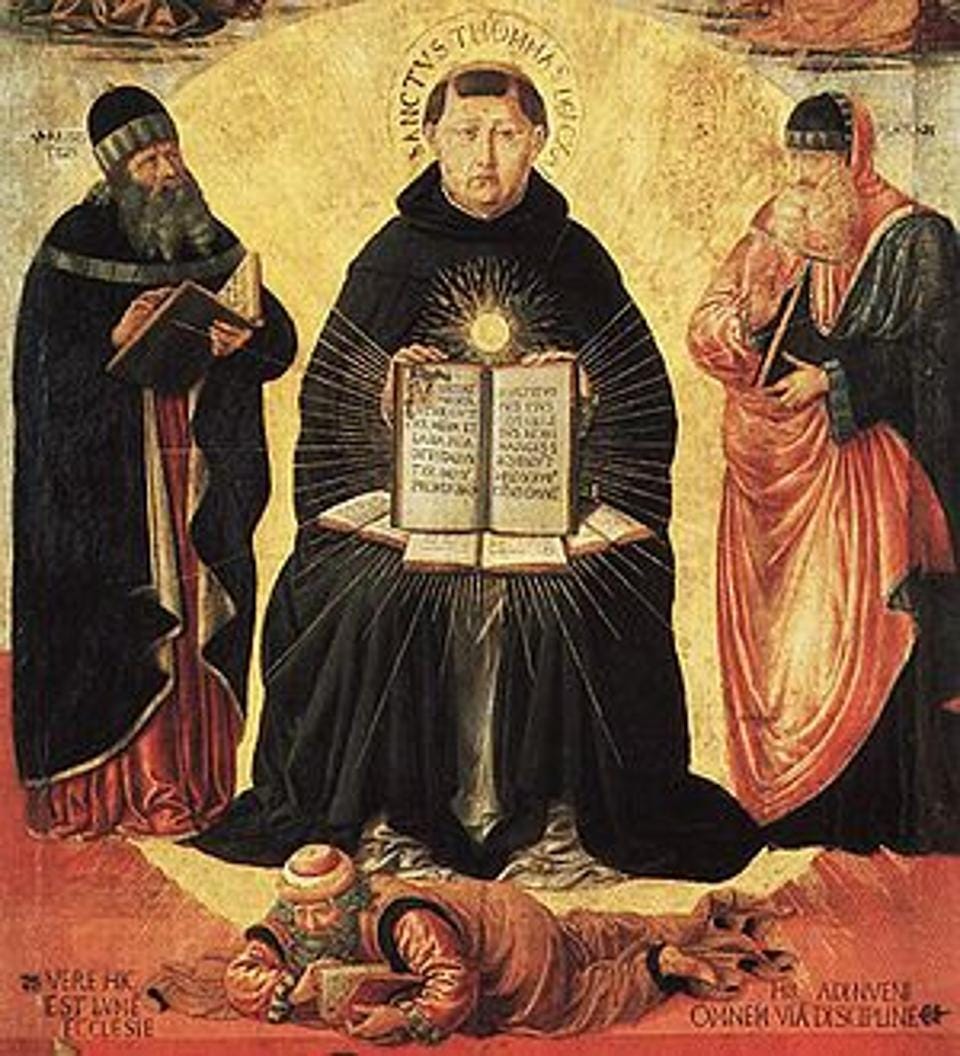
Today, the Church celebrates the feast day of St. Thomas Aquinas, the church’s greatest theologian. The Gospel provided today is the parable of the sower. I have previously written on this parable here and here. Since I have covered the parable, I want to reflect on the role of Christ in this Gospel passage, that of teacher, and I can think of no greater day to do that than the feast of such a great teacher in St. Thomas.
One of the most beautiful and simultaneously frightening discourses concerns the teacher and the golden crown, called an aureole, promised to teachers of the faith.1 In his writing, he tells us that the aureole “is an exceptional reward corresponding to an exceptional victory.”2 He considers these aureoles to be given to three groups who have gained exceptional victory over the flesh, the world, and the devil.3 Each of these aureoles is a conforming of the person to Christ in His perfections of virgin, martyr, and teacher. Those who have gained victory over the flesh are the holy virgins who have conquered the sins of the flesh and offered themselves to God. Those who have victory over the world are the martyrs who have loved God above all things, even their own lives. Finally, those who have conquered the devil are the teachers:
“The chief victory is to expel the enemy not only from oneself but also from the hearts of others… This is done by teaching and preaching, and consequently the third aureole is due to teachers and preachers.”4
St. Thomas, following the fathers of the church, assigns this third little golden crown to those who teach the faith, and by it, expel the enemy from the hearts of the hearers. Teaching is an act over and above that of merely studying. The reason for this, and why it is meritorious, is that teaching is an act of mercy infused with charity. This crown represents the glory of the body, which is added to the beatitude of the soul.5
However, along with the promise of an aureole comes a very stern warning to the teacher. And this is one that all teachers and preachers must keep at the forefront of their minds when teaching. The teacher will lose his aureole if he teaches out of vainglory. This is especially the case for those who teach for gaining the aureole as if the little crown is the goal for their teaching and not the salvation of the souls entrusted to them.
Teachers, especially, are susceptible to vainglory. St. Thomas lists three ways in which a disordered desire for glory can occur:6
When we seek glory for something unworthy of glory.
When we seek glory from someone whose judgment is uncertain and who should not confer glory on us.
When we do not refer our glory to a due end, such as God’s honor or our neighbor’s spiritual welfare.
The teacher is susceptible in these three ways to vainglory, but I would say that the third is probably the easiest to fall into. It is very easy to see the fruit of our teaching or hear the praise of our students and to become puffed up with vainglory. In reality, a good class or a good article is produced only in cooperation with God’s grace. Thus, our writing and teaching must always refer back to God’s glory and be ordered toward the student’s salvation.
The remedy to this vainglory is, of course, the virtue of humility. The teacher must always remember the words of Christ:
“My teaching is not my own; it comes from the one who sent me.” John 7:16
We must never allow perceived greatness get in the way of the fact that all that is taught ultimately comes from God, and this is most evident in the teaching of the Faith. The teachers of the faith participate in Christ’s role as teacher. He gives them the grace to do it, and thus they need to order any praise given to them to Him above all.
For more from Dr. McGovern, visit his Substack at A Thomist, Dedicated to the Theological tradition of St. Thomas Aquinas. Exploring Thomas’ Spiritual Theology and topics in Christology and Mariology.
Fr. Andrew Hofer, OP, writes a masterful essay entitled Thomas Aquinas on Christ’s Judgment of Teachers of the Faith on this topic as the introduction for a volume of collected essays entitled Thomas Aquinas and the Crisis of Christology. The collection itself is very good, but the introduction, in my opinion, is one of the best essays in the volume. I assign it every year to one of my diaconate classes. It truly is worth returning to for me, year after year.
St. Thomas Aquinas, Commentary on the Sentences, Bk IV, d. 49, q. 5, a. 5, qc, 3. Cf. Summa Theologiae Supp. q. 96, a. 11.
Cf. 1 John 2:16.
Sent IV, d. 49, q. 5, a. 5, qc, 3.
ST Supp. q. 96, a. 1.
ST II-II, q. 132, a. 1.
So relevant to our aspiring catechists, as well as the clergy. Thank you Andrew.