
Noli me tangere
Gospel Reflection for Wednesday, July 22, 2026; Feast of St. Mary Magdalene

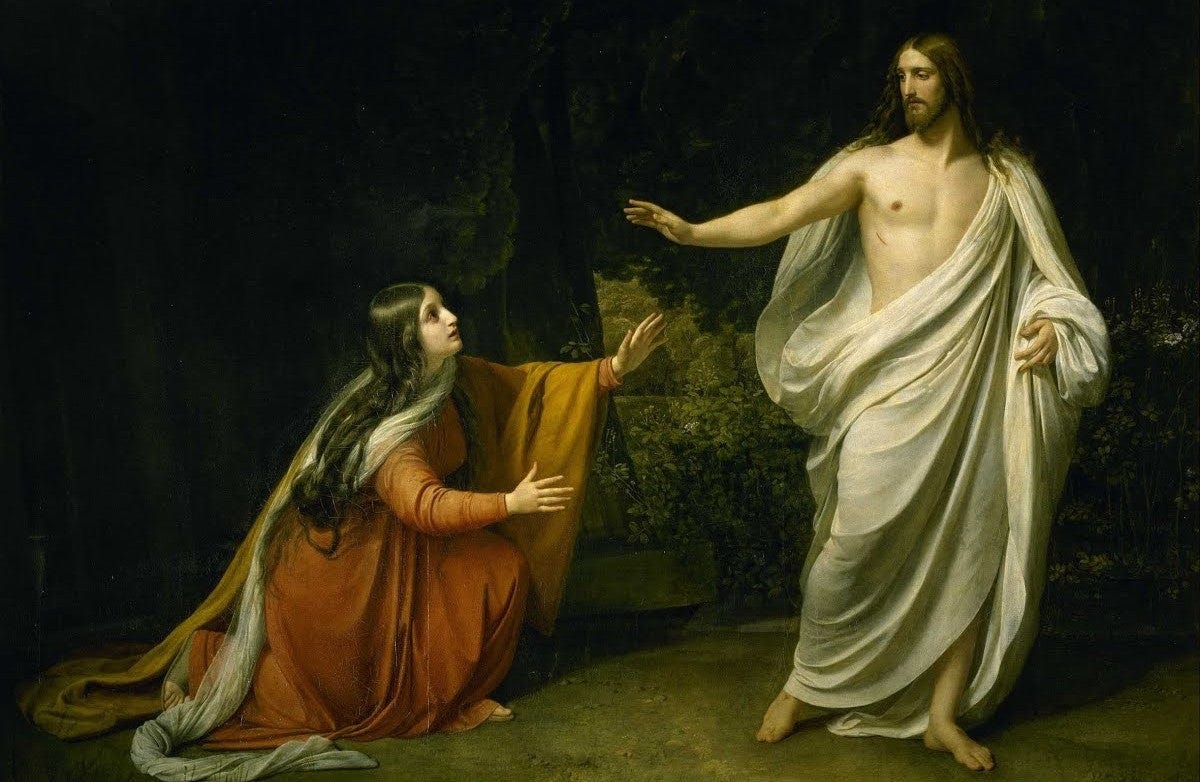
“Jesus said to her, ‘Mary.’ She turned and said to him in Hebrew, ‘Rab-boni!’ (which means Teacher). Jesus said to her, ‘Do not hold me, for I have not yet ascended to the Father; but go to my brethren and say to them, I am ascending to my Father and your Father, to my God and your God.’ Mary Magdalene went and said to the disciples, ‘I have seen the Lord’; and she told them that he had said these things to her.” John 20:16–18.
Today’s gospel records the meeting of the Risen Lord with St. Mary Magdalene on the morning of Easter Sunday. It is here that we find what I believe to be the beginning of the tradition of St. Mary as a holy contemplative after the Ascension of Christ. One tradition records that St. Mary journeyed to modern-day France and passed the rest of her life as a hermit in a cave. I want to lean into this tradition, considering the words of Christ: Noli me tangere. There are various ways to translate this phrase; some translate it as “do not touch me,” but it can also be translated as “do not hold me.”
It is a curious interaction between Our Lord and St. Mary that, in passing, amounts to Him not wanting to be touched. But with all things, there is an intentional desire behind this interaction, and it gives birth to the contemplative who would spend the rest of her life in deep prayer. The basis of this is found in the instruction from the Lord not to hang on to Him. Those closest to the Lord had just gone through a terrible dark night at the crucifixion and the three days without Him. Up to that point, Our Lord’s presence was consoling their sensible desires. They were with Him. How often do we hold onto the sensible consolations found in the early stages of the spiritual life? Our Lord was exhorting Magdalene to leave the sensible consolations behind. Why? Because they were no longer going to serve her, because in forty short days, Our Lord would ascend into heaven, and that physical presence that she had been consoled by for the last three years would be gone. St. Thomas comments on this matter:
“It is that touch is the last stage of knowledge, when we see something, we know it to a certain extent, but when we touch it our knowledge is complete. Now this particular woman had some faith in Christ, which was that he was a holy man; and this was why she called him Master. But she had not yet reached the point of believing that he was equal to the Father and one with God. Thus Christ says, do not touch me, that is, do not allow what you now believe of me to be the limit of your faith, for I have not yet ascended to my Father, that is, in your heart, because you do not believe that I am one with him; yet she did believe this later. In a way, Christ did ascend to the Father within her when she had advanced in the faith to the point of believing that he was equal to the Father.”1
So many souls turn back when the sensible consolations are taken away. Through the retraction of these consolations, the Lord is beckoning us deeper into the obscurity of faith. He does this with Mary at His tomb and through it, lifts her into a deeper mysticism that would characterize the rest of her life. Mary Magdalene stands as an immense exemplar for the contemplative life. All souls are given at least a remote and general call to this level of mysticism. It is indicative of the climb that all souls must make of the mountain of the spiritual life toward union with God. St. Mary enters into a hidden life away from the world to be united to her greatest love.

Our Lord is calling us to that same depth of spiritual union. He is calling us to reject our reliance on sensible consolations and enter into the obscurity of faith, that place where the light of faith is so bright that we must enter the darkness of the night in order to see the brightness of the stars. This is the obscurity of infused contemplation, where the soul is lifted into an intimate conversation with God in the depths of the wine cellar of their interior life.
For more from Dr. McGovern, visit his Substack at A Thomist, Dedicated to the Theological tradition of St. Thomas Aquinas. Exploring Thomas’ Spiritual Theology and topics in Christology and Mariology.
St. Thomas Aquinas, Commentary on the Gospel According to St. John, C. 20, L. 3, n. 2517.