

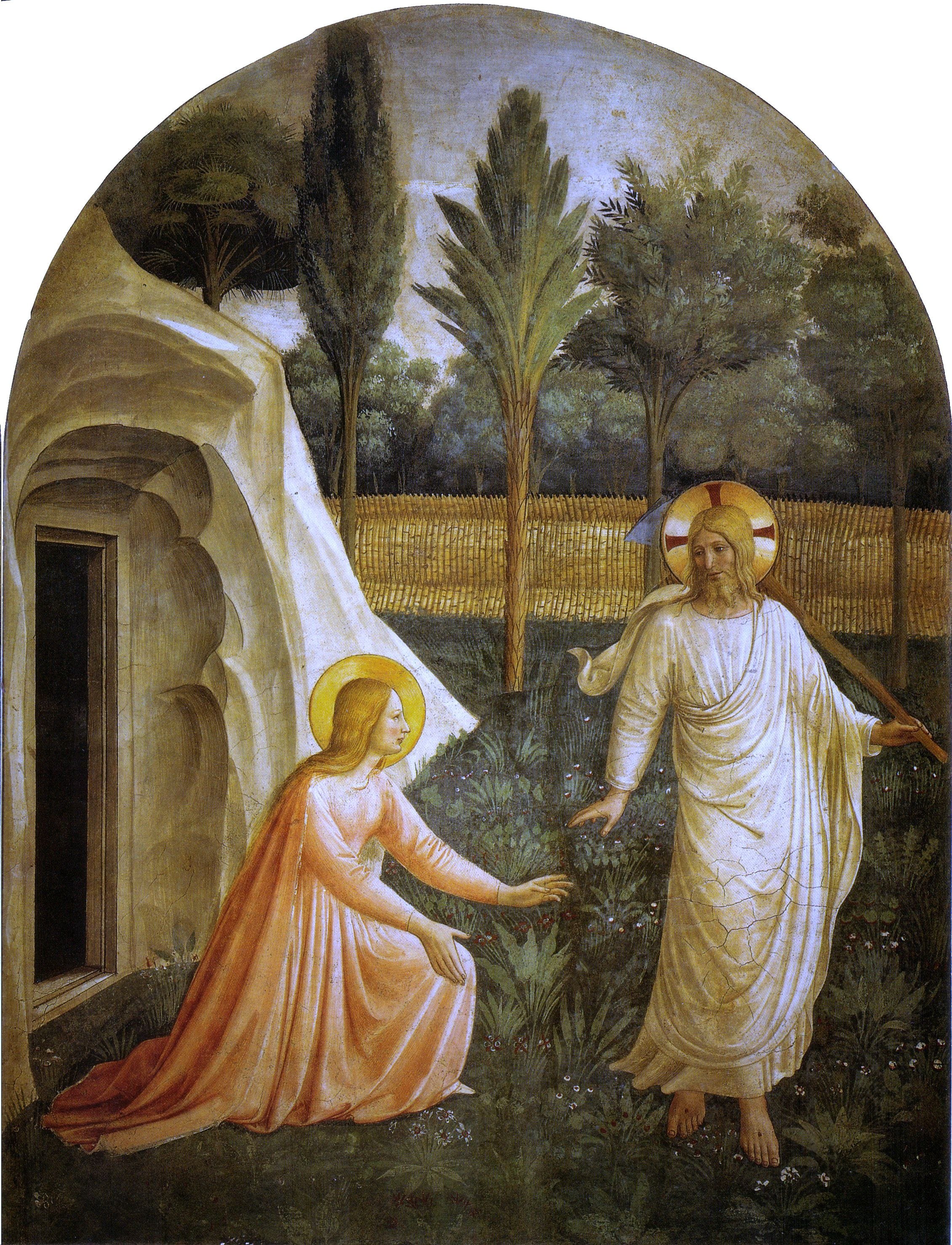
She is weeping outside an empty tomb, and she does not know why it is empty.
Mary Magdalene has come in the dark, before the others, and found the stone rolled away and the body gone. She has run to tell Peter and the Beloved Disciple. They have come, seen, and gone home - the Gospel says they went home - and she has stayed. Bent over the entrance, weeping, she sees two angels where the body had been. They ask her why she is weeping. She tells them what she told the disciples: someone has taken him, and she does not know where.
Then she turns. There is a man standing there. She does not know it is Jesus.
“Woman, why are you weeping? Whom are you looking for?”
She thinks he is the gardener. She asks if he has carried the body away, and says she will take him. She will carry him herself if she has to. The grief has made her practical. Just tell me where he is.
And then Jesus says one word:
“Mary.”
She turns - the Greek straphēsa suggests a full turning, a complete reorientation of the whole person - and says “Rabbouni” - Teacher. She has recognized him not by sight, not by argument, not by the evidence of the empty tomb or the folded burial cloths.
She has recognized him by his voice, speaking her name.
St. Augustine, reflecting on this moment, observes that Mary sought him weeping and found him rejoicing - that her tears were transformed not by an explanation but by an encounter.1 She did not need the theology of the resurrection explained to her. She needed to hear her name in the voice of the one she loved.
And from that single word, that recognition, flows everything else: “Go and tell my brothers.” The first Easter proclamation is given not to the apostles but to the one who stayed, who wept, who would not leave.
“I have seen the Lord.” Five words. The entire kerygma. It is enough.
There is something in the human person that knows, at the deepest level, what it means to be called by name in a beloved voice. Those who have worked with the dying - on battlefields, in hospitals, in hospice rooms - report with striking consistency that men and women at the moment of their greatest extremity, stripped of everything, will call out for their mothers.2 Not for a doctrine, not for an explanation, but for the one whose voice they knew first, the one who first spoke their name with love. The cry is instinctive and ancient: I want to be known. I want to be found.
This is what Jesus does in the garden. He does not offer Mary a proof. He does not explain the mechanics of resurrection. He speaks her name, in his voice, and she is found.
Peter’s proclamation in Acts is the public eruption of this same reality. He has seen the Lord. “God has made him both Lord and Christ, this Jesus whom you crucified.”
The crowd is cut to the heart - the Greek katenugesan, a word of piercing, of something going in deep - and asks what to do. Three thousand are baptized. The witness that flows from Mary’s private recognition in the garden has become, by Pentecost, a flood.
Recognition precedes proclamation, always. You cannot say “I have seen the Lord” without first having been found by him.
The household - the domestic church, the family table, the marriage - is the first place where names are spoken with love. Parents name children. Spouses call each other by name in ordinary moments that carry, whether we notice it or not, the weight of covenant. The home is where the voice is first learned and where belonging is first known. It is also, therefore, the first site of witness.
Mary did not go to the philosophers or the authorities. She went to the brothers. She went to the people she knew. “I have seen the Lord” - said face to face, in a room, to the people who mattered most to her. The Easter proclamation begins there, in the household, before it reaches the streets and the synagogues and the ends of the earth.
We are in the Octave of Easter - eight days that the Church holds open, refusing to let the feast collapse into a single Sunday. The alleluia is still ringing. The question the readings press this Tuesday morning is not doctrinal but personal.
Has Jesus spoken your name? Not in some vague spiritual sense, but in the concrete history of your life - in a moment of grace that found you, a conversion, a healing, a return after a long absence, a prayer answered in a way you did not expect? In the person who first told you about him, the sacramental moment that broke something open in you, the ordinary Tuesday when something became clear that had been dark?
And if he has, how has that changed you? Does it show? Do the people nearest to you - the ones at your table, in your home, in your daily life - know that you have seen the Lord? Not because you have delivered a lecture on the resurrection, but because something in you is different, because you carry an encounter that has reoriented you the way Mary was reoriented when she turned?
The Octave gives us eight days to let Easter move from event to testimony. Go and tell.
A note from the author:
If you are reading this on Substack, you already know what it means to follow a writer’s work week by week - to live inside a voice across time, to let a story find you in the ordinary course of your days.
I have just launched something I’ve been building quietly for a long time: Lux Perpetua - a serial novel platform publishing Ordo: A Chronicle of Lux Perpetua, a story set in Alton, Illinois, at the edge of the Mississippi River.
Ordo follows Joshua Maren, a historian of ideas who inherits his grandfather’s house and finds - in the basement, in a journal, in an envelope taped to the underside of a table - evidence of something that has been kept and passed forward across centuries. The story releases in two tracks: a free Monday chapter called The Living Thread, and a paid Thursday chapter called The Lost Crown, which carries the historical record behind everything Joshua is discovering.
It is a story about what was lost and what remains; about custody and fidelity and the long flame passed from hand to hand; about what it means to receive something you didn’t ask for and discover it is exactly what you needed.
The first chapters are live now. If this is the kind of story you have been waiting for, come in:
Deacon Michael Halbrook is husband to Suzanne, father of four sons, and a permanent deacon of the Diocese of Springfield in Illinois. He serves at St. Elizabeth Parish in Granite City. He is the founder of Domus Formation, a collection of Catholic prayer and formation resources for every stage of life, and he writes at DeaconMichael.net.
Domus Formation has built the & Altar app to bring daily Catholic prayer and formation into the rhythms of the household - with tracks for families, men, women, teens, and those in the second half of life. Because the first school of faith is the home, and every member of it deserves to be formed.
Augustine of Hippo, Tractates on the Gospel of John, Tractate 121.1.
See the documented accounts in combat literature and hospice care: nonfiction sources of combat deaths consistently record dying soldiers calling for their mothers, confirmed also in hospice settings where 10-25% of elderly patients vocalize "mother" or similar parental terms at death. See also Russell Moore, "Why Do Dying Men Call for 'Mama'?" (2019), which connects this phenomenon to the crucifixion narrative and Psalm 22.
Great reflection, thank you Michael
Most Holy Theotokos save us! 🌐🕊️