
Lord, Save Me
Memorial of Saint John Vianney, Priest | Jeremiah 30:1-2, 12-15, 18-22 | Psalm 102 | Matthew 14:22-36

Note: Today is the Memorial of Saint John Vianney, Priest. The Church provides proper readings for this memorial; I have chosen to reflect on the weekday readings, though the Curé d’Ars appears where the readings invite him.
The wound is incurable. Jeremiah doesn’t soften it, and God himself names it: “Incurable is your wound, grievous your bruise; there is none to plead your cause, no remedy for your running sore, no healing for you.” Why? “Because of your great guilt, your numerous sins, I have done this to you.”
This is an honest yet uncomfortable opening. The wound has roots, and the wound and the roots are real, and God will not pretend otherwise.
But then the passage turns from a single word: See.
“See! I will restore the tents of Jacob, his dwellings I will pity; city shall be rebuilt upon hill, and palace restored as it was. From them will resound songs of praise, the laughter of happy men.”
The wound is incurable, and yet God will heal it. The healing of the wound requires the one who alone can reach into the incurable and bring something back.
And then the line that stops everything: “When I summon him, he shall approach me; how else should one take the deadly risk of approaching me? says the LORD. You shall be my people, and I will be your God.”
Saint John Vianney knew this passage too. He was ordained a priest in 1815 into a France that had nearly destroyed its own Catholicism. He was sent to Ars, a village of 230 souls where the faith had gone cold. He was by all accounts a mediocre student - he had nearly failed his seminary examinations - and he knew it. He reportedly wept over his own unworthiness throughout his priestly life.
He understood, in the language of Ezekiel’s watchman, that he was responsible for souls he could not save by his own power. The weight of that responsibility was real to him in the way that only things we cannot manage by ourselves become real.
And yet for forty-one years he spent sixteen to eighteen hours a day in the confessional, hearing the incurable wounds of thousands of people who came from across France and eventually from across Europe. For them, he was the presence of the one who could heal them. He was the intermediary of a summons - the priest who stood between the wound and the restoration, placing the penitent before the God who had already said see, I will restore.
He died in 1859, worn out, having heard an estimated one hundred thousand confessions in the last decade of his life alone.
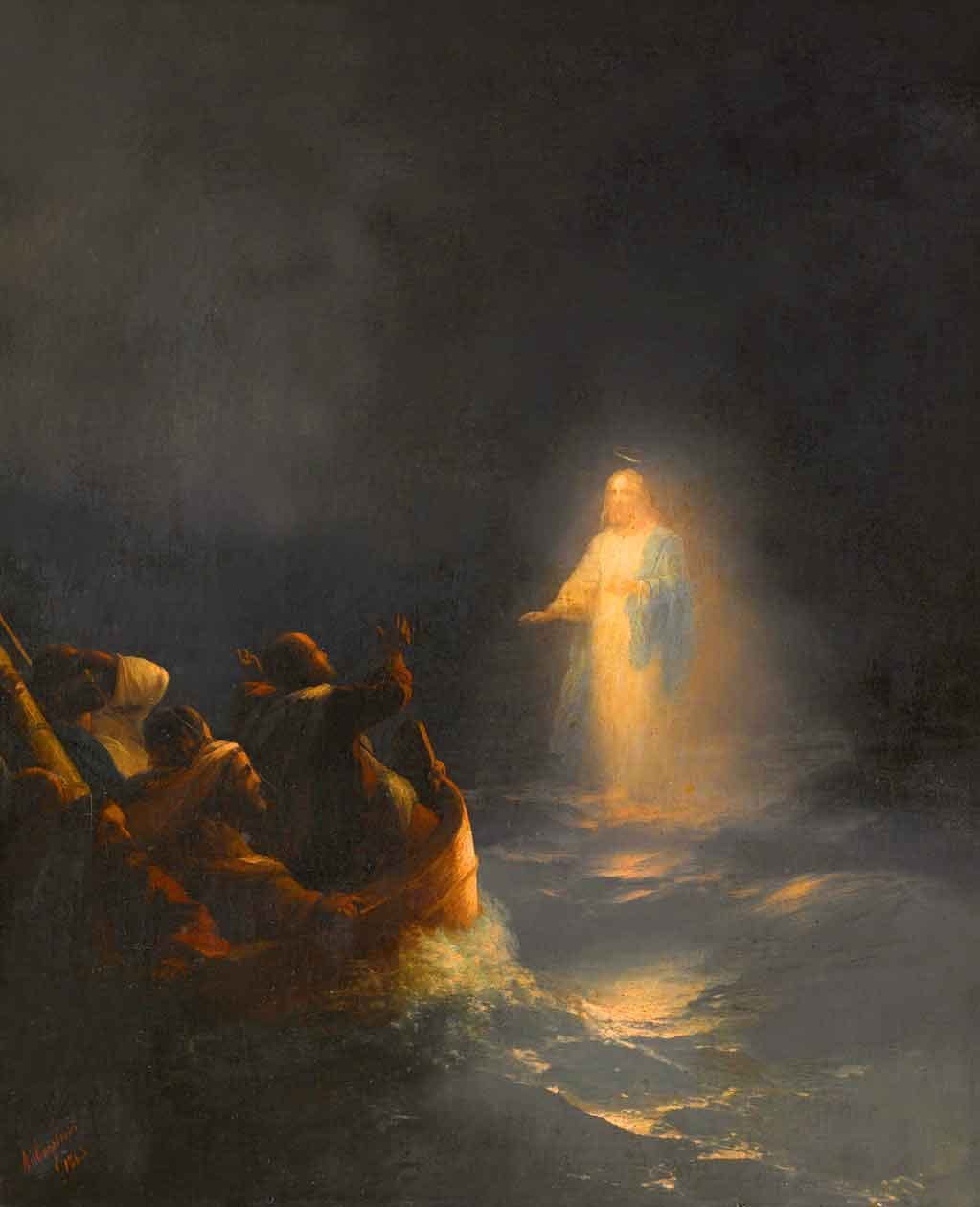
Meanwhile, in the Gospel, the boat is already a few miles offshore, being tossed about by the waves.
Jesus has dismissed the crowds after the feeding of the five thousand and gone up the mountain alone to pray. The disciples have been sent ahead - he made them get into the boat, Matthew says, as though they were directed to go without him. And in the fourth watch of the night, the darkest hours before dawn, he comes toward them walking on the sea.
They see him and are terrified. “It is a ghost.”
He speaks: “Take courage, it is I; do not be afraid.”
And Peter, who is incapable of receiving good news quietly, says: “Lord, if it is you, command me to come to you on the water.”
Come.
Chrysostom, in his homily on this passage, pauses at this moment to note that Peter is neither seeking a sign nor testing Jesus. He is not asking to walk on water for its own sake. He wants simply to be near him. “None so loved Jesus,” Chrysostom writes. “He required an exceedingly great thing, for love only, not for display. For neither did he say, Bid me walk on the water, but what? Bid me come unto you.”1 The request is a love-request dressed in an impossible demand. Peter is asking: let me close the distance between us, whatever that costs.
He gets out and he walks, but then he looks at the wind.
Beginning to sink, he cried out: “Lord, save me!”
Immediately Jesus stretched out his hand and caught him.
Chrysostom’s image for this moment is precise and tender: “As when a nestling has come out of the nest before the time, and is on the point of falling, its mother bears it on her wings, and brings it back to the nest; even so did Christ.”2
Jesus catching Peter is is not a rebuke dressed as rescue. It is the response of someone who has been watching all along, who let Peter walk far enough to learn something, and who will not let him drown for the lesson.
“O you of little faith, why did you doubt?”
Chrysostom notes that Jesus allows the wind to continue blowing even after he catches Peter, “showing that no hurt comes thereby, when faith is steadfast.”3 The wind was never the problem. The faith was. And the faith - insufficient, wavering, yet love-filled even in its failure - was enough to produce the cry that brought the hand.
Augustine, reading this passage, sees the whole Church in the boat: “The ship which carries the disciples, i.e., the Church, is tossed and shaken by the tempests of temptation; and the contrary wind, i.e., the devil her adversary, rests not, and strives to hinder her from arriving at rest. But greater is He who maketh intercession for us.”4
The one who makes intercession - who is intercession itself - is on the mountain praying. He is watching the boat from the heights. He comes at the fourth watch - at the hour of deepest darkness - walking on the very thing that was threatening them.
The household in its own fourth watch is in this boat - the 3 AM of a marriage, a diagnosis, a season of faith gone cold, a child who has stopped praying. The wind and waves are real. The darkness before dawn is real. And yet the one who comes walking on the sea is not absent, and has not been absent. He has been on the mountain, praying, watching, and he comes at the hour when the need is most acute and the faith is most afraid.
The cry that brings the hand is simple. Three words spoken while sinking: Lord, save me.
John Vianney heard this cry a hundred thousand times in the darkness of a confessional in Ars. He heard it in every possible form the wound takes - the great guilt, the sin the person had been carrying so long they no longer believed it could be healed. And every time, he offered what he had: not his own power, but his presence at the place where the hand reaches down.
The domestic church is called to be this presence for the people in its own boat. Not to heal the incurable wound by its own strength, but to be the place where the three words can be spoken, where the cry is received without judgment, where the hand that catches is mediated through the ordinary fidelity of people who keep showing up for one another in the fourth watch.
Lord, save me.
It is enough. It has always been enough. The hand is already reaching.
The domestic church doesn’t form itself. Domus Formation’s & Altar app gives your household a daily rhythm of Catholic prayer and formation - tracks for families, men, women, teens, and those in the second half of life. Start a free trial at WeAreDomus.com/start.
If Catholic fiction that takes the Communion of Saints seriously - as doctrine, not sentiment - is what you are looking for, I am writing two things. Lux Perpetua is a serial novel publishing weekly in two tracks, set in Alton, Illinois, at the edge of the Mississippi - a story of custody and fidelity and a flame passed forward across centuries. And Two Lamps is a weekly short story on Substack, each one braiding two saints from different centuries into a single imagined meeting. Both are for the kind of reader who believes the imagination is also a faculty of faith.
Deacon Michael Halbrook is husband to Suzanne, father of four sons, and a permanent deacon of the Diocese of Springfield in Illinois. He serves at St. Elizabeth Parish in Granite City. He is the founder of Domus Formation, a collection of Catholic prayer and formation resources for every stage of life, and he writes at DeaconMichael.net.
John Chrysostom, Homilies on the Gospel of Matthew, Homily 50 (on Matthew 14:28-31); available at New Advent, newadvent.org.
Ibid.
Ibid.
Augustine of Hippo, commentary on Matthew 14:22-33; cited in multiple patristic commentaries on this passage.