
Look and Live
Tuesday of the Fifth Week of Lent | Numbers 21:4-9 | Psalm 102 | John 8:21-30

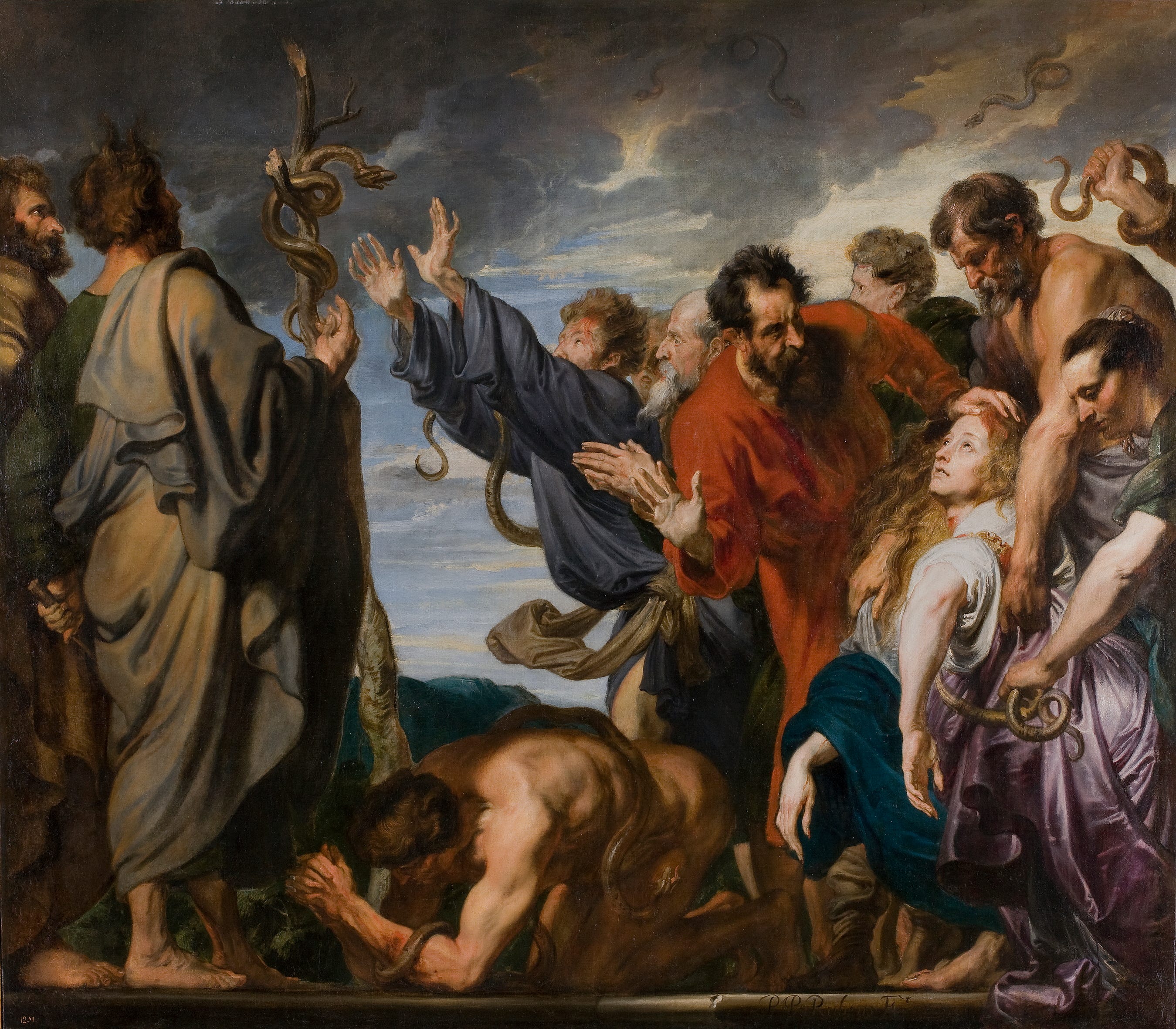
The people of Israel are tired.
They have been in the desert long enough that the miracle has become routine. The manna comes every morning - bread from heaven, the same bread, day after day - and they have grown disgusted with it. “We are disgusted with this wretched food,” they say, which is to say: we are disgusted with the ordinary grace that is keeping us alive. The complaint is not really about bread. It is about the long middle of a journey, the end of which they cannot yet see.
The serpents come, people die, and then God instructs Moses to do something strange: make a bronze image of the very thing that is killing them, and mount it on a pole. Look at it, and live.
Not a journey to make, a rite to perform, or a work to accomplish. Just a look - a willingness to turn the gaze toward the source of the wound, now lifted up, and to receive life from that looking. Many looked. We can wonder - did some refuse?
Into this context in today’s readings, John places a confrontation in the Temple courts: Jesus is speaking with the Pharisees, and the exchange grows dense and strange. “When you lift up the Son of Man,” he says, “then you will realize that I AM.” The word John uses for “lift up” - hypsōthē - carries both meanings at once: to be raised on a cross and to be exalted in glory. The crucifixion and the glorification are, in John’s theology, a single act. The lifting up is the revelation.
The Pharisees cannot see it. “Who are you?” they ask - and he has been telling them from the beginning. What they lack is not information. They lack the willingness to look at what is in front of them and let it be what it is.
Pope Benedict XVI, reflecting on the bronze serpent in Jesus of Nazareth, observes that the image of the serpent on the pole is a paradox of redemption: the instrument of death becomes, when lifted up and looked upon in faith, the instrument of life.1 The looking is itself an act of faith - a turning of the whole person toward the wound, toward the cross, and receiving from it rather than turning away. Augustine makes the same point in his Tractates on John: the Israelites were not healed by understanding the serpent, but by looking at it.2 Faith precedes comprehension. The gaze precedes the theology.
We are in the Fifth Week of Lent. This past Sunday, in many parishes, the statues and images were veiled - the crucifixes covered in violet, the faces of the saints hidden. The Church is doing something deliberate. She is stripping the visible, disciplining the gaze, preparing us for a single unrepeatable moment of seeing. Holy Week is not a surprise arrival. The liturgy has been walking us toward it with intention, week by week, reading by reading - and the question this week presses is whether we have been walking with it, or merely enduring it.
This is where the complaint of Israel cuts close. The manna of Lent is ordinary: the same daily prayer, the same Friday abstinence. It is easy, by the fifth week, to feel the weariness of the long middle. To find the “food” wretched. To be present in body with the practices of the season while the heart has quietly disengaged.
The domestic church feels this acutely. Families that pray together through Lent know the friction of it by now: the children who resist, the evenings that are too short for the family to pray, the prayers that feel rote. Couples who have kept some Lenten discipline together may be feeling the fatigue of it. Those in the second half of life, who have kept this season for decades, may find the manna of this season most ordinary of all.
And yet Holy Week is almost here. The Triduum - those three days that are in a sense one day liturgically, and the only day, the axis on which all of Christian time turns - is within reach. What we do with intentionality in these final days of Lent is not incidental preparation. It is the difference between arriving at the cross having been formed by the journey, or arriving having merely survived it.
The veils will come down after Good Friday. On that day, it is the deacon’s privilege, in the tradition of the Roman Rite, to remove the veil from the crucifix and present it for veneration, in three steps, drawing it gradually into view: Behold the wood of the Cross, on which hung the salvation of the world. The congregation responds: Come, let us adore.
That moment is what the whole of Lent has been preparing. The long veiling, the ordinary manna, the desert road - all of it is the journey toward a look. And the look, as Moses knew, is enough.
Hearth & Altar offers daily prayer and formation for Catholic families, and Eventide & Altar accompanies those in the second half of life through the Church’s daily prayer. Both are rooted in the conviction that what happens at home is not separate from the mission of the Church - it is the first school of faith.
Deacon Michael Halbrook is husband to Suzanne, father of four sons, and a permanent deacon of the Diocese of Springfield in Illinois. He serves at St. Elizabeth Parish in Granite City. He is the founder of Domus Formation, a collection of Catholic prayer and formation resources for every stage of life, and he writes at DeaconMichael.net.
Joseph Ratzinger (Benedict XVI), Jesus of Nazareth, vol. 1, trans. Adrian Walker (New York: Doubleday, 2007), 218-219.
Augustine of Hippo, Tractates on the Gospel of John, Tractate 12.11.