
Is the LORD in Our Midst or Not?
Gospel Reflection for March 8, 2026, the Third Sunday of Lent - John 4:5-42

5 He cometh therefore to a city of Samaria, which is called Sichar, near the land which Jacob gave to his son Joseph.
6 Now Jacob’s well was there. Jesus therefore being wearied with his journey, sat thus on the well. It was about the sixth hour.
7 There cometh a woman of Samaria, to draw water. Jesus saith to her: Give me to drink.
8 For his disciples were gone into the city to buy meats.
9 Then that Samaritan woman saith to him: How dost thou, being a Jew, ask of me to drink, who am a Samaritan woman? For the Jews do not communicate with the Samaritans.
10 Jesus answered, and said to her: If thou didst know the gift of God, and who he is that saith to thee, Give me to drink; thou perhaps wouldst have asked of him, and he would have given thee living water.
11 The woman saith to him: Sir, thou hast nothing wherein to draw, and the well is deep; from whence then hast thou living water?
12 Art thou greater than our father Jacob, who gave us the well, and drank thereof himself, and his children, and his cattle?
13 Jesus answered, and said to her: Whosoever drinketh of this water, shall thirst again; but he that shall drink of the water that I will give him, shall not thirst for ever:
14 But the water that I will give him, shall become in him a fountain of water, springing up into life everlasting.
15 The woman saith to him: Sir, give me this water, that I may not thirst, nor come hither to draw.
16 Jesus saith to her: Go, call thy husband, and come hither.
17 The woman answered, and said: I have no husband. Jesus said to her: Thou hast said well, I have no husband:
18 For thou hast had five husbands: and he whom thou now hast, is not thy husband. This thou hast said truly.
19 The woman saith to him: Sir, I perceive that thou art a prophet.
20 Our fathers adored on this mountain, and you say, that at Jerusalem is the place where men must adore.
21 Jesus saith to her: Woman, believe me, that the hour cometh, when you shall neither on this mountain, nor in Jerusalem, adore the Father.
22 You adore that which you know not: we adore that which we know; for salvation is of the Jews.
23 But the hour cometh, and now is, when the true adorers shall adore the Father in spirit and in truth. For the Father also seeketh such to adore him.
24 God is a spirit; and they that adore him, must adore him in spirit and in truth.
25 The woman saith to him: I know that the Messias cometh (who is called Christ); therefore, when he is come, he will tell us all things.
26 Jesus saith to her: I am he, who am speaking with thee.
27 And immediately his disciples came; and they wondered that he talked with the woman. Yet no man said: What seekest thou? or, why talkest thou with her?
28 The woman therefore left her waterpot, and went her way into the city, and saith to the men there:
29 Come, and see a man who has told me all things whatsoever I have done. Is not he the Christ?
30 They went therefore out of the city, and came unto him.
31 In the mean time the disciples prayed him, saying: Rabbi, eat.
32 But he said to them: I have meat to eat, which you know not.
33 The disciples therefore said one to another: Hath any man brought him to eat?
34 Jesus saith to them: My meat is to do the will of him that sent me, that I may perfect his work.
35 Do you not say, There are yet four months, and then the harvest cometh? Behold, I say to you, lift up your eyes, and see the countries; for they are white already to harvest.
36 And he that reapeth receiveth wages, and gathereth fruit unto life everlasting: that both he that soweth, and he that reapeth, may rejoice together.
37 For in this is the saying true: That it is one man that soweth, and it is another that reapeth.
38 I have sent you to reap that in which you did not labour: others have laboured, and you have entered into their labours.
39 Now of that city many of the Samaritans believed in him, for the word of the woman giving testimony: He told me all things whatsoever I have done.
40 So when the Samaritans were come to him, they desired that he would tarry there. And he abode there two days.
41 And many more believed in him because of his own word.
42 And they said to the woman: We now believe, not for thy saying: for we ourselves have heard him, and know that this is indeed the Saviour of the world. (John 4:5-42 DRA)
Today is the third Sunday of Lent. Yesterday, we celebrated the traditional feast of St. Thomas Aquinas, the Angelic and Universal Doctor of the Church. So, for this reflection, I would like to interpret the readings in light of an especially insightful quote from St. Thomas which I believe reveals the meaning of these readings and applies them to our times in an important way:
The love of bodily pleasures leads man to have a distaste for spiritual things, and not to hope for them as arduous goods. In this way despair is caused by lust.
This ‘love of bodily pleasures’ is the definition of lust – not the love of bodily pleasure per se, but immoderately and to excess, prioritized above higher goods such as love of God and love of neighbor. This quote perfectly explains the ‘testing’ of God by the Israelites in the first reading. Despite their afflictions as slaves in Egypt, they still longed for its creature comforts, the security of its empire and luxurious rewards for their good service to their masters (like building the Pyramids).
In the deprivation of the wilderness, the miraculous acts of God in freeing them from slavery suddenly seemed as though they had happened in another life, and many even doubted their efficacy, since now they seemed doomed to die in the desert. To these thirsting Israelites, only the easy good of earthly water, the bodily pleasure of a quenched appetite seemed meaningful anymore, not the covenant promises of God or the requirements of His Law. The spiritual goods of salvation and holiness were simply too difficult and too much for God to ask of His poor people. Why was God so demanding and the reward He offered so arduous to obtain?
This question could serve as the motto for our culture today. Even apart from more intellectualized philosophies such as scientism, relativism and empiricism, what the modern world really follows is hedonism, the idea that goodness is pleasure and evil is pain, whether sensory or emotional. Based on this, learned as it is from a childhood of ‘gentle parenting’ and rights without responsibilities, where every need and want must be met immediately and any discomfort avoided at all costs, spiritual goods are no longer pursued. Indeed, many even see them as unjust; their very arduousness is such a pain that it disproves their goodness. If spiritual goods were really good, surely they would be easier!
Mired in this despair of ever attaining spiritual goods, people today seek happiness in temporal goods, even while knowing that they can only ever be temporary (hence the name) and incomplete. This spirit of pusillanimity, of small-souledness whereby what is great is seen as too toilsome to be worth chasing, has created a culture of lowered standards in every field, of toleration for every form of debauchery, vulgarity, immodesty and blasphemy, and of indifference to the greatest of evils, even the genocide of the unborn, while any perceived threats to hedonistic pleasure and ‘freedom’ are responded to with childish rebelliousness and barbaric acts of violence.
St. Thomas tells us that the ‘daughters’ or effects of lust are “blindness of mind, thoughtlessness, inconstancy, rashness, self-love, hatred of God, love of this world and abhorrence or despair of a future world.” It goes without saying that these are the very shadows darkening the minds and hearts of people today – even many who are well-intentioned or who consider themselves Catholic, like those recently surveyed at the Eucharistic Congress who, despite saying they attend Mass almost every Sunday, still include 82% who say they approve of contraception.
The lack of clear moral teaching, reproach for sins, exhortation to virtue and saintly example in the modern Church has given Catholics today the impression that holiness no longer means to be ‘set apart’ from the world; instead, one may simply blend into Egypt without being its slave. But this is a diabolical delusion leading only to despair, and it has caused not only the aforementioned permissiveness and laxity among Catholics but also an unwillingness to evangelize, to defend the Faith against attacks or even to live one’s faith openly and unapologetically.
There is no greater time to correct this than Lent, when we are called to pursue three works which directly counter the three types of lust described in Scripture: “For all that is in the world, is the concupiscence of the flesh, and the concupiscence of the eyes, and the pride of life, which is not of the Father, but is of the world.” (1 Jn 2:16) St. Thomas directly connects these to the corporal works of mercy:
There are three good works, namely, alms, prayer and fasting: alms against the concupiscence of the eyes; prayer against the pride of life, and fasting against the concupiscence of the flesh.
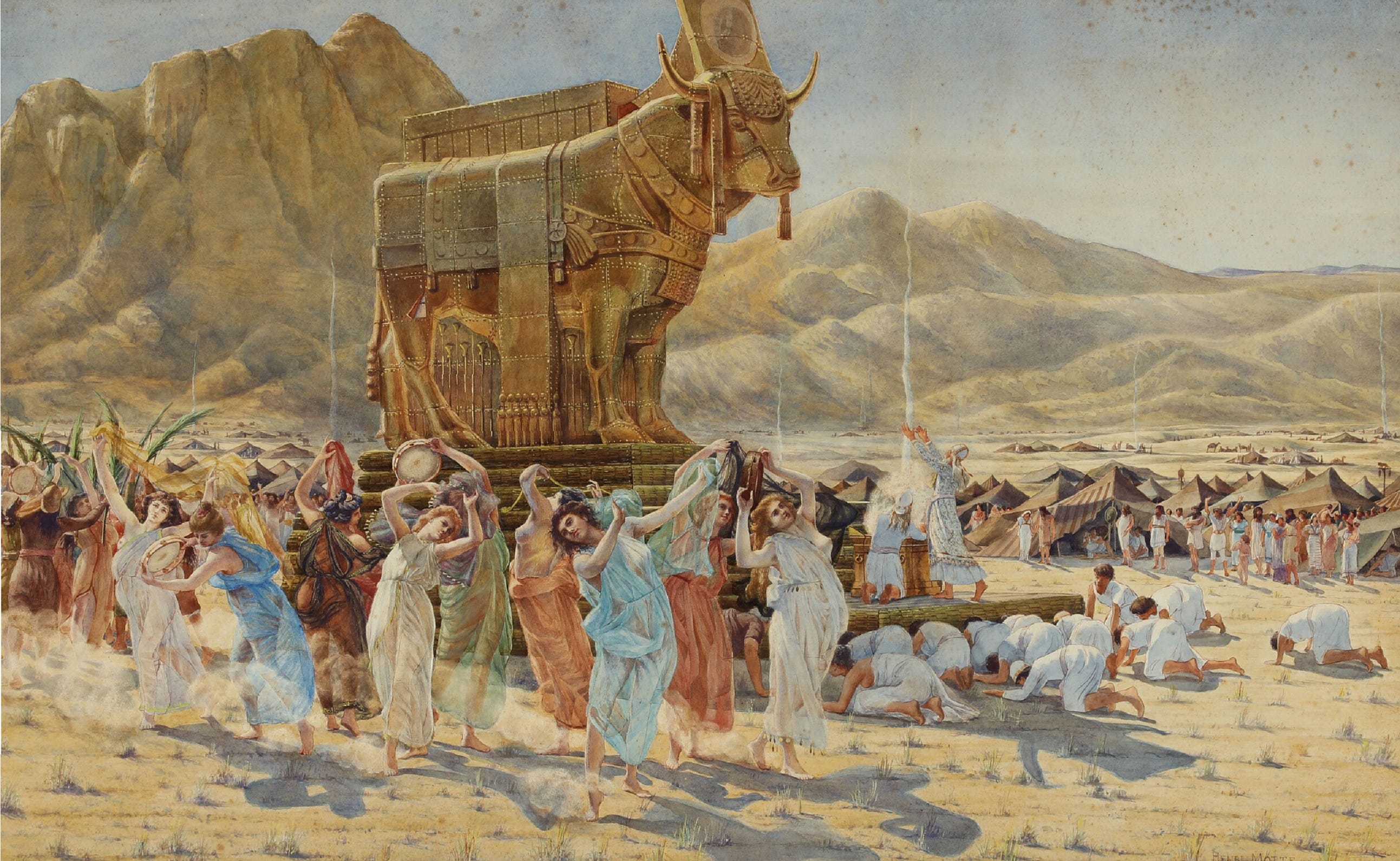
In the world today, anyone who is great-souled (magnanimous), who loves spiritual goods and sees them as things worth fighting for, is not only ignored but openly hated, labeled a bigot and fascist because by his very life, he holds the hedonists accountable. He shows them what they could be but choose not to even try. And it is precisely by humbly recognizing his inability as a creature to gain spiritual goods without the grace of God that he is able to overcome the chains of hedonism which seek to pin him to the foot of Mount Sinai, where the hedonists are having their orgy around their Golden Calf. By allowing God to remove their shackles, he is enlightened to see the Bright Cloud of God’s glory and empowered to scale the mountain with Moses to meet God and see Him face-to-face.
As our initial quote from St. Thomas intimated, it may be said that, among all the virtues, the one that is most lacking today is hope – not worldly hope or optimism, which our Enlightenment progressivism still vainly clings to, hoping in the power of technology or democracy or wealth to save us from all evils – but the theological virtue of hope, which as St. Thomas explains is an assurance of union with God as an arduous good through His grace. Hope does not make this union easy; instead, it gives us the strength to press on, to endure any hardships of life and to train ourselves in holiness for every good work, so that we may be made into the perfect likeness of Christ. This is why St. Paul taught,
For we are saved by hope. But hope that is seen, is not hope. For what a man seeth, why doth he hope for? But if we hope for that which we see not, we wait for it with patience. (Rom 8:24-25)
This is the living water which Our Lord offers to the Samaritan woman, identified by tradition as the holy martyr St. Photina, today. But He does not make it easier for her by dumbing down His expectations. Instead, He challenges her, pointing out her sins and calling her to repentance, and it is by this very knowledge and moral clarity that she recognizes Him as the Messiah.
Christ sent the Holy Ghost into the world for this exact purpose: “And when he is come, he will convince the world of sin, and of justice, and of judgment.” (Jn 16:8) This is not the happy-go-lucky, feel-good hippie Jesus of popular culture. No, it is the God of Abraham, Isaac and Jacob, the God of Moses who vanquished the Egyptians and freed the Israelites from their spiritual slavery to worldliness. And He is still our God today, calling us to the same liberation from lust as He did the Israelites and the Samaritan woman at the well and offering us the same reward of beatitude through union with Him.
Join the Fellowship at Saint Tolkien!
I have been seeing a sermon of the Samaritan woman everywhere I turn, thrice on Substack and several times on TikTok. Is the Lord trying to tell me something?
I enjoyed this very much, thank you