
Into Your Hands
Tuesday of the Third Week of Easter | Acts 7:51-8:1a | Psalm 31 | John 6:30-35

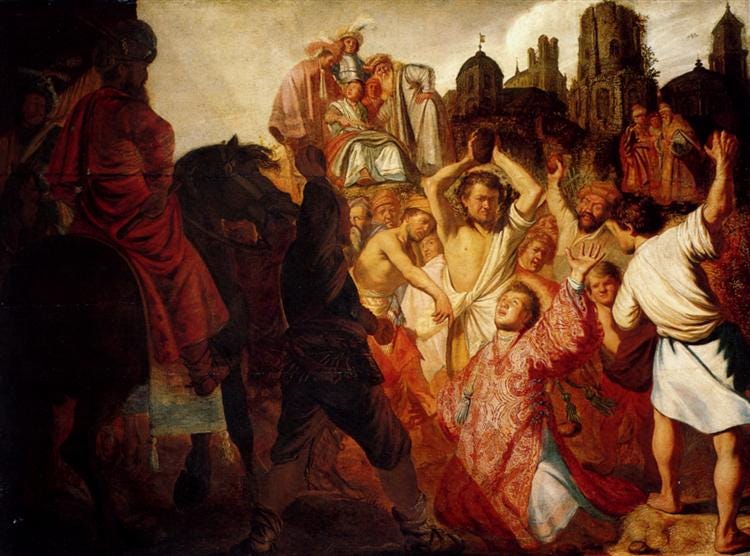
There is a thread running through today’s readings that is easy to miss because it is so familiar.
“Into your hands, O Lord, I commend my spirit.”
It is the refrain of Psalm 31, sung today as the responsorial. It is also what Jesus says from the cross in Luke’s Gospel - words before he dies, drawn from this same psalm. And it is what Stephen says, in his own words, as the stones begin to fall: “Lord Jesus, receive my spirit.”
Three voices (or one voice - Christ’s, the Word’s). One prayer. Across centuries and in the span of a single liturgy, David, Jesus, and Stephen are saying the same thing at the moment of extremity - not as resignation, but as the most deliberate act available to a person. To commend your spirit is to place yourself, consciously and completely, into hands you trust absolutely.
Stephen can say this because of what he has just seen. Filled with the Holy Spirit, he looks up - and the heavens open. He sees the glory of God, and Jesus standing at the right hand of the Father. Not seated, as the creeds and most of the New Testament describe, but standing - as if rising to receive him, to witness his faithfulness, to be present at the moment of his death. Stephen looks at that vision and finds, already available to him, the language of the cross: receive my spirit, do not hold this sin against them.
He has been so formed by the paschal mystery that it becomes his own death vocabulary.
The crowd surrounding him does the opposite. They cover their ears. They cry out in a loud voice. They rush upon him together. Stephen is offering them the same vision - “I see the heavens opened” - and they cannot bear to hear it. The infuriation, the grinding of teeth, the covered ears: these are not the responses of people who have considered the evidence and found it wanting. They are the responses of people who have decided, before Stephen speaks, that they will not receive what he is offering.
The crowd in John’s Gospel is doing something similar, though more politely. They invoke the manna - “our ancestors ate bread from heaven in the desert” - and demand that Jesus produce something comparable. A sign. A demonstration. Something on their terms, in their category, that they can evaluate and accept or reject. Jesus answers by offering himself: I am the bread of life. Not a sign pointing to something else, but the thing itself. The hunger they are trying to satisfy with signs is the hunger that only he can fill.
Both crowds are asking for proof while refusing the proof being given.
Augustine, in his Tractates on John, reflects on the crowd’s request and notes that they want to see in order to believe, but that Jesus is inverting the order: you must receive in order to see.1 The bread of life is not something you analyze from a distance and then decide whether to consume. It is something that, received, changes the one who receives it - that forms in us, over time, the capacity to see what Stephen saw. The heavens opened not because Stephen had solved a theological problem but because he had been fed, and formed, and was now dying in the image of the one who had fed him.
This is a striking thing to sit with in the third week of Easter. The resurrection is not primarily an argument to be won. It is a life to be received, again and again, at the altar and in the daily prayer of the household, until it becomes - as it became for Stephen - the language we have available to us when nothing else is left.
There is one more detail in the Acts passage that Luke drops almost in passing, saving it for last: “Now Saul was consenting to his execution.”
The word Luke uses - suneudokōn - carries more than passive consent. It shares its root with the Father’s words at Jesus’s baptism: “in whom I am well pleased.” Saul is not merely failing to stop the stoning. He is actively pleased by it, approving it with satisfaction, taking a kind of pleasure in what is happening. He is there. The witnesses have laid their cloaks at his feet. He is not throwing stones himself - he is something worse, the one who frees the hands of the killers and finds the whole thing agreeable. And he will go on from this moment to pursue the Church with extraordinary violence, by his own later testimony dragging men and women to prison, consenting to their deaths.
This is the man who will become Paul.
The range of grace implied by that sentence - “Now Saul was consenting” - is almost incomprehensible. And yet there it is, embedded in the martyrdom of Stephen, a seed planted in the hardest possible soil. Chrysostom suggests that Stephen’s prayer - “Lord, do not hold this sin against them” - was answered, in part, in the conversion of the man who stood watching.2
The household that prays for the resistant ones, the stiff-necked ones, the ones who cover their ears - is praying in the company of Stephen. And the answer may take longer than we expect, and arrive in a form we could not have anticipated, and change everything.
Into your hands.
Domus Formation has built the & Altar app to bring daily Catholic prayer and formation into the rhythms of the household - with tracks for families, men, women, teens, and those in the second half of life. Because the first school of faith is the home, and every member of it deserves to be formed.
If the idea of a long story passed forward across centuries - of custody and fidelity and a flame that refuses to go out - resonates with you, I am writing it. Lux Perpetua is a serial novel publishing weekly: a free Monday chapter and a paid Thursday chapter, set in Alton, Illinois, at the edge of the Mississippi. The first chapters are live. Free readers are welcome. LuxPerpetua.net
Deacon Michael Halbrook is husband to Suzanne, father of four sons, and a permanent deacon of the Diocese of Springfield in Illinois. He serves at St. Elizabeth Parish in Granite City. He is the founder of Domus Formation, a collection of Catholic prayer and formation resources for every stage of life, and he writes at DeaconMichael.net.
Augustine of Hippo, Tractates on the Gospel of John, Tractate 25.12.
John Chrysostom, Homilies on the Acts of the Apostles, Homily 17.