

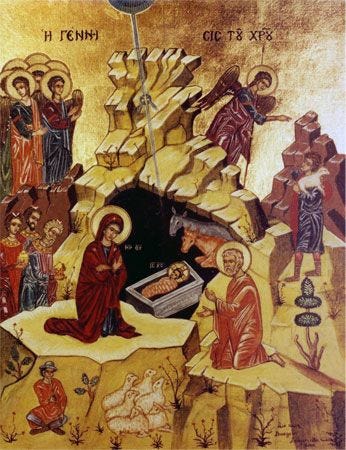
In the beginning was the Word,
and the Word was with God,
and the Word was God.
He was in the beginning with God.
All things came to be through him,
and without him nothing came to be…
And the Word became flesh
and made his dwelling among us,
and we saw his glory,
the glory as of the Father’s only-begotten Son,
full of grace and truth. John 1:1-3, 14.
Today’s Gospel is referred to as the Prologue to John’s Gospel since it begins with a discourse prior to the Incarnation. John has two aims with this Prologue. The first aim is to show the eternal origin of Christ and confess His divine nature. He then turns to the temporal origin and confesses the incarnation.1
St. John begins with a familiar phrase, “In the beginning…” No doubt, for someone who knew his scriptures well, John intentionally begins his gospel the same way that Genesis begins. It is here that we can see the parallels. Genesis begins in the beginning, prior to the creation of all things. Verse two indicates this:
“The earth was without form and void, and darkness was upon the face of the deep; and the Spirit of God was moving over the face of the waters.” Genesis 1:2
The Genesis text gives us three important attributes: without form, void, and darkness over the deep. These three attributes indicate that there was nothing prior to God’s creative act. This creation, ex nihilo, is uniquely a divine action. Only God can create from nothing. Thus, the formless, void, and darkness are brought into existence and given shape, fullness, light, essence, and existence.
John attests, most importantly, that in the same sense that Genesis uses the term, in the beginning was the Word. That is, in the beginning, before the creative act, the Word was. John makes an important distinction here:
The Word was with God
and
The Word was God.
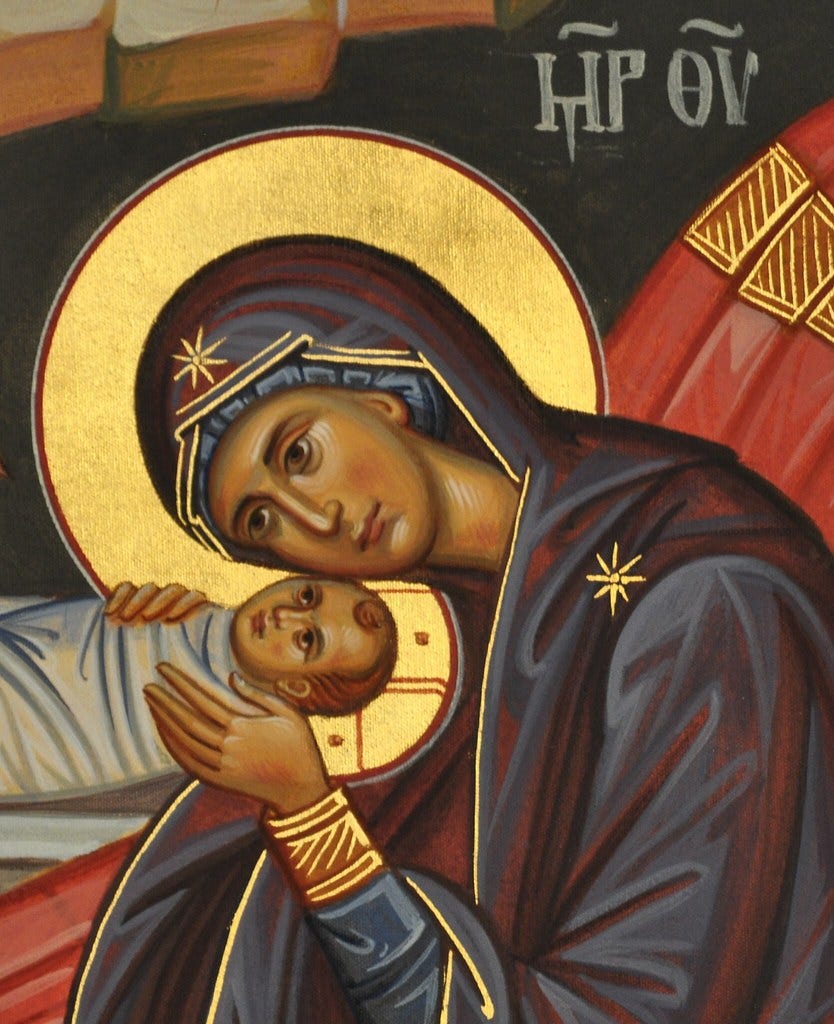
These two realities form the basis of Trinitarian Theology. The Word is both with God, indicating a relational aspect to the Word and God. He also was God, indicating a union in essence between the Word and God.
These are the two defining aspects of Trinitarian Theology, that the persons of the Trinity are of the same Essence, ie, there is One God. And in that one essence, the distinction of persons is found in their relation to one another. That is to say, the Father is Father because He has a Son. The Son is Son, precisely because He has a Father, etc. The Father is not the Son because the Father does not have a Father, and so on. The unique and distinct persons of the Trinity are distinguished by their relation to one another.
John’s use of the name Word is very important. A word is something that begins within the speaker and proceeds out of him, revealing a certain truth that the speaker wishes to convey. In the same way, the Word of God begins within the Father and proceeds outward, eternally. The aspect of eternity is vital here. Unlike human words, this Divine Word has no beginning and no end. For human words, they are conceived in the human intellect and proceed out and have an end when the vocal sound dissipates. But in the case of the Divine Word, who is God, this Word has a co-eternity with God. The Word is eternally conceived in the Intellect of the Father and is eternally begotten of the Father, God of God, Light of Light, True God of True God.
John then affirms the creative act of the Divine Word. As said above, only God can create Ex Nihilo. Thus, John affirms that all things came to be through Him. Again, we see a parallel with the Genesis text. Throughout the creation story, we hear that God created through His Word. The Genesis text, over and over, repeats the same line: Then God said… God’s creative act, from nothing, is the Word: All things came to be through Him, and without Him nothing came to be. John adds another clause here to show that there is nothing in creation that came to be without the creative act of the Word.
This includes the Word, Himself.
For those who would say that the Word is created before all other things, John condemns that by saying that nothing came to be without Him. How can He come to be through Himself? That is a logical contradiction. John clearly shows that the Word is eternal and uncreated.
Then:
“The Word became flesh and made His dwelling among us…” John 1:14
John confesses the Incarnation of Christ. The same Word that is eternal and creative. The same Word that was with God and was God became flesh and dwelt among us. The Greek word that is used here is tabernacled. The Word tabernacled among men. He dwelt with us and for us, assuming a human nature to His divine person and became subject to death.2
Through this Incarnation, we are able to behold the Father’s glory in His only-begotten Son. Jesus Christ is the Icon of the Father and is truly God with us.3 This dwelling in the flesh is the great mystery that we are celebrating in this Octave of Christmas. The Word from before all ages, who holds us in our very being and wills that we exist, chose to come to earth and become what He has created. Assuming a true human nature to His divine person, Christ opened the way to salvation. The Word became flesh and dwelt among us. God became man so that man might become God.4
For more from Dr. McGovern, visit his Substack at A Thomist, Dedicated to the Theological tradition of St. Thomas Aquinas. Exploring Thomas’ Spiritual Theology and topics in Christology and Mariology.
Cf. St. Thomas Aquinas, Commentary on the Gospel of John, C. 1, L. 1, 23.
Cf. Philippians 2:5-8.
Cf. Matthew 1:23.
Cf. 2 Peter 1:4. St. Athanasius, On the Incarnation.