
If You Love Me, Keep My Commandments
Gospel Reflection for May 10, 2026, the Sixth Sunday of Easter - John 14:15-21

15 If you love me, keep my commandments.
16 And I will ask the Father, and he shall give you another Paraclete, that he may abide with you for ever.
17 The spirit of truth, whom the world cannot receive, because it seeth him not, nor knoweth him: but you shall know him; because he shall abide with you, and shall be in you.
18 I will not leave you orphans, I will come to you.
19 Yet a little while: and the world seeth me no more. But you see me: because I live, and you shall live.
20 In that day you shall know, that I am in my Father, and you in me, and I in you.
21 He that hath my commandments, and keepeth them; he it is that loveth me. And he that loveth me, shall be loved of my Father: and I will love him, and will manifest myself to him.
(John 14:15-21 DRA)
The greatest of all the commandments, according to Christ Himself, is this: “Thou shalt love the Lord thy God with thy whole heart, and with thy whole soul, and with thy whole mind” (Mt 22:37). Unfortunately, the word “love” in English has taken on many different meanings over time, and today, it is most often associated with emotional affection, like the love we feel for our family and friends. That’s why we can even say that our pets ‘love’ us or that we ‘love’ our house, car, clothes, etc.
But this is not the kind of love Our Lord meant in the greatest commandment or in our Gospel reading today. Indeed, while it is certainly possible to have affection for those we love as Christ commands us to love, this may not always be the case, as when He tells us to love our enemies and to do good to those who hate us. According to the classical definition given by St. Thomas Aquinas, love means to will the good of another person. This corresponds to charity (Greek agape, Latin caritas), what is sometimes called ‘disinterested love’ – not detached or unfeeling love, but love that wills another’s good for their own sake because we love God, regardless of how they treat us or what worldly good we receive in return.
Most Christians would say that they love God – this is what it really means to be a Christian, after all. But how many Christians really love Him? In today’s Gospel, Our Lord shows us that to love Him is not merely to feel affection for Him, which tends to be what people mean when they say they love God. Rather, to love God means to will the Good that He is, and we do this most of all by obeying His commandments.
Since Jesus is God, this goes beyond just the commandments He gave personally during His earthly ministry. It includes all the commandments of the Old Testament, whether directly (like the Ten Commandments) or indirectly through their New Testament fulfillment, like the Eucharist which fulfills the Temple sacrifices, Baptism which fulfills circumcision or the Lord’s Day which fulfills the Sabbath. It also includes the commandments of the Church, including those given by the apostles in the New Testament and in their oral Tradition, as well as the teachings and laws promulgated by their successors, the pope and bishops. As St. Basil the Great taught,
Of the beliefs and practices whether generally accepted or publicly enjoined which are preserved in the Church some we possess derived from written teaching; others we have received delivered to us in a mystery by the tradition of the apostles; and both of these in relation to true religion have the same force. And these no one will gainsay — no one, at all events, who is even moderately versed in the institutions of the Church. For were we to attempt to reject such customs as have no written authority, on the ground that the importance they possess is small, we should unintentionally injure the Gospel in its very vitals; or, rather, should make our public definition a mere phrase and nothing more. For instance, to take the first and most general example, who is thence who has taught us in writing to sign with the sign of the cross those who have trusted in the name of our Lord Jesus Christ? What writing has taught us to turn to the East at the prayer? Which of the saints has left us in writing the words of the invocation at the displaying of the bread of the Eucharist and the cup of blessing? For we are not, as is well known, content with what the apostle or the Gospel has recorded, but both in preface and conclusion we add other words as being of great importance to the validity of the ministry, and these we derive from unwritten teaching. Moreover we bless the water of baptism and the oil of the chrism, and besides this the catechumen who is being baptized. On what written authority do we do this? Is not our authority silent and mystical tradition? (On the Holy Spirit, 66)
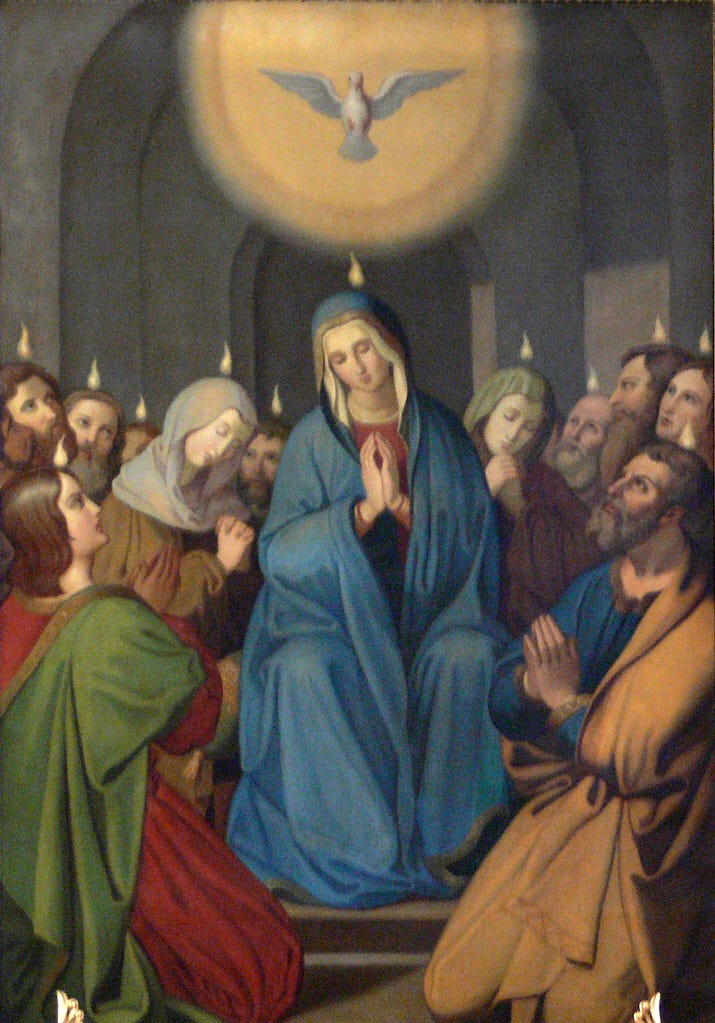
This is why Our Lord in today’s Gospel connects His teaching on love to the gift of the Holy Ghost, whose coming we will celebrate in two weeks on the Feast of Pentecost. In the Old Testament, the coming of the Holy Ghost was not simply a sign of miraculous powers. Primarily, His infusion signified the giving of wisdom – the understanding of God and what we must do to be one with Him. This remains true for us today. The primary gift of the Holy Ghost is divine wisdom, and it is this that teaches us what it really means to love Christ: to keep His commandments. Not out of mere servile fear of punishment or blind obedience but out of true love, the charity the wills the good of another.
The danger of treating this love as mere emotional affection can be seen in the moral and doctrinal laxity so rampant today among Christians, even in the Catholic Church. We are willing to ‘tolerate’ any measure of sin or error so long as we don’t ‘feel bad’ or make others ‘feel bad’ about themselves or us. This is even why many people become irreligious or atheists, because they are raised with this distorted understanding of Christian love, so when God permits evils to occur, they no longer feel affection for Him and thus believe that they no longer love Him. It is also why so few Catholics today speak out against the evils that have overwhelmed our world, including the genocide of unborn children, the mockery of gay ‘marriage’ and their theft of children, the willingness to call a man a woman or vice versa – all simply to appease ‘feelings’.
Misunderstanding St. Peter’s lesson in the Epistle, many Catholics engaged in apologetics or interreligious dialogue even believe that to do these necessary acts “with gentleness and reverence” means to compromise the truth or to accommodate sin – but these are neither gentle nor reverent, and they risk prioritizing love of neighbor over love of God.
We must obey Christ’s commandments and show the world that it is truly possible to do so by the grace of the Holy Ghost. Otherwise, we cannot love Him, nor can anyone else.
Join the Fellowship at Saint Tolkien!
I really wanted to "like" thisbut an app update means I can't hit the like button. I just about managed to write this instead.!
Wonderful instruction, thank you Kaleb