

Hosea is diagnosing a system failure.
Israel has made its own kings - “not by my authority,” the LORD says, not by my knowledge. It has made its own gods from silver and gold - the golden calf of Samaria, the work of an artisan’s hands, destined for the flames. It has multiplied altars, but the altars meant to expiate sin have become occasions of sin. It has received God’s ordinances but treats them like a stranger’s letter, something addressed to someone else.
And then the line that stops everything: “When they sow the wind, they shall reap the whirlwind.”
The image is agricultural but the logic is moral. What you plant is what grows. If the seed is wind - insubstantial, directionless, the motion of something that has no weight and no root - then the harvest is whirlwind: the same nothingness, magnified, violent, destructive. The self-made system - self-made kings, self-made gods, self-made religion - does not produce freedom. It produces a larger version of its own emptiness.
The responsorial psalm presses the diagnosis deeper.
“Their idols are silver and gold, the handiwork of men. They have mouths but speak not; they have eyes but see not; they have ears but hear not; noses but smell not... Their makers shall be like them, everyone that trusts in them.”
This is one of the most penetrating lines in all of Scripture, and it is easy to read past it. The idols cannot speak, cannot see, cannot hear. But notice where the line goes: their makers shall be like them. It is not merely that the idol is empty. It is that the person who worships the empty thing becomes progressively less able to speak, see, and hear. The worship forms the worshiper. We become what we adore.
Augustine, in his commentary on this psalm, draws out the same logic: the soul that turns away from God and toward the creature is not merely exchanging one love for another.1 It is exchanging life for a diminishment of life, exchange full personhood for an attenuated one. The idol does not simply fail to save. It unmakes, slowly, the person who trusts in it.
Matthew opens his passage with a man who literally cannot speak.
He is mute, and the muteness has a demonic source. He is brought to Jesus. The demon is cast out. The man speaks. The crowds are amazed: “Nothing like this has ever been seen in Israel.”
The Pharisees say: “He drives out demons by the prince of demons.”
Notice what has happened. The crowds have seen a mute man speak and their response is wonder. The Pharisees have seen the same thing and their response is a theological category: this belongs to the prince of demons. They cannot receive what they are seeing because their interpretive system has become a closed loop, an idol of a different kind - a human construction that, like the golden calf, cannot see, cannot hear, cannot speak the truth of what is right in front of it. The Pharisees are, in Hosea’s terms, reaping the whirlwind of their own system. They have sown a framework so total that even a mute man speaking cannot penetrate it.
Then Matthew pulls back the camera.
Jesus goes through all the towns and villages, teaching in the synagogues, proclaiming the Gospel of the Kingdom, curing every disease and every sickness. And then the passage gives us the moment that holds everything together:
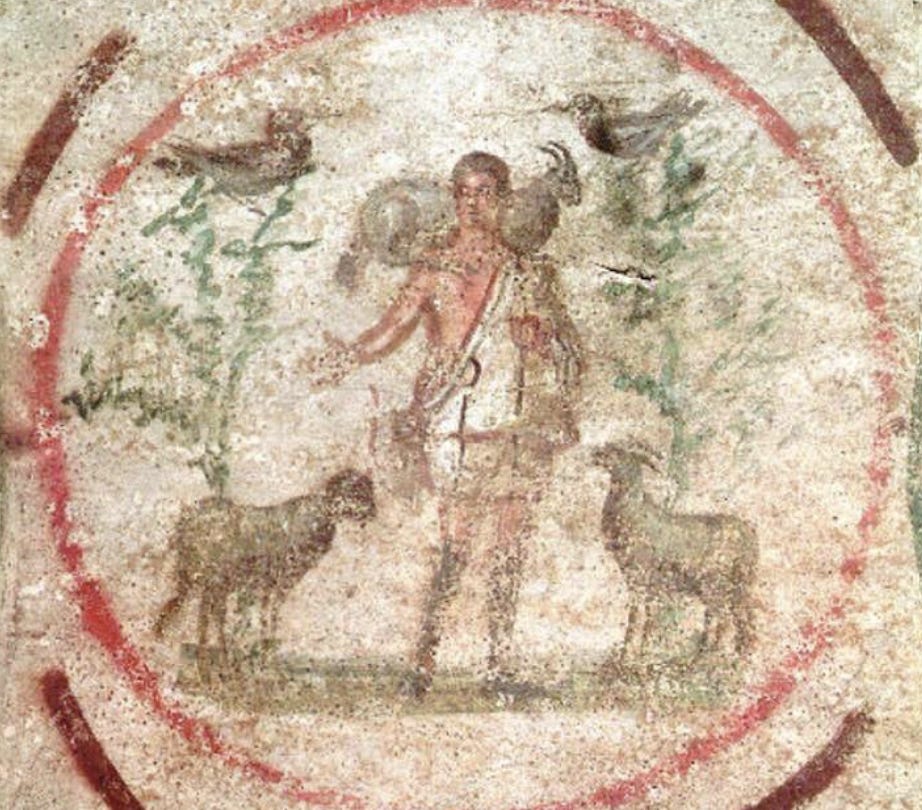
“At the sight of the crowds, his heart was moved with pity for them because they were troubled and abandoned, like sheep without a shepherd.”
The Greek is worth dwelling on. Eskulmenoi - troubled, harassed, flayed, torn. Errimmenoi - thrown down, cast aside, lying prostrate. These are not words of mild discontent. They describe people who have been worked over by something and left where they fell. The idol cannot see them. The Pharisees have a category for them. The self-made system has used them and discarded them.
Jesus sees them.
And what happens in him when he sees them is splanchnizomai - a word that comes from splanchna, the viscera, the internal organs, the seat of the deepest emotions in the ancient world. He is moved in the gut. He is, as Origen observed, the divine Logos bending down to lift up the creature - a movement of condescension that runs through the entire Gospel, from the Incarnation to the cross.2 Chrysostom notes that Jesus does not look upon the crowds with contempt or discouragement but with the love of a shepherd searching for lost sheep.3 The compassion is not pity from a distance. It is the gut-response of the one who made them for himself and sees what they have been reduced to by everything that is not him.
The contrast between the idol and the shepherd is total.
The idol has a mouth and speaks not. Jesus speaks and a mute man finds his voice. The idol has eyes and sees not. Jesus sees the crowds and is moved. The idol has ears and hears not. Jesus hears the prayer of the harvest and sends laborers. The makers of idols become like them - silent, blind, deaf. Those who follow the shepherd find, over time, that they are becoming more able to see, to hear, to speak: more like the one they are following.
This is the formation the household is called to. Not the formation of a system - not a set of rules and practices maintained by willpower - but the formation of people who are turning their faces toward the one whose heart moves with pity when he sees them. The parent who prays with a child is not merely transmitting content. They are orienting a person toward a shepherd who sees, who hears, who is moved in the gut by the troubles of the ones he has made. The grandparent who keeps praying when no one seems to be listening is not wasting seed. They are sowing something heavier than wind.
“The harvest is abundant but the laborers are few; so ask the master of the harvest to send out laborers for his harvest.”
The response to the world’s abandonment begins in prayer before it becomes action. Not because action doesn’t matter - Jesus has just spent Matthew’s summary verses going through all the towns, teaching and curing and proclaiming. But because the compassion that drives the action has to come from somewhere. It comes from seeing the crowds the way Jesus sees them. And that seeing is itself a gift - the gift of the shepherd to the laborers he sends: look at them. Your heart will move. Then go.
The household that asks the master of the harvest to send laborers - and that offers itself as one - is doing the same thing the disciples are invited to do here. Not heroics. Prayer first. And then the willingness to be sent into the harvest that is already before them: the family member who is troubled and abandoned, the neighbor who has been thrown down, the person at the table who cannot quite find their voice.
The shepherd whose heart moves with pity is the one who sends them. They go in his name, not their own.
Domus Formation offers tracks of daily prayer and formation for families, men, women, teens, and those in the second half of life. The first school of faith is the home, and every member of it deserves to be formed. WeAreDomus.com
If Catholic fiction that takes the Communion of Saints seriously - as doctrine, not sentiment - is what you are looking for, I am writing two things. Lux Perpetua is a serial novel publishing weekly in two tracks, set in Alton, Illinois, at the edge of the Mississippi - a story of custody and fidelity and a flame passed forward across centuries. And Two Lamps is a weekly short story on Substack, each one braiding two saints from different centuries into a single imagined meeting. Both are for the kind of reader who believes the imagination is also a faculty of faith.
Deacon Michael Halbrook is husband to Suzanne, father of four sons, and a permanent deacon of the Diocese of Springfield in Illinois. He serves at St. Elizabeth Parish in Granite City. He is the founder of Domus Formation, a collection of Catholic prayer and formation resources for every stage of life, and he writes at DeaconMichael.net.
Augustine, Enarrationes in Psalmos, Ps. 113 (on Psalm 115); on the soul’s diminishment through attachment to what cannot speak, see, or hear.
Origen, cited in the patristic commentary tradition on Matthew 9:36; on splanchnizomai as the divine Logos bending down to lift up the creature - synkatabasis, divine condescension running throughout the Gospel.
John Chrysostom, Homilies on the Gospel of Matthew, Homily 32; on Jesus seeing the crowds with the love of a shepherd rather than contempt or discouragement.
Absolutely beautifully described and so TRUE.
Thank you.
Extremely beautiful and so moving.