
Here Are My Mother and My Brothers
Tuesday of the Sixteenth Week in Ordinary Time | Micah 7:14-15, 18-20 | Psalm 85 | Matthew 12:46-50

Someone interrupts Jesus mid-sentence.
He is speaking to the crowds - teaching, proclaiming, doing what Matthew has shown him doing through the whole of these chapters - and someone comes to tell him that his mother and brothers are outside, waiting, wishing to speak with him. The interruption carries the weight of family obligation: come out. They are here. This matters.
Jesus does not go out. He says: “Who is my mother? Who are my brothers?”
And then he stretches out his hand toward his disciples - toward the people sitting around him, the ones listening, the ones staying - and says: “Here are my mother and my brothers. For whoever does the will of my heavenly Father is my brother, and sister, and mother.”
This passage has sometimes been misread as a slight against Mary. It is the opposite.
Jesus is not contracting the family. He is expanding it - beyond blood, beyond tribe, beyond the boundaries that human kinship had always drawn - to include everyone who does the will of the Father. The definition he gives is not a demotion of natural family. It is a revelation of a deeper family, one that natural family was always meant to point toward.
And the question that hangs over the passage, once you see it, is this: who does the will of the Father most perfectly in all of Scripture?
Augustine, preaching on this very passage, asks it directly: “Did the Virgin Mary - who believed by faith and conceived by faith, who was the chosen one from whom our Savior was born among men - did she not do the will of the Father?”1 His answer is unambiguous. “Indeed the blessed Mary certainly did the Father’s will, and so it was for her a greater thing to have been Christ’s disciple than to have been his mother, and she was more blessed in her discipleship than in her motherhood.”
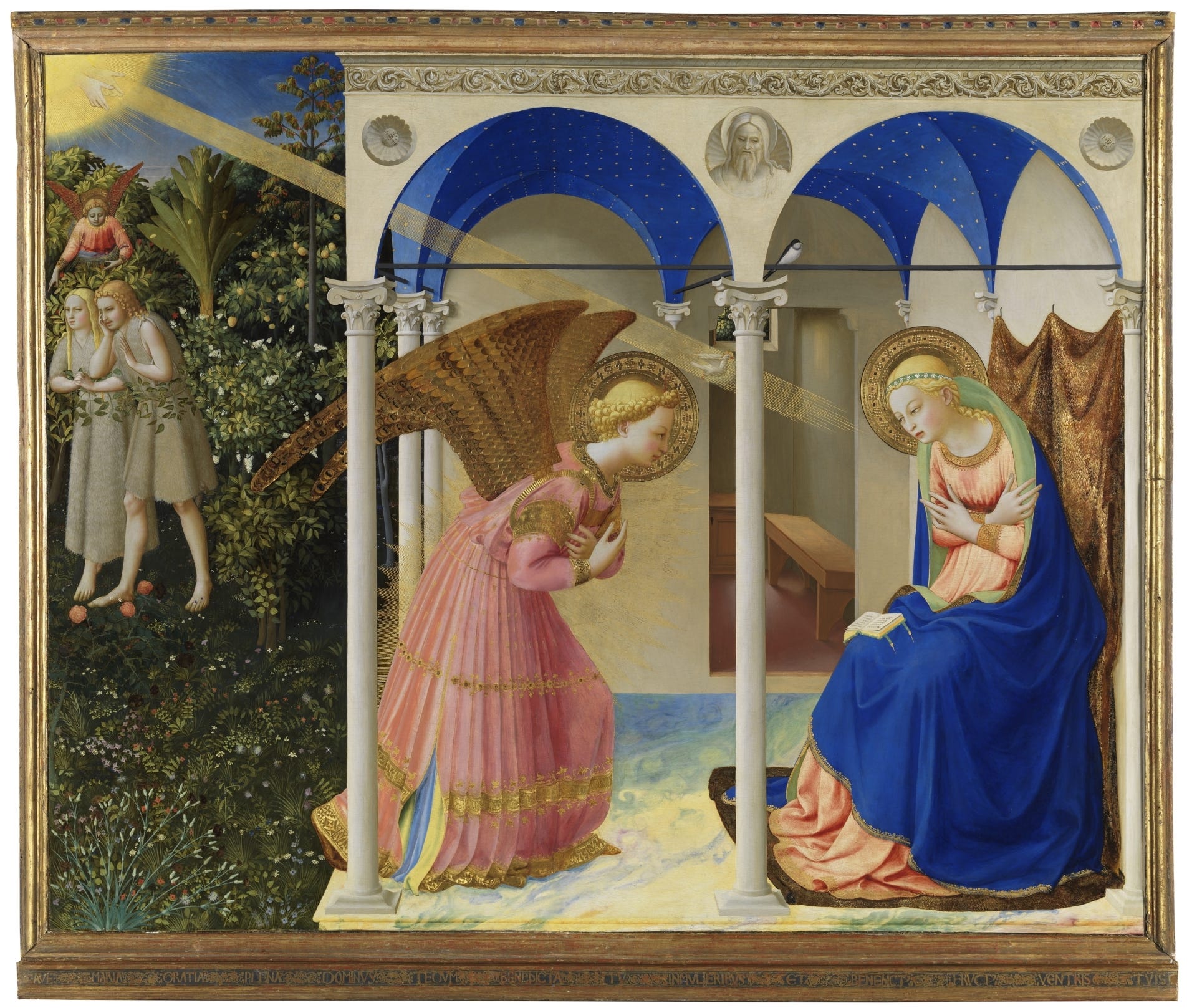
Mary is not standing outside the definition Jesus gives. She is its exemplar and its fullest expression. When Jesus stretches out his hand and says here are my mother and my brothers - he is describing the family whose founding act was a young woman in Nazareth saying let it be done to me according to your word. The fiat gave way to the Incarnation. She did the will of the Father before the Word took flesh in her. So when Jesus defines the new family by the will of the Father, Mary is already inside that definition more completely than anyone else who has ever lived.
Augustine says it plainly elsewhere: “Mary is more blessed in receiving the faith of Christ than in conceiving the flesh of Christ.”2 Not because the physical motherhood was insignificant - it was the hinge of history - but because the physical motherhood was itself the fruit of something deeper. She bore him in her heart before she bore him in her womb. The fiat is the deeper thing. And the fiat is exactly what Jesus names as the basis of the family he is defining.
Behind the Gospel stands Micah, and Micah is asking a question that has no answer.
“Who is there like you, the God who removes guilt and pardons sin for the remnant of his inheritance; who does not persist in anger forever, but delights rather in clemency?”
No one. There is no one like this God - the one who delights in clemency, who does not persist in anger, who turns back toward his people again and again despite everything they have done and failed to do.
“You will cast into the depths of the sea all our sins.”
Not file them, archive them, or hold onto them, ready to be retrieved at the next failure. Cast them into the depths of the sea - where they are unreachable, where the water closes over them, where they are as gone as anything in this world can be. The Hebrew tashlikh - to throw, to cast - is the word used when you are done with something. God is done with the sins. He throws them in.
This is the God whose family Jesus is defining in Matthew 12. The family of the Father is the family of the one who casts our sins to the bottom of the ocean. Membership is not earned by a sufficient record of obedience. It is received by those who turn toward this Father with whatever will they have - imperfect, incomplete, repeatedly failing - and keep turning.
The domestic church can live this definition.
The household of faith is not the same as the household of blood, though they can and often do overlap. The family that gathers at the Eucharistic table, that prays together, that does the will of the Father in the ordinary space of daily life - is a family in the deepest sense Jesus intends here. Not a metaphor for family. The thing itself.
And Micah’s prayer is the prayer available to every such household: the God who heads this family casts our sins into the depths of the sea. He does not bring them back at dinner. He does not file them for reference in the next argument. The Psalm refrain today is the petition and the confidence at once: “Lord, show us your mercy and love.” Show us what you are always already showing - the mercy that covered the guilt, the love that withdrew the burning anger, the kindness that precedes our asking.
The hand Jesus stretches out toward his disciples is still stretched out. Toward everyone who hears the word and keeps it. Toward everyone who, however imperfectly and with however many failures, is trying to do the will of the Father in the place where they have been put.
Here are my mother and my brothers.
Mary said yes before any of us. She shows us what the yes looks like at its fullest. And the family she belongs to - the family defined not by blood but by the will of the Father who casts our sins into the sea - is the family we have been given to inhabit.
Domus Formation offers tracks of daily prayer and formation for families, men, women, teens, and those in the second half of life. The first school of faith is the home, and every member of it deserves to be formed. WeAreDomus.com
If Catholic fiction that takes the Communion of Saints seriously - as doctrine, not sentiment - is what you are looking for, I am writing two things. Lux Perpetua is a serial novel publishing weekly in two tracks, set in Alton, Illinois, at the edge of the Mississippi - a story of custody and fidelity and a flame passed forward across centuries. And Two Lamps is a weekly short story on Substack, each one braiding two saints from different centuries into a single imagined meeting. Both are for the kind of reader who believes the imagination is also a faculty of faith.
Deacon Michael Halbrook is husband to Suzanne, father of four sons, and a permanent deacon of the Diocese of Springfield in Illinois. He serves at St. Elizabeth Parish in Granite City. He is the founder of Domus Formation, a collection of Catholic prayer and formation resources for every stage of life, and he writes at DeaconMichael.net.
Augustine of Hippo, Sermon on Matthew 12:46-50; used in the Roman Office of Readings for the Presentation of the Blessed Virgin Mary. “Did the Virgin Mary... did she not do the will of the Father? Indeed the blessed Mary certainly did the Father’s will, and so it was for her a greater thing to have been Christ’s disciple than to have been his mother, and she was more blessed in her discipleship than in her motherhood.”
Augustine of Hippo, De Sancta Virginitate, III: “Mary is more blessed in receiving the faith of Christ, than in conceiving the flesh of Christ.”
I truly enjoyed reading this today. Thank you for the inspiration 🙏.