
Healthy Conflict
Arguing Amongst the Saints

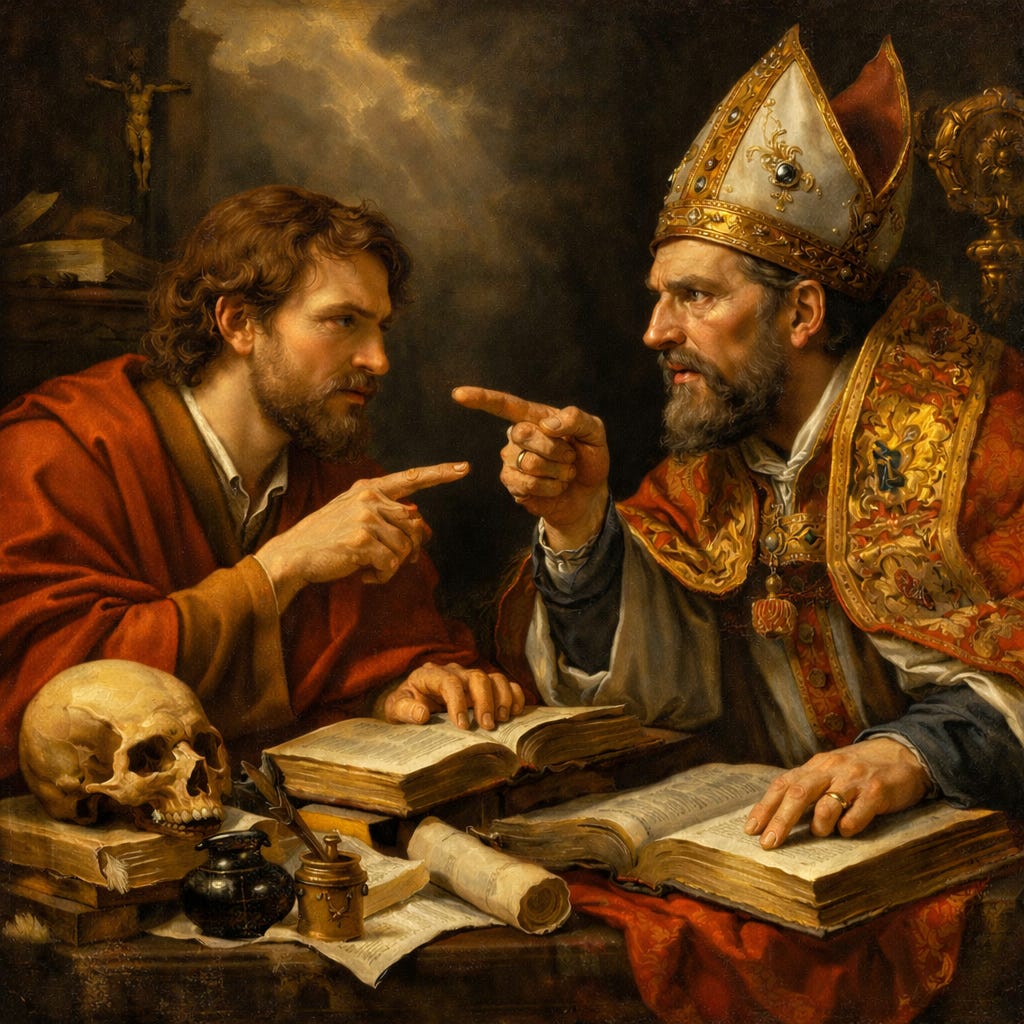
Dialogue is not a tactic or a tool, but a way of life — a journey of the heart that transforms everyone involved, the one who listens and the one who speaks. What is more, we walk this journey not by abandoning our own faith, but by standing firmly within it. For authentic dialogue begins not in compromise, but in conviction — in the deep roots of our own belief that give us the strength to reach out to others in love.
Pope Leo XIV, “Walking Together in Hope.” 28 October, 2025.
We are often aware of the many conflicts amongst those deemed as heterodox, heretics, and the Saints or Father’s of the Church. We see in the political sphere a sense of polarization, and often vilification. At the beginning of Lent, we witnessed Jesus confronting the Liar in the desert, and sending Him away, in a burst of righteous anger (as noted by St. Thomas Aquinas). Yet our imagination rarely extends to two saints or more entering into heated argument. One of the reasons this doesn’t often occur in our mind as a possibility is due to what psychologists often deem as “splitting.”
Splitting is a defense mechanism in which a person unconsciously divides people, into all-good or all-bad categories, without integrating both positive and negative qualities into a unified whole.
It is sometimes called black-and-white thinking, where a person is not able to hold in a tension the naturally ambiguous moral nature that exists in complex beings. This particular approach typically shows itself in the personality disorder Borderline, wherefore the person, even when they judge themselves, may not be able to cope with a complex way of approaching conflict. Splitting of itself does not determine whether a person has such a personality disorder, but its a characteristic that many experience to varying degrees, especially when a cultural approach to conflict quickly demonizes opponents or crowns a savior.
Scripture does endorse black-and-white thinking in a certain sense - and this is actually healthy too. When we consider Christ asking us to become perfect, or His separation of the goats and the sheep, we have to admit, there is a type of splitting taking place here, where the heart and soul of man ought to be oriented toward a simplicity, purity, and goodness.
Even within the damned, however, there may be good characteristics of the person. For instance, outside of the moral perspective, we would consider the goodness of their existence, and within their moral character, the degree of virtues that may exist. Nonetheless, as we see in the trial of a criminal, these factors do not absolve a person of an egregious crime, especially if there is an absence of sorrow and regret. Thus, even within the black-and-white approach to God’s judgment, which is simply a definitive conclusion that takes one of two paths, one still has to admit of complexity.
The Saints Arguing
While the saints might have argued with those who died in their sin and error, we must also take a look at the sad, but also healthy dimension of where the saints argue. In Sacred Scripture we note that St. Paul and St. Peter argued over an important matter, such as the law, and circumcision (doctrinal matter). We note that St. Paul and St. Barnabas, having a matter of a prudential judgment arise.
First one has to recognize that disagreements often arise and are sought to be addressed because the matter is important to both parties. When we vilify another, in the midst of such conflict, we may not be deeply aware of the reason underneath what they are saying. It is always possible that there could be sinister motives, but meekness also demands a level of wonder in regard to whether the person might be coming from a good place. In the case of the saints, that seems to be the case.
St. Augustine and St. Jerome are another example of conflict between the saints, where matters become incredibly heated. We often see this when varying disciplines within theology rub up against one another (i.e. systematic theology and biblical theology). Writing letters, offering public discourse, and ensuring that private, real, and difficult conversations actually occur, permit the Church to advance Her approach to the truth, and honoring the personal dignity of each person while this takes place

.
A Church that Deeply Listens
Listening is something that the whole person ought to do, but it is difficult to accomplish when we are operating out of unhealed wounds. Our unhealed wounds often obstruct our ability to see the truth clearly, as though we see and perceive things through a glass, darkly (1 Cor 3:12). The book of Wisdom speaks about how our trust in God leads us to understanding truth, and loving God (Wisdom 3:9). It is interesting to consider how trust clarifies, because with trust we are able to not filter God’s revelation through our own defensive mechanisms. We all have them, having been conceived in a fallen-world, as a fallen being. But there needs to be some level of self-awareness in this regard, to at the very least second guess our own judgements and approaches to listening.
Deep Listening is a matter of being able to open our heart to the person, with a willingness to develop trust, and to root ourselves in hearing what is underneath the agenda of others, and their own concerns. This is not the same as reading between the lines. This is not a matter of indirect or direct forms of communication. Rather, it is about coming to know the deep needs of others, wounds, insecurities, hopes, joys, and hungers that are signified in what has been said. But when approaching such conversations and arguments with a defensive approach, we might assign an interpretation that isn’t charitable and inaccurate.
Mining for Conflict
Conflict itself should not be seen as something to always and everywhere avoid. It is profoundly true that all dialogue should begin from a commonly shared value, belief, and truth. But this operates as a foundation, which ends up being entirely underutilized if nothing is ever built off of such stability. Conflict is sought because communion is a goal, and a real goal. The absence of conflict does not indicate that communion has ipso-facto been established, it may simply mean that many people have repressed their anger, frustration, and disagreements, or become indifferent entirely to communion. At the heart of conflict is a marriage to communal-truth (shared-truth) wherefore, the mind and heart of the Christian genuinely share the same God, the same mission, and the same love.
This type of conflict may be sought with the platitude of what I’ve written above, but it may not actually be the motive as such. It is incumbent on each individual person to check-themselves as to the motive of such a conversation or argument in order to ensure such dialogue occurs in a genuine and fruitful manner. It is unlikely that a person who has hidden and evil motives will be able to interpret and listen to the other person speak accurately if this is the case.
Development and Growth Takes Time and Involves Pain
When our body grows, it often involves aches and pains as things continue to develop, some legging behind, while others advancing. This physiological type of conflict is a natural progression of development, and it is often quite uncomfortable. But it is a sign of life and growth. This isn’t always the case; conflict can devolve and lead to a breakdown in relationships. It ultimately depends on our attitude or the maintenance of respect and dignity. When Jesus cleansed the temple, it is often overlooked that he did not approach the dysfunction or errors of the Jews immediately, but rather spent the night, prior to turning tables over (Mark 11:11). Argument, anger, disagreement, and difficult actions are not imitating Christ when they occur in the “heat of the moment.” That isn’t to say that some matters don’t require immediate reaction, but it is to say that a regulated approach that isn’t impulsive and operating out of our own pride, woundedness, and agenda. Pausing matters is a good approach, but it ought to be distinguished from avoiding conflict indefinitely.
Where one avoids conflict entirely is if a reasonable boundary is required for safety and avoiding enabling sin. But to be clear, it isn’t conflict that is being avoided, but abuse. Where one perceives all conflict as abuse, this becomes a problem that needs to be examined deeply, and perhaps with a therapist. While there is no question that various temperaments are inclined or disinclined toward conflict, there is a need for versatility when circumstances require it. As such, Avoidant Personality Disorder can be a pathological problem, when as early as childhood one developed their identity on the sole basis of acceptance from others, even on matters of agreement or disagreement.
Don’t Forget the Person
Pope Leo XIII wrote,
From what has been said it follows that it is quite unlawful to demand, to defend, or to grant unconditional freedom of thought, of speech, or writing, or of worship, as if these were so many rights given by nature to man. For, if nature had really granted them, it would be lawful to refuse obedience to God, and there would be no restraint on human liberty. It likewise follows that freedom in these things may be tolerated wherever there is just cause, but only with such moderation as will prevent its degenerating into license and excess. And, where such liberties are in use, men should employ them in doing good, and should estimate them as the Church does; for liberty is to be regarded as legitimate in so far only as it affords greater facility for doing good, but no farther.
Libertas, 42.
When people are given permission to articulate their own view, as erroneous as it might be, without the fear of inordinate judgment of their character, and the presence of an acknowledgement of them as a person with dignity, the whole person is dialogued with. Persons are not the sum of their beliefs, and it is for this reason, that persons have rights, while errors do not. In the case of Pope Leo XIII’s comment here, we need to reflect on both the limits and purpose of liberty. When we consider that dialogue promotes conversion, and even self-awareness of one’s own views, accountability, and the possibility of refinement, we see that such a platform enables growth for “doing good.” On the other hand, when such speech begins to devolve into tautological, and intentionally equivocal (manipulative) or Orwellian vagaries: shut it down. Discerning this is often a process, one which discerns between the saints and the corrupt.
When a person’s underlying fears can be addressed, often the errors (which self-soothe the individual into complacency), the healing and correction can take place. Fear is like a clenched fist, wrapped around an idea. Where that fear is diffused, acknowledged, and held with the other, light exposes the lie and strips it of disguise.
Accompaniment, not Enablement
Errors need to be corrected, and this cannot be denied. It is a goal within conflict, but conflict really is often a healthy means to accomplish the ultimate goal of conflict which is communion. Accompaniment is often characterized by a zeal for the truth concomitant with a patience that recognizes a process of surrender. Rationalists tend to think that a simple and clear argument is often sufficient for conversion. Socrates made that error, but St. Thomas Aquinas did not. He recognized the complexity of the human person, and that not all error is caused by pride, but sometimes caused by our wounds, and our own human nature (which is complex). We must journey with one another in all three of these dimensions, and this recognition grounds us in the reasonability of patience for the process.
For those who are zealous, there is something really good to be preserved in that endeavouring for the salvation and conversion of others. Amongst the saints, mutual growth and correction can go both ways. Zeal must never blind us to the possibility of our own error, even when we are passionately-certain. But that zeal must integrate the person as a subject of zeal. Seeking the salvation of souls, implies that persons are the objective, each of which as St. John Paul II clarified are unrepeatable.
What is left unsaid…
This is hardly an exhaustive topic, always with a lot to nuance. I’d say that prudential judgment is important for each of us to examine moving forward as we lovingly mine for conflict. It might be important to ask ourselves, “What does God ask of us?” King David sought to build a temple, and he was not prompted by God to do this. Thus, a level of discernment through prayer is often required.
When it comes to online versions of conflict, reintegrating the person into our own heart, as we type, becomes increasingly important. It is not natural to consider that we are speaking with a real, dynamic, complex, wounded, and perhaps saintly person. We sometimes are so vexatious, impulsive, and uncharitable in our initial reaction due to our own wounds. Read James 3, if this is a difficulty you’ve experienced.
The Gospel of Matthew (C. 18) also offers some good reflection about how to take one aside. Typically, if we find ourselves challenging a person’s character in front of others it won’t bear fruit. It might feel justified, but it rarely produces fruit. Jesus took people aside in order to heal their wounds and did not publicly humiliate them. He did publicly disagree, but he never sought to humiliate in order to justify or vindicate Himself. St. Thomas Aquinas speaks about the times where Jesus got angry in scripture and clarifies that it was always in regard to a love of someone other than Himself. In the temple it was out of disrespect for His Father’s house, and those being exploited. In the desert, it was due to the offence flung at His Father, insinuating that He could be replaced by a creature such as Satan. Jesus’ anger was always loving, never self-serving. That is certainly something to aim for.
Conflict Examination of Conscience
There is more to be said, on this topic, but I encourage you to return to a self examination as follows:
When I disagree with others do I split? That is, do I turn certain apologists into heroes without possible faults, and those in error as morally corrupt in all ways? Does making others into perfect saviours lead me to accept even their own errors unwittingly, or crumble when their failures are on display? Am I always suspicious, in an inordinate way, of those who are in error, and cannot imagine them becoming holier than I, provided I become as Holy as I ought?
Do I avoid conflict, and people please because my identity comes from how others view me? Do I crumble at the thought that others speak about me behind my back? Do I view disagreement as a personal attack? Am I more preoccupied with my own image-management, than I am on serving others with truth and charity?
Do I avoid reconciliation when God prompts me to facilitate it? Do I avoid making strong boundaries when abuse is involved, so as to avoid enabling sin in another, and admitting of my own limits?
Am I able to be meek, by entertaining in my own mind, how someone might come to believe something false? Can I admit of that possibility within myself, and empathize? Do I offer clemency to others, and at least try to validate what I can in their point? Am I able to pause the conflict in order to ensure the dignity of the person is respected?
Am I willing to submit the call to enter into conflict according to God’s will, and not base it on my own fallible “fight, flight, or freeze” tendencies? Am I willingly to seek healing for coping mechanisms, so that I can discern each particular circumstance and situation according to good prudential judgment?
Excellent article. I love your point/question- does this bear fruit?
Three things I have been reading lately that touch on similar themes- The Coddling of the American Mind tackles our tendency towards tribalism/black and white thinking.
John Gottman's work on communication in marriage and research how healthy marriages tackle conflict.
Pope Leo's comments to youth during Holy Week contrasting unfettered fluidity with the stability of love that integrayes constancy/fidelity with growth and willingness to make sacrifices. https://www.vatican.va/content/leo-xiv/en/speeches/2026/march/documents/20260328-principato-dimonaco-giovani.html